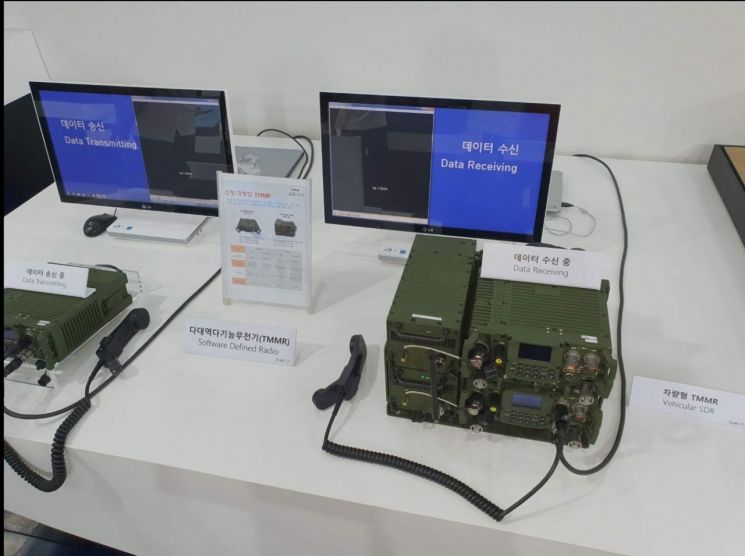
[Monthly Defense Times Editor-in-Chief An Seung-beom] The Defense Acquisition Program Administration's multifunction military radio (TMMR) development project involves developing software for seven types of radios. These are divided into four analog radios (VHP-AM, UHF-AM, VHF-FM, HF-AM) and three new digital radios (VHF-FM, HF-AM, K-WNW·Wide Band Network Waveform).
On June 3, 2016, the Joint Chiefs of Staff's operational test and evaluation results determined that among the CSMA (Carrier Sense Multi-Access) software, the digital VHF-FM and HF-AM functions did not meet the requirements of the user forces (such as voice transmission range and degradation of stealth quality).
This month, the Defense Acquisition Program Administration plans to announce the TMMR performance improvement project request for proposal and proceed with research and development by multiple companies. The performance improvement consists of two parts: development of NNW (Narrow Band Network Waveform) and development of compact and lightweight equipment.
The request for proposal states that the VHF-AM, UHF-AM, VHF-FM, and WNW developed by existing companies must be compatible with the M0DEM developed through performance improvement. The Defense Acquisition Program Administration allowed participating companies to review related documents developed with the existing CSMA method, but access was very limited. Therefore, it is known that no company other than the CSMA method developer can ensure compatibility with equipment that develops the four waveforms. As a result, no proposals were submitted, and this request for proposal became a non-competitive one.
The recommendation from the Korea Institute for Defense Analyses (KIDA) was to reduce costs and development time and to promote early deployment by resolving issues through technical cooperation with overseas companies that have already deployed and are operating the systems.
However, after the failure to develop the CSMA-based digital data communication VHF-FM and HF-AM, the current approach pursued by the Defense Acquisition Program Administration applies relaxed performance requirements (transmission range, voice quality) compared to the initial requirements requested by the user forces to activate related domestic small and medium enterprises. Therefore, even after development, the actual operational feasibility must be evaluated during operational test and evaluation. Additional performance improvements to meet the final requirements of the user forces must be pursued in the future. It is also known that it is unclear whether the CSMA method can meet user requirements related to transmission range, voice quality, and simultaneous operation of 2 channels.
While the CSMA method faces difficulties such as delay occurrence and inflexible response to AD hoc deployment and redeployment in complex terrain, the TDMA (Time Division Multi-Access) method used overseas is adapted to network components suitable for complex terrain.
The ongoing performance improvement project, including the first small batch production, is a project only possible with the CSMA method. In future additional performance improvements to meet user requirements, compatibility with equipment developed only with the existing CSMA method is emerging as a problem.
It is expected that proceeding according to the recommendation of the Korea Defense Research Institute will ensure the smooth execution of the improvement project.
The TMMR project is a core equipment of TICN (approximately 5 trillion KRW project), so it must be developed with the initial performance required by the user forces. Otherwise, it will affect the entire TICN project.
For reference, in Europe and major countries, companies such as HARRIS, THALES, and ELBIT initially pursued development using the CSMA method but abandoned it due to CSMA performance limitations and completed development using the TDMA method.
© The Asia Business Daily(www.asiae.co.kr). All rights reserved.