'Greenbelt Release Controversy'
Deputy Prime Minister Hong's Statement Overturned by Deputy Minister of Land, Infrastructure and Transport
Party Intervention Leads to Another Reversal
Seoul City: "We Will Protect It Without Wavering"
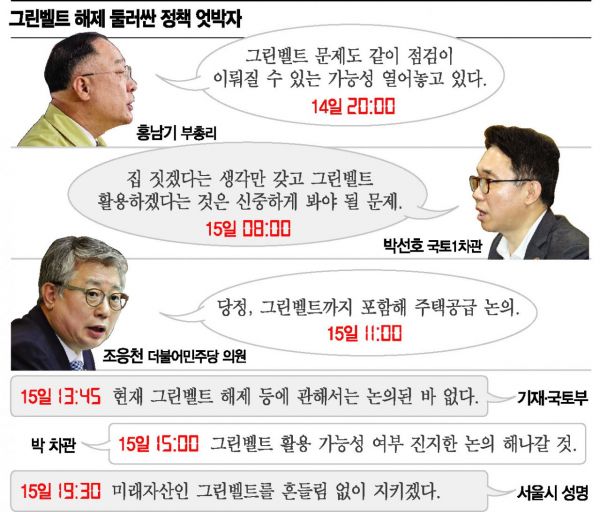
[Asia Economy Reporters Inho Yoo, Chunhee Lee] "At this point, it is questionable whether there is even a proper control tower for real estate policies in the government, let alone a proper supply plan." (Private research institute official)
The 24-hour controversy over the 'Greenbelt (Development Restriction Zone)' sparked by the remarks of Deputy Prime Minister and Minister of Economy and Finance Hong Nam-ki on the night of the 14th is increasingly being criticized as revealing the overall confusion in the government's real estate policy.
The confusion began when First Vice Minister Park Seon-ho of the Ministry of Land, Infrastructure and Transport (MOLIT) reversed Deputy Prime Minister Hong's statement on the morning of the following day that the government was considering lifting the Greenbelt. Hong is the head of the government's 'Housing Supply Expansion Task Force (TF),' and Park is the 'Practical Planning Team Leader' of this TF.
Moreover, when the controversy erupted, both the Ministry of Economy and Finance and MOLIT issued official statements saying "there are currently no plans to review" the Greenbelt issue. However, in the opening remarks at the Practical Planning Team meeting held on the afternoon of the 15th, Vice Minister Park completely reversed his stance, saying, "We will discuss issues that have not been considered so far, including the possibility of utilizing the Greenbelt."
The meeting was attended not only by officials from the Ministry of Economy and Finance and MOLIT but also by representatives from related local governments such as Seoul, Gyeonggi Province, and Incheon.
However, that evening, the Seoul Metropolitan Government issued an official statement under the spokesperson's name opposing the move, stating, "We will steadfastly protect the Greenbelt as a future asset," continuing the government's policy to wander aimlessly throughout the day.
The Fundamental Problem is the 'Absence of a Control Tower'
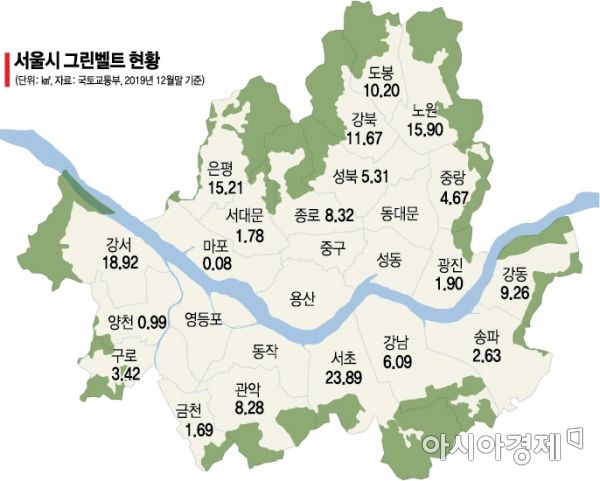
It is rumored that political intervention influenced the government's actions. Right after a private meeting between the ruling party and the government on real estate, Cho Eung-cheon, the Democratic Party's ranking member of the National Assembly's Land, Infrastructure and Transport Committee, stated, "We will discuss housing supply plans on a pan-governmental level, including such matters as the Greenbelt," bringing the Greenbelt lifting issue to the discussion table.
The 'lifting of the Greenbelt' was not mentioned at the time of the July 10 real estate measures announcement. At that time, the government presented five plans related to supply expansion: ▲ high-density development in urban areas ▲ increasing floor area ratio in the 3rd new towns ▲ discovering idle land and national facility sites around cities ▲ public redevelopment and reconstruction ▲ utilization of vacant commercial and office spaces in urban areas, explicitly stating that lifting the Greenbelt was not being considered.
However, reversing this position in just five days is seen as an acknowledgment that these measures alone cannot effectively expand supply.
In the market, this Greenbelt controversy is viewed as a predictable outcome of the government's repeated patchwork real estate measures. The fundamental cause of the inconsistent policy moves is the absence of a control tower for real estate policy.
In fact, there are criticisms that it is inappropriate for Deputy Prime Minister Hong, not the Minister of MOLIT, the main ministry in charge, to lead the Housing Supply Expansion TF. On the 16th, Kim Hyun-ah, a member of the Future United Party's emergency committee, appearing on KBS's 'Kim Kyung-rae's Strongest Current Affairs,' said, "The MOLIT should be the first to talk about lifting the Greenbelt, but the Ministry of Economy and Finance is bringing it up, while the MOLIT is taking the lead on tax-related policy statements, which is confusing whether the roles have been reversed or are out of sync."
Lee Eun-hyung, a senior researcher at the Korea Construction Policy Research Institute, said, "When discussions among government ministries and officials have not been made, continuously expressing opinions externally like this will undermine the credibility of government policy," adding, "Sudden discussions about lifting the Greenbelt are likely to be hasty measures that raise doubts about the credibility of government real estate policies."
Criticism has also been raised that the Blue House bears responsibility for the confusion. Earlier this month, President Moon Jae-in instructed to "strengthen the burden on speculative homeowners such as multiple homeowners," but the person who reported at that meeting was not Deputy Prime Minister Hong, who oversees taxation, but Minister Kim Hyun-mi of MOLIT. Because of this, there were rumors inside and outside the government about the Blue House 'Hong Nam-ki passing over' theory regarding real estate measures.
The confusion over the control tower for real estate measures does not end there. Recently, the political sphere, not the government, has been leading the measures. The Democratic Party, shaken by public sentiment due to real estate market instability, announced it would prepare real estate measures 'led by the party,' and since then, it has competitively introduced bills to strengthen comprehensive real estate tax and introduce the three lease laws. As a result, not only are effective measures lacking, but it is also unclear where the control tower is.
Seo Jin-hyung, president of the Korea Real Estate Society (professor at Gyeongin Women's University), said, "There is confusion among the Blue House, government, and ruling party regarding real estate measures," adding, "The government should show consistency when announcing policies, but when there is a mismatch, the public wonders whose words to trust, raising many issues about credibility."
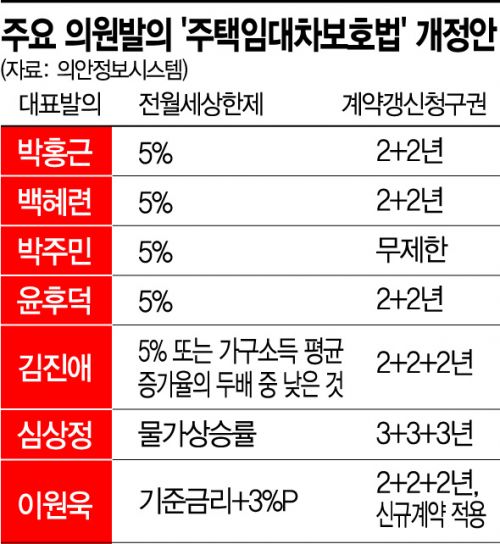
The industry agrees that not only supply and demand adjustment but also tax, finance, and policies must all work harmoniously to be effective. If each ministry and the political sphere prematurely release policies or unfiltered remarks into the market, it only increases market confusion.
Criticism also arises that the government's failure to control housing prices despite 22 rounds of measures is because, under the pretext of 'pinpoint regulation,' each ministry has only produced a department store-like array of policies without considering side effects or adverse effects. A representative example is that the related TF was formed only after three years despite the market's continuous calls for stable supply expansion.
Experts point out that the loss of trust in policies has increased due to the government's improvisational measures every time housing prices fluctuate without strategic principles. Especially regarding the lifting of the Greenbelt, they agree that careful consideration is necessary.
Choi Hwang-soo, professor of real estate at Konkuk University, said, "Every time housing prices rise, there is talk about lifting the Greenbelt to supply housing, but I think some of the land should be preserved," adding, "I understand the government's concerns, but instead of simply focusing on supply expansion, a tactical shift to also address the unfreezing of existing listings is needed."
Lee Eun-hyung, senior researcher at the Korea Construction Policy Research Institute, said, "The fact that the idea of suddenly lifting the Greenbelt to build houses is being publicized without sufficient discussion on the Greenbelt's utility, necessity, and changes in the era and environment is itself a problem," adding, "While lifting the Greenbelt may have some effect, it is doubtful whether housing prices will be controlled."
© The Asia Business Daily(www.asiae.co.kr). All rights reserved.
![User Who Sold Erroneously Deposited Bitcoins to Repay Debt and Fund Entertainment... What Did the Supreme Court Decide in 2021? [Legal Issue Check]](https://cwcontent.asiae.co.kr/asiaresize/183/2026020910431234020_1770601391.png)


















