Reexamination of Article 250(1) of the Public Official Election Act and Article 383(4) of the Criminal Procedure Act Today
Second Trial Imposes 3 Million Won Fine...If Confirmed by Supreme Court, Governor Position Lost and Candidacy Rights Revoked
If Remanded, Possible Revival...On Way to Work, "I Will Humbly Await the Outcome"

[Asia Economy Reporter Kim Hyung-min] The Supreme Court's full bench ruling on June 16 regarding Gyeonggi Province Governor Lee Jae-myung is drawing significant attention, as it is expected to serve as a milestone not only for Lee's political career but also for many upcoming election-related lawsuits involving elected officials. A Supreme Court official told reporters on the phone that "the full bench will deliver a judgment today on Article 250, Paragraph 1 of the Public Official Election Act (crime of false statement publication) and Article 383, Clause 4 of the Criminal Procedure Act (grounds for appeal)."
◆ "A fine of 1 million won leads to disqualification... but there is no relief mechanism" = Lee did not appeal to the Supreme Court on the grounds that the 3 million won fine imposed in the second trial was excessive. Strictly speaking, he claims that the second trial's verdict should be 'not guilty' rather than 'guilty.' Article 383 of the Criminal Procedure Act limits appeals to the Supreme Court on the grounds of 'unjust sentencing' to cases involving 'death penalty, life imprisonment, or imprisonment for ten years or more.' According to this law, Lee cannot appeal to the Supreme Court to challenge the unfairness of his sentence (a 3 million won fine).
Lee argues that this provision infringes on the fundamental rights of elected officials. If a sentence of 1 million won or more is confirmed for violating the Public Official Election Act, the official loses their position, but there is no way to contest the unfairness of the sentence at the Supreme Court, nor are there any other relief measures or exceptions. Lee claims this is a legislative omission and violates the Constitution.
◆ "The standard for 'false statement publication' during election periods is ambiguous" = Regarding Article 250, Paragraph 1 of the Public Official Election Act, Lee argues that it violates the principle of legality under the Constitution. This article stipulates that "anyone who publishes or causes to publish false facts for the purpose of being elected or helping someone to be elected shall be punished by imprisonment for up to five years or a fine of up to 30 million won." However, Lee claims that the standards and definitions of what constitutes false facts are unclear, leaving room for broad interpretation. He argues that this legal ambiguity disrupts election campaigns and administrative work.
Lee requested a constitutional review of these two provisions by the Supreme Court in November last year. He argued that the provisions are partially ambiguous and infringe on the fundamental rights of elected officials, and thus their constitutionality should be determined. However, the Supreme Court reportedly decided not to send Lee's request to the Constitutional Court but to hear it in the full bench and deliver a ruling today. The full bench does not have the authority to determine whether the provisions violate the Constitution, unlike the Constitutional Court. Instead, it can provide standards on how the law should be interpreted in cases where these provisions are applied. Typically, the standards set by the Supreme Court's full bench act as guidelines and influence rulings in similar cases across courts nationwide. Considering this, today's Supreme Court ruling on Lee is highly likely to become a precedent that significantly impacts similar cases involving other elected officials in the future.
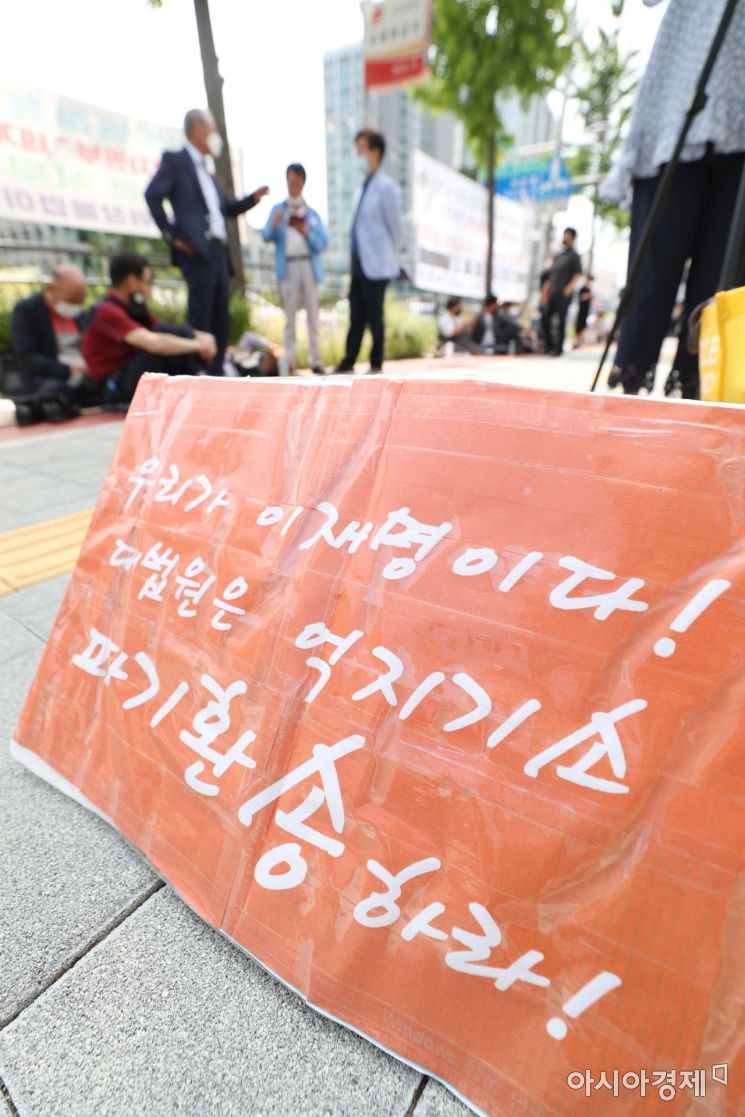 The Supreme Court's final ruling by the full bench on the charge of false public announcement regarding the 'forced hospitalization of elder brother' involving Lee Jae-myung, Governor of Gyeonggi Province, will be delivered on the 16th. On that day, a supporter of Governor Lee Jae-myung placed a hand sign in front of the Supreme Court in Seocho-gu. Photo by Moon Ho-nam munonam@
◆ Calm Lee Jae-myung, tense Seocho-dong = Lee arrived at the Gyeonggi Provincial Government building as usual on the morning of the ruling day. To the waiting press, he said, "I will humbly await the result and do my best to manage provincial affairs until the last moment given to me," and bowed in gratitude, saying, "Thank you, fellow citizens." Until the day before, Lee refrained from mentioning his political future on various social media platforms and only shared updates related to provincial administration, attracting attention. Underneath, supportive comments from his backers created a lively atmosphere.
Meanwhile, tension filled the area in front of the Supreme Court ahead of the ruling. The "Lee Jae-myung Supporters Emergency Committee" held a rally from 10 a.m. near the Seocho Station exit, urging, "Please acquit Governor Lee."
Lee was indicted on charges of abuse of authority and obstruction of rights for allegedly ordering the forced hospitalization of his elder brother in a psychiatric hospital in June 2012 while serving as mayor of Seongnam, and on charges of false statement publication under the Public Official Election Act for allegedly making a false statement during a TV debate before the 2018 local elections.
During the debate, when candidate Kim Young-hwan asked, "You tried to have your brother hospitalized in a psychiatric hospital, right? You tried to do it through the public health center director, right?" Lee replied, "That never happened." The issue was whether Lee's denial of the question's intent and partial concealment of facts (non-disclosure) could be considered "publication of false facts." The first trial acquitted him of both abuse of authority and false statement publication charges. However, the second trial court found him guilty of false statement publication and sentenced him to a 3 million won fine, which leads to disqualification. If the full bench upholds the second trial's ruling, Lee will lose his position and be barred from running for office for five years. Conversely, if the case is remanded, Lee will have a chance to revive his political career.
© The Asia Business Daily(www.asiae.co.kr). All rights reserved.


















