Mobilizing Policies for SMEs, Large Corporations, and Public Demand Stimulation
Revising Enforcement Decree to Expand RPS Mandatory Ratio and Promote RE100
Distributing 1.33 Million Green Mobility Vehicles by 2025
Fostering Smart Green Industrial Complexes... Renovating Industrial Complexes, the Main 'Greenhouse Gas Culprits'
[Asia Economy Reporter Moon Chaeseok] The government announced the 'Green New Deal' policy, which aims to more than triple the capacity of new and renewable energy power generation by 2025 and distribute 1.33 million electric and hydrogen vehicles. A total investment of 73.4 trillion won (42.7 trillion won from the national budget) will create 659,000 jobs and reduce greenhouse gas emissions by 12.29 million tons. Green energy will be expanded throughout citizens' daily lives, including schools, homes, cities, and industries.
On the 16th, Minister of Environment Cho Myung-rae and Minister of Trade, Industry and Energy Sung Yun-mo held a joint briefing at the Government Complex Sejong to announce the Green New Deal plan. They presented the goal of creating a 'carbon-neutral (Net-zero) society.'
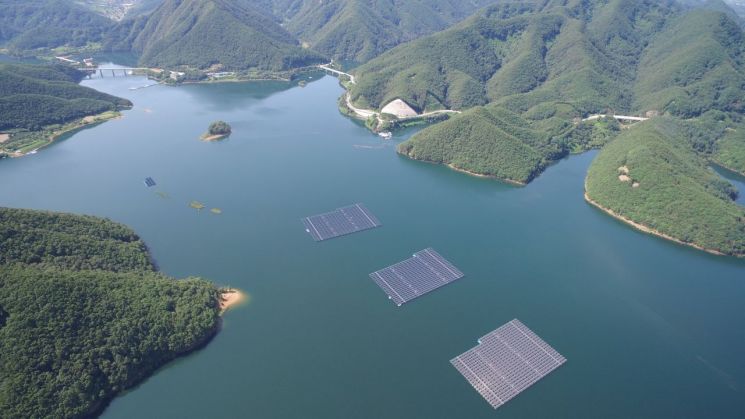 The government's position is that solar power facilities must succeed in achieving energy independence through new and renewable energy, even if it means floating them on water. This is to create a 'carbon-neutral society.' The success of the Green New Deal, into which 73.4 trillion won (42.7 trillion won of national funds) has been poured, depends on energy independence.
 (Photo by Korea Water Resources Corporation)
The success of the Green New Deal depends on whether the government can increase solar and wind power generation capacity from the current 12.7GW to 42.7GW by 2025, as stated. The most notable policy is the 'Green Energy Project.' As part of the Renewable Energy 3020 Implementation Plan (which aims to meet 20% of the national energy supply with new and renewable energy by 2030), it is the core of the government's so-called 'energy transition from coal and nuclear power to new and renewable energy.'
Specifically, the government will foster the renewable energy industry ecosystem through projects such as the citizen shareholder project, loans for installing solar panels on factory roofs, and establishing a solar power joint research center. To support this, institutional improvements will be made in parallel, including the development of cluster complexes, raising the Renewable Portfolio Standard (RPS) ratio, and preparing measures for RE100 (companies sourcing 100% of their electricity from renewable energy). Existing projects such as distribution and loans will be further expanded.
The government has introduced demand stimulation policies covering small and medium-sized businesses (citizen shareholder projects), large corporations (RE100), and the public sector (raising RPS ratios). This expresses the intention to quickly overcome power supply and demand issues by expanding the market size. Earlier, the 9th Basic Plan for Electricity Supply and Demand announced in early May stated that the share of new and renewable energy in power generation would increase from 5.2% in 2019 to 26.3% in 2034. However, until the intermittency issue (the characteristic of power supply fluctuating depending on weather) is resolved, South Korea's reality is that it must rely on expensive liquefied natural gas (LNG).
The government will revise enforcement ordinances to raise the RPS ratio from 8% to 9% next year and from 9% to 10% in 2022. It will support the establishment of a joint research center for solar panel manufacturers, feasibility studies for large-scale offshore wind farms, the construction of demonstration complexes, and the development of core green hydrogen technologies. Intelligent power meters capable of two-way communication will be distributed to 5 million apartments, and an energy diagnosis database (DB) will be established for 3,000 old buildings to manage demand and promote investment expansion.
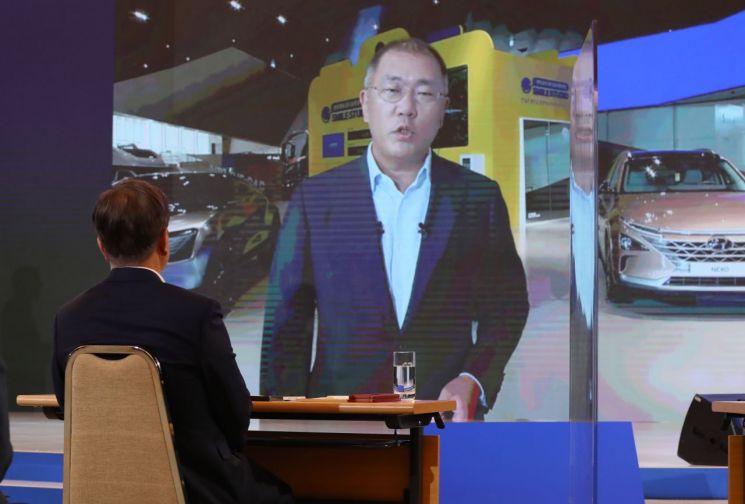 Hyundai Motor Group Vice Chairman Chung Eui-sun reporting on the Green New Deal at the 'Korean New Deal National Report Conference' on the 14th. (Photo by Yonhap News)
By 2025, 1.13 million electric vehicles and 200,000 hydrogen vehicles will be distributed. The government will install 15,000 fast electric vehicle chargers and 450 hydrogen charging stations. The eco-friendly vehicle transition model will expand from passenger cars to trucks, commercial vehicles, and construction machinery. A total of 1.16 million old diesel vehicles and construction machinery will be scrapped early, and old diesel trucks and children's school buses will be replaced with eco-friendly liquefied petroleum gas (LPG) vehicles.
To innovate the green industry, 1.9 trillion won in green loans will be supplied. Projects such as creating smart green industrial complexes, clean factories, and ecological factories will be carried out. New research and development (R&D) projects for greenhouse gas reduction will be supported.
The creation of smart green industrial complexes is key. Currently, industrial complexes emit 77% of greenhouse gases from the industrial sector, and this will be improved. By 2025, smart energy platforms will be established in 10 industrial complexes, and energy self-sufficient complexes will be created through the use of fuel cells and energy storage systems (ESS). Support will be provided for waste recycling linkages among companies in 81 industrial complexes. Projects to build 100 smart ecological factories and 1,750 clean factories will be promoted.
Additionally, to transform infrastructure, green remodeling will be promoted for 225,000 public rental housing units, and 2,890 elementary, middle, and high school buildings will be converted into green smart schools. Smart classrooms will be installed with digital facilities such as electronic blackboards.
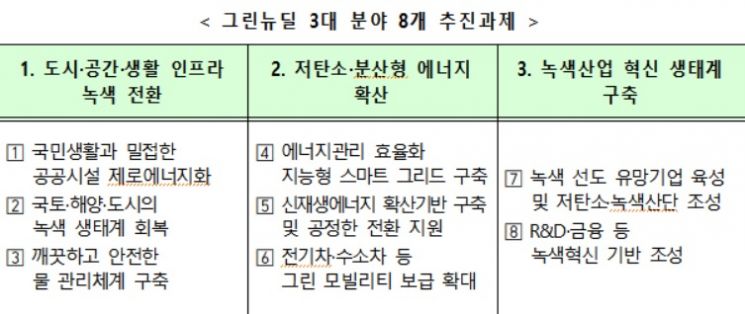
Although the government declared a leap toward a 'Net Zero society' and national energy transition, the response has been cold. Both environmental groups and the industry are critical. Environmental groups pressure the government to present more concrete carbon reduction targets. The industry points out that support measures such as deregulation of solar power companies, policies to maintain profitability for small-scale operators, and domestic technology development plans are insufficient.
© The Asia Business Daily(www.asiae.co.kr). All rights reserved.
![User Who Sold Erroneously Deposited Bitcoins to Repay Debt and Fund Entertainment... What Did the Supreme Court Decide in 2021? [Legal Issue Check]](https://cwcontent.asiae.co.kr/asiaresize/183/2026020910431234020_1770601391.png)

















