25 Trillion KRW Investment Over 3 Years... Priority 5G Network Investment in Seoul and 6 Major Metropolitan Cities Within the Year
Minister Choi Ki-young: "We Must Strive to Improve Perceived Quality and Enhance User Benefits"
Telecom Industry to Discuss Joint 5G Investment Plans for Rural and Remote Areas
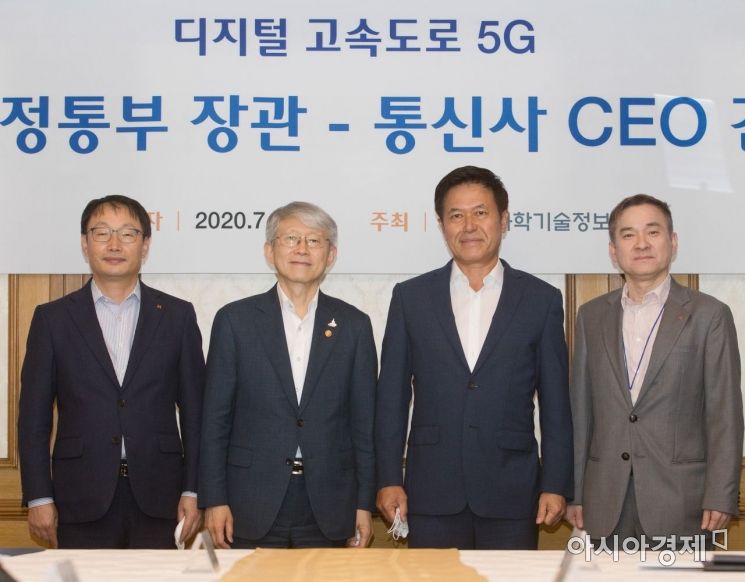 On the 15th, Choi Ki-young, Minister of Science and ICT, held an emergency meeting with the CEOs of the three major telecom companies to discuss the implementation of the Digital New Deal. From the left: Koo Hyun-mo, President of KT; Choi Ki-young, Minister; Park Jung-ho, President of SK Telecom; Ha Hyun-hoe, Vice Chairman of LG Uplus.
[Asia Economy Reporter Han Jinju] The mobile telecommunications industry will invest 25 trillion KRW over three years to build a nationwide 5G network. Starting as early as the second half of this year, pilot projects for the 28 GHz band and 5G standalone (SA) standards will also be launched.
On the 15th, Choi Ki-young, Minister of Science and ICT, held an emergency meeting with Park Jung-ho, CEO of SK Telecom, Koo Hyun-mo, CEO of KT, and Ha Hyun-hoe, Vice Chairman of LG Uplus, to discuss the implementation of the Digital New Deal and the construction of a 5G-based data highway.
Minister Choi Ki-young said, "Although 5G quality is rapidly improving, it is still a time when we need to make greater efforts to improve perceived quality and enhance user benefits."
The CEOs of the telecom companies announced plans to continue aggressive investments since 5G services are still in their early stages. Hong Jin-bae, Director of the Communications Policy Bureau at the Ministry of Science and ICT, said, "Compared to other countries, Korea's 5G quality is good, but since it is still early, there was a discussion to secure quality that meets the expectations of the public."
The telecom companies plan to build 5G networks this year in about 2,000 multi-use facilities centered around Seoul and six major metropolitan cities, as well as in the Seoul metropolitan subway lines 2 and 9, non-metropolitan subways, and 32 major highway sections.
Next year, they plan to build 5G networks in about 4,000 multi-use facilities centered around major administrative districts in 85 cities nationwide, all railway stations including subways, KTX, and SRT, and about 20 highways. In 2022, 5G networks will be built in small and medium multi-use facilities in administrative districts and towns of the 85 cities, railway stations including ITX Saemaeul, and all highways.
At the meeting, Park Jung-ho, CEO of SK Telecom, said that the evolution of 5G is an important opportunity for media and proposed securing an ecosystem to strengthen content competitiveness. Koo Hyun-mo, CEO of KT, suggested that the three companies jointly build 5G infrastructure in rural areas to increase speed and efficiency. Ha Hyun-hoe, Vice Chairman of LG Uplus, also expressed consensus on the need for content ecosystem construction and joint infrastructure development.
Policy Director Hong Jin-bae explained, "Equipment testing is still ongoing, and the testing schedule was delayed due to COVID-19. Considering market demand, we will focus on pilot projects for the 28 GHz band in the second half of the year," adding, "Since equipment must be ready first, the intention is to start pilot services immediately after testing is completed."
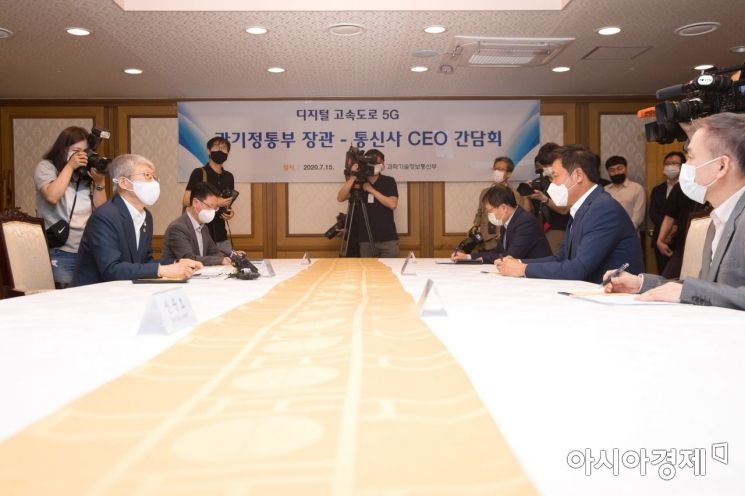 On the 15th, Choi Ki-young, Minister of Science and ICT, held an emergency meeting with the CEOs of the three major mobile carriers to discuss the implementation of the Digital New Deal.
The Ministry of Science and ICT and the CEOs of the three telecom companies confirmed their consensus on expanding 5G investment. However, topics initially expected to be discussed, such as 5G frequency reassignment or the launch of mid-to-low priced 5G plans, were not discussed in depth.
Policy Director Hong explained, "Regarding mid-to-low priced plans, the CEOs generally agreed on the necessity, but since investments are ongoing, it is difficult to specify a timeline. We decided to monitor investment status and subscriber trends and review the matter separately through further consultations."
The Ministry of Science and ICT also plans to continue efforts to support telecom companies' expanded 5G investments through measures such as investment tax credits and reductions in base station registration license taxes. The 5G quality evaluation is targeted to be completed by July. As of the end of June, there are 7.4 million 5G subscribers in Korea, and telecom companies have invested 9.6 trillion KRW up to last year.
Minister Choi Ki-young said, "The core of the government's 'Digital New Deal' is the data dam and data highway, and 5G will be integrated into all industries such as autonomous vehicles and healthcare, creating new opportunities not only for innovation across the ICT ecosystem but also for our economy," adding, "During this turbulent time, the public and private sectors will cooperate to ensure that 5G becomes an infrastructure that presents new breakthroughs and approaches, and we will continue to make greater efforts."
© The Asia Business Daily(www.asiae.co.kr). All rights reserved.


















