A Total of 5,069 Vacant Houses in Busan... Leading Among Special and Metropolitan Cities in Survey
Busan City to Invest 250 Billion KRW in 'LIGHT UP' Regeneration Project by 2030
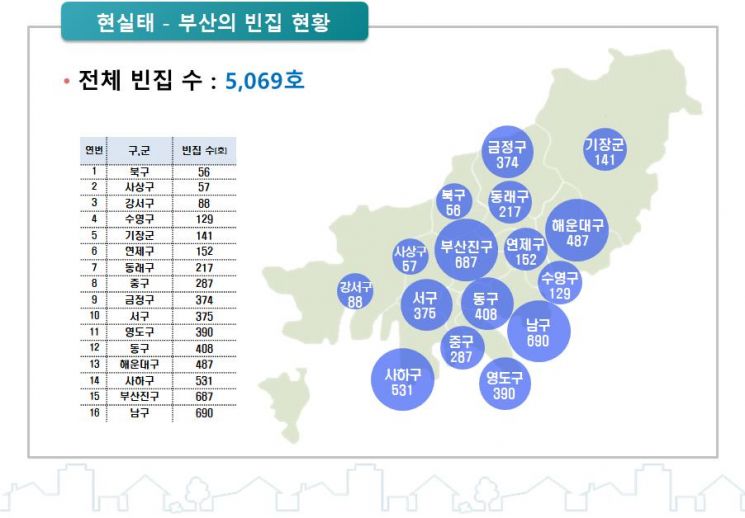 Status of abandoned vacant houses in Busan. Busan was found to have the highest number among special and metropolitan cities.
[Asia Economy Yeongnam Reporting Headquarters, Reporter Kim Yong-woo] A project to “light up” abandoned vacant houses in the city center, left in darkness, is being promoted in Busan. Busan has the highest number of vacant houses among Seoul and other metropolitan cities nationwide.
On the 15th, Busan City announced that it will carry out the “Vacant House LIGHT UP Project,” a comprehensive plan for vacant house regeneration aimed at illuminating new hope in the darkened vacant houses in the city center.
This comprehensive plan was prepared to resolve vacant houses by linking social, economic, and cultural regeneration projects, considering that vacant houses in urban areas have good transportation accessibility, a large floating population, and development potential.
The city formulated this plan by reflecting ideas submitted through last year’s “Vacant House Regeneration Activation Project Idea Contest” for citizens and opinions from the Busan Vacant House Regeneration Support Group.
According to a survey conducted last year by Busan City on the location and condition of vacant houses in 16 districts and counties, the total number of vacant houses in Busan was 5,069, the highest among special and metropolitan cities where the survey was conducted. Seoul had 2,940, Incheon 3,976, Daejeon 3,858, and Gwangju 2,281.
Among these, 3,590 were classified as usable vacant houses of grades 1 and 2, 331 were grade 4 vacant houses subject to demolition due to safety concerns, and 1,148 were grade 3 vacant houses that are not subject to demolition but difficult to utilize.
The city plans to create a healthier and richer city by 2030 with a total project cost of 259.3 billion KRW, utilizing vacant houses to build cultural infrastructure, create startup spaces, and expand youth housing.
A budget of 43.5 billion KRW will be invested in vacant house utilization and demolition projects, and 215.873 billion KRW will be allocated to vacant house maintenance projects in redevelopment and reconstruction zones, urban regeneration New Deal projects, and Saetteul Village projects.
First, the usable grade 1 and 2 vacant houses will be maintained in three sectors. The city plans to utilize 2,885 structurally safe vacant houses in 12 models across three fields: village workshops (DIY, makerspaces), artist residences (artist residences, cultural cafes, small libraries, complex cultural spaces), and Hae-sal Bogumjari (care centers, youth rental housing, shared circulation housing, corporate rentals, safe shelters, existing Hae-sal Dungji).
For 244 vacant houses subject to demolition due to safety concerns such as collapse, the buildings will be demolished and used as community rest areas and village parking lots. The city plans to create 130 garden rest areas, 17 village parking lots, and 97 resident platforms to provide necessary infrastructure for nearby residents.
Additionally, the city will actively link with redevelopment and reconstruction maintenance projects, urban regeneration New Deal projects, and Saetteul Village projects. Vacant houses within development project zones will be maintained through demolition projects, and public facilities needed by citizens will be installed.
For grade 3 vacant houses that are difficult to utilize, the city plans to promote a “Vacant House Safety Keeper Project,” where nearby residents patrol village vacant houses to create a safe neighborhood while also creating jobs.
Kim Kwang-hoe, Director of the Urban Balanced Regeneration Bureau of Busan City, said, “Vacant houses are a headache but can also be a resource. Through this project, we will discover various systems and projects, actively participate in projects led by national institutions, and strengthen cooperation with related organizations to share information and conduct monitoring. We will continue to systematically and sustainably promote policies to revitalize vacant house regeneration.”
Busan City is working to strengthen vacant house management capabilities by establishing a dedicated vacant house organization and promoting legal and institutional improvements. In addition, as the COVID-19 pandemic prolongs, concerns about infectious disease outbreaks due to abandoned household waste and animal carcasses in vacant houses have increased, so quarantine activities in cooperation with district and county health centers are also being strengthened.
© The Asia Business Daily(www.asiae.co.kr). All rights reserved.

















