All 45 Participants Developed Neutralizing Antibodies... "No Serious Side Effects"
Phase 3 Clinical Trial Starts on the 27th... Stock Soars on High Expectations
Results from 18-55 Age Group... Effectiveness in Elderly and High-Risk Groups Uncertain
[Asia Economy Reporter Hyunwoo Lee] The American pharmaceutical company Moderna announced that in the Phase 1 clinical trial of its novel coronavirus disease (COVID-19) vaccine (mRNA-1273), neutralizing antibodies capable of inactivating the virus were generated in all 45 participants. Moderna also announced that it will conduct a Phase 3 clinical trial at the end of this month, raising expectations for vaccine development. However, some caution that results for the elderly population, which has a high mortality rate, have not been released, and since the number of clinical trial participants is small, the exact efficacy can only be determined after the Phase 3 trial results are available. The U.S. Nasdaq index closed higher.
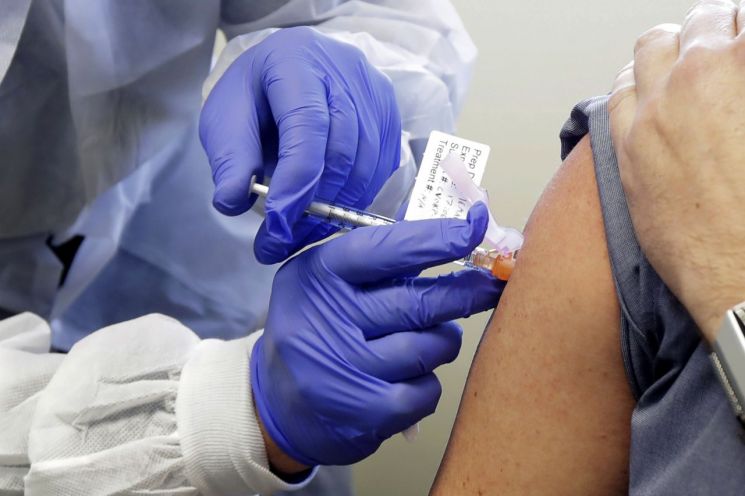
According to CNBC and others on the 14th (local time), Moderna announced in the medical journal New England Journal of Medicine (NEJM) that neutralizing antibodies capable of inactivating the virus were found in all 45 participants in the Phase 1 clinical trial conducted last March. Moderna emphasized that there were no serious side effects in this clinical trial, and participants only showed mild reactions such as fatigue, headache, chills, and muscle pain due to side effects.
Moderna also announced that it will start the large-scale Phase 3 clinical trial from the 27th. The U.S. National Institutes of Health (NIH) stated that 30,000 participants are expected to be enrolled in Moderna's Phase 3 trial, which will be conducted at 87 research centers across the United States. Moderna had previously started a Phase 2 clinical trial with 600 participants from the 2nd of last month, which is still ongoing, and suddenly announced a delay of the Phase 3 trial on the 2nd of this month, causing controversy over the reason for the delay.
The Phase 1 clinical trial results acted as a positive factor, causing Moderna's stock price to surge significantly. On the Nasdaq market that day, Moderna's stock closed at $75.04, up 4.54% from the previous day during trading hours, and surged up to 16% in after-hours trading. Moderna's stock price had fallen to $58.57 on the 2nd when the Phase 3 trial delay was announced but began to rebound after Anthony Fauci, director of the National Institute of Allergy and Infectious Diseases (NIAID), stated on the 10th that "it is very likely that Moderna will start the Phase 3 trial at the end of this month, and the vaccine is expected to be released by the end of this year or early next year."
The surge in Moderna's stock price reflects the high interest in vaccines as COVID-19 resurges in the United States. Since the beginning of this month, Florida recorded a daily high of 15,000 confirmed cases, and on the 14th, Texas also exceeded 10,000 confirmed cases in a single day for the first time. According to the COVID-19 statistics site Worldometer, as of the 14th, the cumulative confirmed cases in the U.S. reached 3,536,690, with cumulative deaths at 139,043.
However, some caution that it is premature to be optimistic based solely on the Phase 1 clinical trial results. The 45 participants in Moderna's Phase 1 trial were healthy volunteers aged between 18 and 55. This means that the efficacy in the elderly population aged 65 and over, who have higher rates of severe illness and death, has not yet been proven. Betty Diamond, chief researcher at the Feinstein Institute for Medical Research in the U.S., told medical media Stat News in an interview, "While these results are certainly a good sign, there is still much we do not know. Results from trials involving more subjects are needed."
The actual efficacy in patients is also not yet clear. Katherine Edwards, chief researcher at Vanderbilt Vaccine Research Center, said, "It has been confirmed that neutralizing antibodies were formed through the vaccine, but how effectively and for how long those antibodies can protect the human body has not yet been revealed."
Interest is also growing in vaccines from other pharmaceutical companies conducting Phase 3 clinical trials. According to the World Health Organization (WHO), the vaccine jointly developed by the UK’s AstraZeneca and Oxford University entered Phase 3 clinical trials last month in the UK, Brazil, and South Africa. Three Chinese companies?Sinovac, Sinopharm, and CanSino?also received approval from the Chinese National Medical Products Administration (NMPA) last month to conduct Phase 3 clinical trials of their COVID-19 vaccines. The vaccine jointly developed by the U.S. Pfizer and Germany’s BioNTech is also scheduled to enter Phase 3 clinical trials at the end of this month.
© The Asia Business Daily(www.asiae.co.kr). All rights reserved.


















