Poor Performance in the First Half Due to COVID-19 Impact... Gradual Improvement Expected from the Second Half
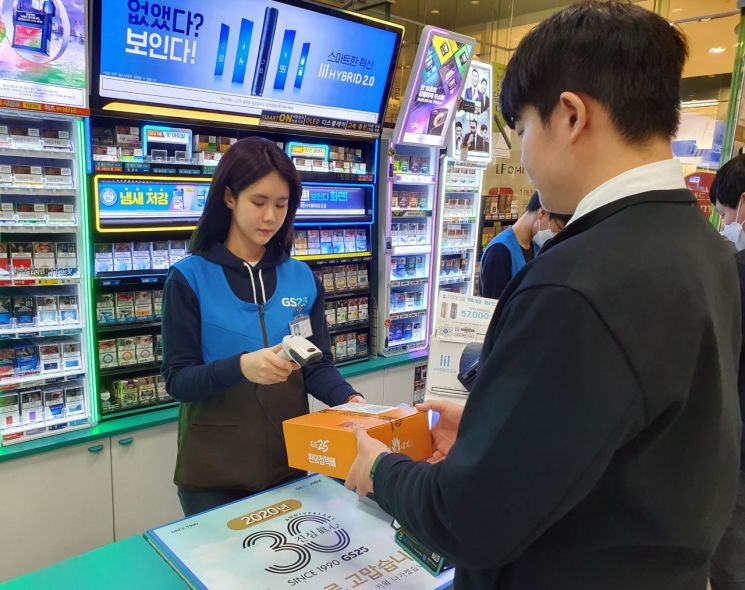
[Asia Economy Reporter Kum Boryeong] Following the confirmation to raise next year's minimum wage by 1.5%, analyses suggest this will have a positive effect on convenience store owners' stock prices.
According to related industries and the government on the 15th, next year's minimum hourly wage was decided to be 8,720 won, an increase of 130 won from this year. The increase rate of 1.5% is the lowest since the minimum wage system was introduced in 1988.
This decision is widely regarded as not unfavorable to the convenience store industry in terms of resolving uncertainty. This contrasts with 2018 and 2019, when minimum wage increase rates were 16.4% and 10.9% respectively, both double-digit figures for two consecutive years, raising concerns for convenience store owners.
After the 2018 minimum wage announcement, on the next trading day, July 17, 2017, GS Retail's stock price fell by 6.16% compared to the previous session. Similarly, after the 2019 minimum wage announcement, on July 16, 2018, GS Retail and BGF Retail's stock prices dropped by 10.7% and 7.8% respectively compared to the previous trading day. In contrast, on the day next year's minimum wage was announced, GS Retail's stock price rose by 0.54%, and BGF Retail's fell by only 1.56%. For BGF Retail, as of 9:45 AM that day, the stock price rose by 1.98%, recovering within a day.
Kim Myungju, a researcher at Mirae Asset Daewoo, explained, "The 1.5% increase in next year's minimum wage is positive for convenience store owners," adding, "If next year's customer growth rate reaches 2.8%, similar to the level in January-February this year, it is judged that store sales growth can offset the minimum wage increase."
Convenience store owners recorded sluggish performance in the first half due to the impact of the novel coronavirus infection (COVID-19), but it is expected to gradually improve from the second half. According to Hanwha Investment & Securities, GS Retail's performance is estimated at sales of 2.3129 trillion won and operating profit of 77.2 billion won. These figures represent increases of 0.2% and 0.4% respectively compared to the previous year but fall short of initial expectations. BGF Retail is expected to see a 0.4% decrease in sales to 1.5102 trillion won and a 26.5% decrease in operating profit to 44.8 billion won in the second quarter compared to the previous year. However, GS Retail still faces effects from partial school openings and differences in vacation timing, and BGF Retail is aggressively pursuing a store expansion strategy, making the second half promising. Nam Seonghyun, a researcher at Hanwha Investment & Securities, said, "GS Retail and BGF Retail are likely to see gradual recovery in the second half."
© The Asia Business Daily(www.asiae.co.kr). All rights reserved.

















