Household Loan Growth Sets New Records Daily
In June, Increased by 8.1 Trillion Won Compared to Previous Month
Deposits at Five Major Banks Withdrawn by Over 10 Trillion Won in One Month
Q3 Bank Credit Risk Index Hits Record High of '45', Surpassing Financial Crisis Levels
Accelerated Branch Reduction and Sale Plans... About 140 Locations to be Closed This Year
Preparing for Funding Pressure and Default Shocks... Most Transferred via Public Auction
Cumulative Bidding Amount in First Half Reaches 2 Trillion Won... Market Concerns Over Large-Scale Sales
[Asia Economy Reporters Kangwook Cho, Eunbyeol Kim] The reason why commercial banks are closing branches and actively selling their real estate holdings is due to signs that the economic downturn caused by the novel coronavirus disease (COVID-19) is becoming prolonged. The credit risk index has surpassed the level seen during the global financial crisis amid record-breaking loan volumes, triggering warning signals. However, with investment sentiment in the commercial real estate market freezing up, banks are struggling to secure cash through cost-cutting and asset sales. Some even express concerns that banks selling off real estate could accelerate the decline in commercial real estate prices.
◆ Loans Increase, Deposits Decrease... Credit Risk Hits Record High = The credit risk index (45) felt by domestic banks in the third quarter of this year reached an all-time high. It surpassed the previous record of 44 set during the 2008 global financial crisis. This reflects expectations that the risk of companies and households failing to repay loans will significantly increase, especially among vulnerable industries and employment groups.
In fact, the increase in loans has been breaking records daily. Last month, household loans at banks rose by 8.1 trillion KRW in just one month. This is the largest increase for June since the Bank of Korea began compiling statistics in 2004. This marks the third-largest monthly increase this year, following March (9.6 trillion KRW) and February (9.3 trillion KRW).
Among these, the growth in mortgage loans, which had decreased from 4.9 trillion KRW in April to 3.9 trillion KRW in May, expanded significantly to 5 trillion KRW last month. Additionally, other loans, mostly consisting of unsecured loans, increased by 3.1 trillion KRW last month. This is nearly three times the increase in May (1.2 trillion KRW) and represents the largest increase for June on record.
On the other hand, deposits at the five major commercial banks?KB Kookmin, Shinhan, Hana, Woori, and NH Nonghyup?decreased by more than 10 trillion KRW in just one month. The decline has been steepening, with reductions of 2.7 trillion KRW in April and 5.8 trillion KRW in May. This is interpreted as a result of the deepening low-interest-rate environment reducing the attractiveness of interest earnings, and the acceleration of the economic downturn due to COVID-19 shrinking the surplus funds that could be kept in time deposits compared to before.
◆ Branch Reduction and Sales Accelerate... 5 Major Banks’ Bidding Amount Hits 2 Trillion KRW in First Half = As concerns over loan defaults grow, banks are accelerating branch reductions and sales. The five major commercial banks?KB Kookmin, Shinhan, Hana, Woori, and NH Nonghyup?plan to close more than 140 branches this year. Nearly 100 branches were reduced in the first half alone. The consolidation of bank branches has been ongoing steadily since 2015. Although the pace slowed temporarily in 2017 when financial authorities increased oversight on branch closures due to customer inconvenience and job losses, the COVID-19 crisis this year has rather accelerated the trend. Banks explain that the need for management efficiency has become urgent due to deteriorating profitability from low interest rates and a sharp decline in customers visiting branches.
Banks are selling off closed branches through public auctions. This is seen as an effort to secure cash by selling idle real estate in preparation for potential funding pressures and default shocks. For example, Shinhan Bank began selling the site of its training center in Jincheon, Chungbuk, in April. In 2011, Shinhan Bank announced plans to build the nation’s largest training center in Jincheon County, capable of accommodating 100,000 people annually. However, the plan was scrapped last year, and the site was put up for sale last month. The minimum bid price at the time of auction was 48 billion KRW, but after failing to sell, it was lowered to 43.3 billion KRW, yet still remained unsold.
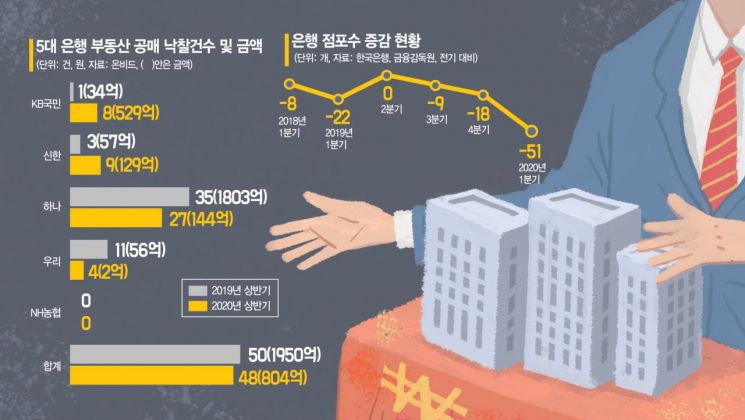
According to the public auction portal Onbid, the number of bids from the five major banks in the first half of this year reached 827, with a cumulative bid amount of a whopping 2 trillion KRW (1.9667 trillion KRW). Among these, only 48 bids (6%) were successful, and the winning bid amount was 80.4 billion KRW, which is only 4% of the total bid amount. Since most auction items failed to sell, the ratio of winning bids to bid amounts is expected to shrink further in the second half of the year.
◆ Concerns Over Commercial Real Estate Market Contraction Due to Massive Real Estate Sales = The financial sector’s decision to sell real estate is also influenced by expectations that commercial real estate prices are likely to decline. The worsening real economy conditions due to the spread of COVID-19 have increased the likelihood of price drops in commercial real estate. Ultimately, banks, already affected in profitability by COVID-19 and facing a sharply reduced need for branches due to digitalization, are rushing to dispose of assets amid the possibility of a contraction in the commercial real estate market.
The problem is that real estate auctions are not as active as expected. Compared to residential real estate, commercial real estate is generally considered to be more volatile depending on the real economy. Although the number of real estate auctions by banks increased in the first half, the number of successful bids was 48, down from 50 in the first half of last year. The scale of successful bids was also about half compared to 195 billion KRW in the first half of last year.
Some even worry that banks’ asset sales are fueling the price decline in the commercial real estate market. According to the Bank of Korea’s Financial Stability Report, the average transaction price per unit area of commercial real estate showed a strong annual increase of around 9% since 2015 but slowed significantly in 2020. From January to April 2020, the average transaction price per unit area was 3.652 million KRW, marking only a 2.8% increase compared to the same period last year.
© The Asia Business Daily(www.asiae.co.kr). All rights reserved.
![User Who Sold Erroneously Deposited Bitcoins to Repay Debt and Fund Entertainment... What Did the Supreme Court Decide in 2021? [Legal Issue Check]](https://cwcontent.asiae.co.kr/asiaresize/183/2026020910431234020_1770601391.png)















