Government Announces 5 Major Tasks for 'Digital New Deal'
Establishing Infrastructure to Activate Data Collection, Trading, and Distribution
Promoting Contactless Industries and Digitizing Administration and SOC
[Asia Economy Reporter Han Jinju] The government plans to open 140,000 public data sets by next year and expand big data platforms to 30 to promote data distribution and trading. It will also provide AI vouchers to about 8,000 companies to enable the use of 5G and artificial intelligence (AI) in existing industries.
On the 14th, the Ministry of Science and ICT, Ministry of the Interior and Safety, Ministry of Health and Welfare, and Ministry of Land, Infrastructure and Transport announced five representative projects and implementation plans for the Digital New Deal. The government aims to invest 58.2 trillion KRW by 2025 to create 900,000 jobs to realize the Digital New Deal. To induce a transition to a digital economy and enhance industrial competitiveness, the government presented five major tasks: ▲Data Dam ▲Intelligent Government ▲Smart Medical Infrastructure ▲Digitalization of National Safety Infrastructure (SOC) ▲Digital Twin.
‘Data Dam’ Opening the Door to the Data Economy by Activating Data Collection and Trading
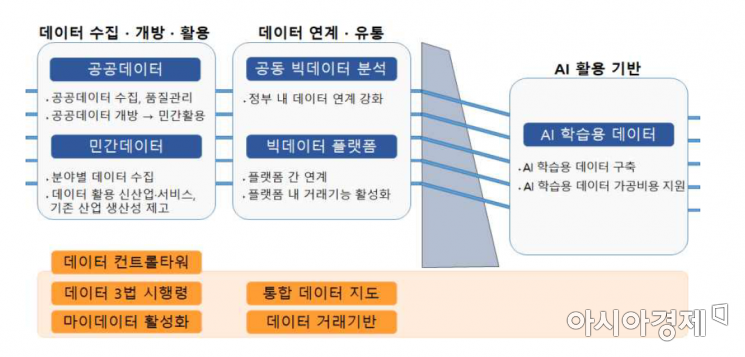
The ‘Data Dam’ project refers to accelerating the data economy through data processing, trading, and utilization, and expanding the 5G and AI convergence service market. Just as the construction of the Hoover Dam, a representative project of the U.S. New Deal policy, led to the growth of related industries, the government plans to collect data necessary for AI training to create new jobs and develop new businesses and industries related to healthcare, education, and manufacturing.
The government will open 142,000 public data sets by next year and build a joint big data analysis system to facilitate data linkage between institutions. In the second half of the year, a public-private joint control tower will be established to oversee data collection, linkage, and utilization. The government will also push forward amendments to the enforcement decree following the Data 3 Act, a comprehensive negative regulation roadmap related to AI, and the establishment of basic AI legislation.
Policies to activate data trading will also be promoted. The number of sector-specific big data platforms will be expanded to 30, and connections between private and public big data platforms will be strengthened. Through big data platforms, support for data pseudonymization and integration will be provided, and data vouchers will be given to about 8,400 companies to activate data trading and distribution. A ‘Data Trading Guideline’ covering data price assessment and quality measurement will also be prepared. While Japan already has related guidelines established, Korea is still at the initial stage.
To advance AI technology, training with vast amounts of data is essential. The government plans to additionally build 1,300 types of AI training data, including voice and autonomous driving video data, by 2025. It will provide AI training data purchase and processing vouchers to 8,400 companies to help small and medium-sized enterprises easily apply AI technology. Incentives such as investment tax credits will be prepared to enable early nationwide 5G network construction. Demonstrations of digital content converged with 5G, autonomous vehicles, and autonomous ships will be promoted, and public leading models will be discovered through the development of non-face-to-face public services.
Professor Lee Sung-yeop of Korea University Graduate School of Technology Management said, “The government’s direction to collect data and enable its utilization and trading is correct. Rather than a grand plan, meticulous policy management that can produce practical effects is necessary. Instead of just expanding public data, private companies should be able to provide data, and infrastructure should be built to encourage private sector participation and job creation.”
Driving Non-Face-to-Face Industries... Digital Transformation of Administration, Education, and SOC
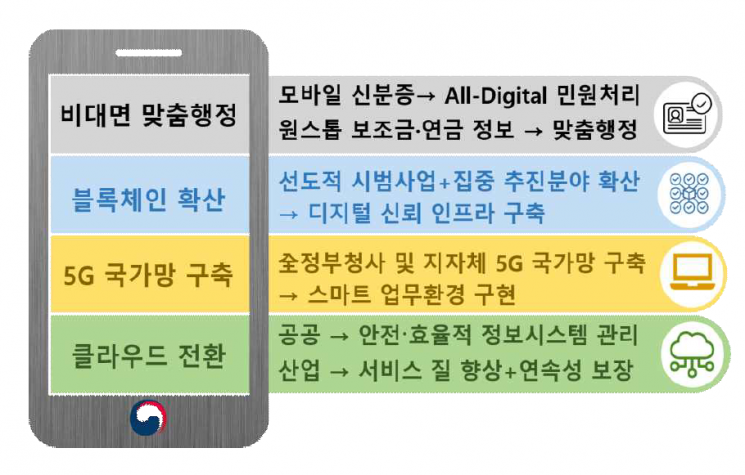
The government will fully introduce the 5G national network to four government buildings by 2024 and migrate public information systems, including major public websites, to private clouds, while important information such as investigations and trials will be moved to public security cloud centers. Mobile government employee IDs will be introduced within this year, and mobile driver’s licenses next year, with related legal amendments also being pursued. The AI Secretary service, which allows citizens to apply for and process civil services such as tax payment and welfare through conversational interfaces, will be provided next year.
Non-face-to-face medical institutionalization for infectious disease response and chronic patients will also be promoted. The pilot project for home medical care health insurance fees will be expanded. Smart hospitals that ensure safety from infectious diseases will be built at a rate of three per year until 2025, and 1,000 respiratory clinics will be established to prepare for the simultaneous spread of COVID-19 and respiratory infections.
Small and medium-sized enterprises struggling with remote work will receive vouchers worth up to 4 million KRW to build related solutions or receive consulting. A ‘Remote Work Guideline’ will also be established to support remote work operation and worker protection. Additionally, 100,000 smart stores equipped with non-face-to-face order and payment systems such as kiosks and QR codes, and 10,000 smart workshops with automated facilities will be built.
Digitalization of social overhead capital (SOC) such as roads, railroads, and airports will also accelerate. Next-generation intelligent transportation systems will be built on national roads, and IoT sensors will be installed on all railways to diagnose their status in real time. By 2022, non-face-to-face biometric recognition systems using boarding passes, IDs, fingerprints, and facial information will be established at 15 airports nationwide. Safety standards necessary for autonomous vehicle production will be gradually established. To lay the foundation for new industries such as autonomous vehicles and drones and to enhance the safety of land and facility management, a realistic virtual world ‘Digital Twin’ will also be built. The early completion of nationwide 3D maps, integrated underground space maps, and precise road maps for national and local roads is planned.
The government stated, “We will execute supplementary budget projects with speed,” and added, “To expand the ripple effect of the Digital New Deal, we will use government investment as a catalyst to promote private company investment and create a virtuous cycle structure where large-scale jobs are created.”
© The Asia Business Daily(www.asiae.co.kr). All rights reserved.


















