Representative Policies for Promoting New and Renewable Energy
Questions Raised About the Effectiveness of Existing Policies
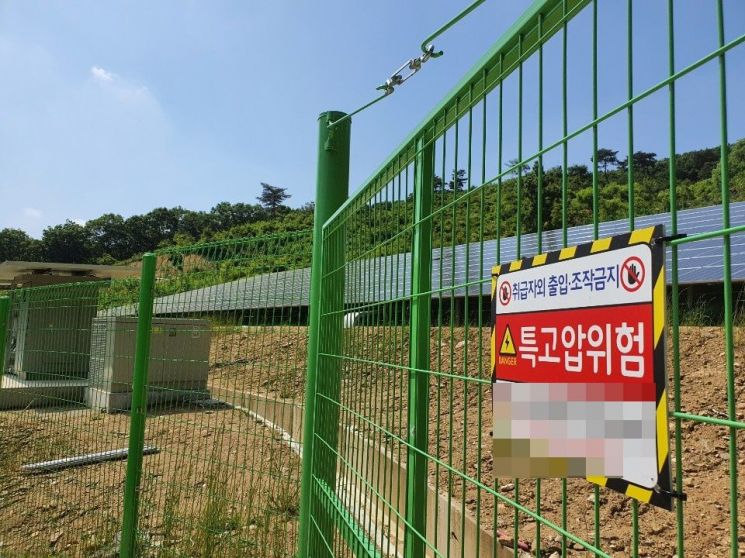 Experts say that rather than blindly expanding new and renewable energy projects that require funding, it is time to have the insight to improve the structure of companies and industries and strengthen investment sentiment to revitalize the market.
 (Photo by Moon Chae-seok)
[Asia Economy Reporter Moon Chaeseok] Although the government announced on the 14th that it would create a 'carbon-neutral (Net-zero) society' by incorporating the Green New Deal into the Korean New Deal policy, criticism has arisen that it merely repeats the existing pattern of increasing projects that require fiscal spending rather than revitalizing the industry. Ultimately, it is said that only the number of businesses relying on 'blind government money' will increase.
Policies to foster new and renewable energy such as wind power and solar power are typical examples. The government's plan to invest 11.3 trillion won (9.2 trillion won in national funds) in ▲discovering sites for large-scale offshore wind farms ▲solar power resident participation profit-sharing projects are policies that have already been introduced and are said to have low effectiveness.
The construction of turbine (which converts wind power into mechanical energy) test beds and demonstration complexes for offshore wind farm development is underway in Changwon, Gyeongnam, and Yeonggwang, Jeonnam, respectively. Since expansion of transmission networks, designation of energy development zones, and creation of support wharf hinterlands are necessary, voices say the projects are unlikely to succeed without government support. ▲Enhancing turbine technology and ▲overcoming resident opposition due to noise, etc., are also required to revitalize the wind power industry.
Solar power policies are also not free from repetition and effectiveness controversies. The resident participation profit-sharing projects and expanded loan support for rural and industrial complexes included in the Green New Deal were mentioned when the Ministry of Trade, Industry and Energy submitted the third supplementary budget bill to the National Assembly earlier last month. The policy to support installation costs of self-use new and renewable energy facilities for 200,000 households including houses and commercial buildings is similar to the 'up to 80% support for installation costs of self-use new and renewable energy pilot facilities' introduced by the Ministry of Industry and Resources in 2007.
On the other hand, complementary measures such as the Korean-style Feed-in Tariff (FIT) system, which solar power operators demand to secure profitability, were not mentioned.
Jung Yong-hoon, a professor in the Department of Nuclear and Quantum Engineering at KAIST, said, "What the government should do is to increase corporate sales and nurture the industrial ecosystem through deregulation and rationalization, not to produce projects by injecting fiscal funds." He added, "I am concerned that the new and renewable energy industry will not be revitalized, the market will become dependent on national funds, and only short-term profit-seeking operators will increase."
The new and renewable energy industry is dying. According to the '2018 New and Renewable Energy Supply Statistics' announced by the Korea Energy Agency on December 31 last year, the domestic new and renewable energy industry's sales amounted to 9.9671 trillion won, down 2.3% from the previous year. The number of companies decreased by 11.9% (385 companies in 2018), employment decreased by 3.9% (13,885 people), export sales decreased by 11.8% (3.4919 trillion won), and investment amounted to only 142.1 billion won, down 82.5%. Only domestic sales increased by 11.1% (4.6392 trillion won) thanks to government support.
© The Asia Business Daily(www.asiae.co.kr). All rights reserved.

















