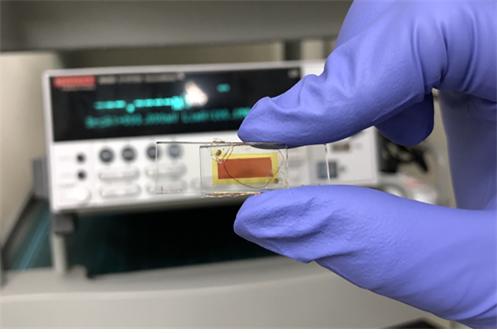
 This is a dye-sensitized beta battery developed by Daegu Gyeongbuk Institute of Science and Technology. This battery generates electricity by beta electrons emitted from a radioactive isotope colliding with a semiconductor that acts as a radiation absorber.
[Asia Economy Reporter Junho Hwang] Domestic researchers have developed a dye-sensitized beta battery that can be used semi-permanently without charging. This battery is expected to become a next-generation battery applicable in extreme environments such as space, deep sea, and medical fields due to its mass production capability and excellent stability. On the 15th, the research team led by Professor In Su-il from the Energy Engineering Department at Daegu Gyeongbuk Institute of Science and Technology announced that they have developed the dye-sensitized beta battery for the first time, and the related research results were recently published in the international journal Chemical Communications.
Development of Beta Battery Using Affordable Materials
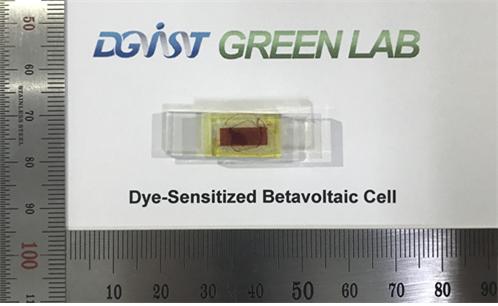
The beta battery developed by the research team is a next-generation battery that uses radioactive isotopes as raw materials. It generates electricity by beta particles emitted from radioactive isotopes colliding with a semiconductor radiation absorber. It requires no separate charging, and its lifespan is proportional to the half-life of the radioactive isotope, allowing semi-permanent use. In particular, beta rays have low human toxicity and low penetration, ensuring high safety.
Research on beta battery development is ongoing both domestically and internationally. The key is to construct the battery using inexpensive materials and simple processes. The research team replaced the expensive semiconductor materials used as radiation absorbers in existing beta batteries with the affordable ruthenium-based dye ‘N719.’ They also simplified the structure by applying Carbon-14, a beta-emitting isotope. They increased energy density by producing Carbon-14 in nanoparticle form.
Commercialization Still Challenging

According to performance tests, the research team observed that this battery generated 32,000 times more electrons compared to electrons emitted from Carbon-14, producing stable power for 10 hours. The team expects that if commercialization succeeds, batteries that can be used semi-permanently without charging can be produced. The Carbon-14 used in the beta battery has a half-life of about 5,730 years.
However, many challenges remain for commercialization. Professor In stated, "This research is meaningful in that it succeeded in developing a new beta battery by applying an inexpensive dye." However, he added, "The performance of the beta battery is still far from sufficient for commercialization," and explained, "We aim to improve the efficiency of the beta battery to a practical level through follow-up research and establish a foundation for commercialization as a next-generation battery."
© The Asia Business Daily(www.asiae.co.kr). All rights reserved.
![Clutching a Stolen Dior Bag, Saying "I Hate Being Poor but Real"... The Grotesque Con of a "Human Knockoff" [Slate]](https://cwcontent.asiae.co.kr/asiaresize/183/2026021902243444107_1771435474.jpg)


















