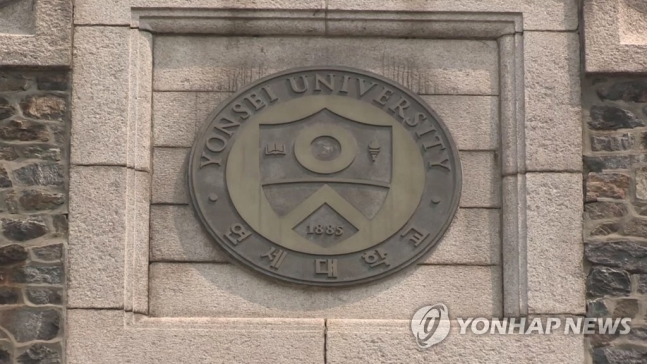
[Asia Economy Reporter Kim Hyo-jin] It was revealed during a Ministry of Education audit that a professor at Yonsei University instructed his daughter to take the course he was teaching and then awarded her the highest grade.
The Ministry of Education disclosed the results of a comprehensive audit of Yonsei University, which included this information.
According to the Ministry, a professor at Yonsei University, who was in charge of an accounting-related course in the second semester of 2017, encouraged his daughter, an undergraduate majoring in Food and Nutrition, to enroll and gave her an A+ grade.
He was found to have attempted to evade the audit by creating exam questions and answer sheets at his home where he lived with his daughter, and by not separately keeping the grade calculation materials.
It was also uncovered that during the graduate school admission process, six evaluation committee professors held prior consultations with the head professor and raised a fellow professor’s daughter, who ranked 9th in the quantitative evaluation, to 5th place in the document screening, thereby granting her an opportunity for the oral exam.
The evaluation committee professors then unjustly awarded the fellow professor’s daughter a perfect score of 100 on the oral exam, while unfairly lowering the oral exam scores of two applicants who had passed the document screening in 1st and 2nd place to 47 and 63 points, respectively. Ultimately, the fellow professor’s daughter was admitted as a new graduate student.
The Ministry of Education stated that it has requested the prosecution to investigate the professors who unfairly awarded grades to their children and those involved in the unfair selection of graduate students on charges of obstruction of business, and has ordered severe disciplinary actions such as dismissal, removal, or suspension.
Numerous accounting irregularities were also uncovered. Professors holding key positions within Yonsei University used corporate cards amounting to a total of 1,051.8 million KRW without proper documentation.
Professors affiliated with Yonsei University’s affiliated hospital were found to have improperly used corporate cards for 16.69 million KRW at entertainment bars and karaoke bars over 45 occasions, and 205.63 million KRW at golf courses.
Yonsei University was cited for a total of 86 issues in this comprehensive audit. As a result, 26 individuals are to receive severe disciplinary actions.
Eight cases were reported for violations such as breaches of the Private School Act and embezzlement or breach of duty, and four cases were referred for investigation on charges including obstruction of business and breach of duty, marking more findings than audits of other universities.
A Ministry of Education official explained, "The reason Yonsei University has many issues is because this is the first time it has undergone a comprehensive audit since its founding. Other schools have at least undergone accounting audits even if not comprehensive audits, but Yonsei University had never undergone an accounting audit."
In the comprehensive audit of Hongik University, it was found that four professors improperly received 16 million KRW by submitting summaries of their students’ theses to academic journals as research achievements to apply for academic research promotion funds.
Additionally, Hongik Foundation was found to have paid 620 million KRW in property taxes for 49 plots of land from the school fund account, which is funded by students’ tuition fees, instead of from the corporate account where it should have been paid.
Hongik University failed to designate 63 facilities, including retaining walls, as disaster-vulnerable facilities and did not conduct regular inspections. Despite the exterior surfaces of some buildings peeling off and the risk of falling bricks, no repairs or other measures were taken.
© The Asia Business Daily(www.asiae.co.kr). All rights reserved.
![Clutching a Stolen Dior Bag, Saying "I Hate Being Poor but Real"... The Grotesque Con of a "Human Knockoff" [Slate]](https://cwcontent.asiae.co.kr/asiaresize/183/2026021902243444107_1771435474.jpg)
















