"Sustainable New and Renewable Energy Expands to Society
Preparing for the Era of Future Energy Paradigm Shift"
[Asia Economy Reporter Moon Chae-seok] The government has reassessed the ripple effects and urgency of the climate change crisis in light of the novel coronavirus disease (COVID-19) and is promoting a transition to a "green economy," which means a low-carbon and eco-friendly economy. To this end, it plans to invest 73.4 trillion won (42.7 trillion won in national funds) in the "Green New Deal" by 2025. It aims to invest 35.8 trillion won (24.3 trillion won in national funds) in the transition to new and renewable energy, the core driving force of the Green New Deal, creating 209,000 jobs.
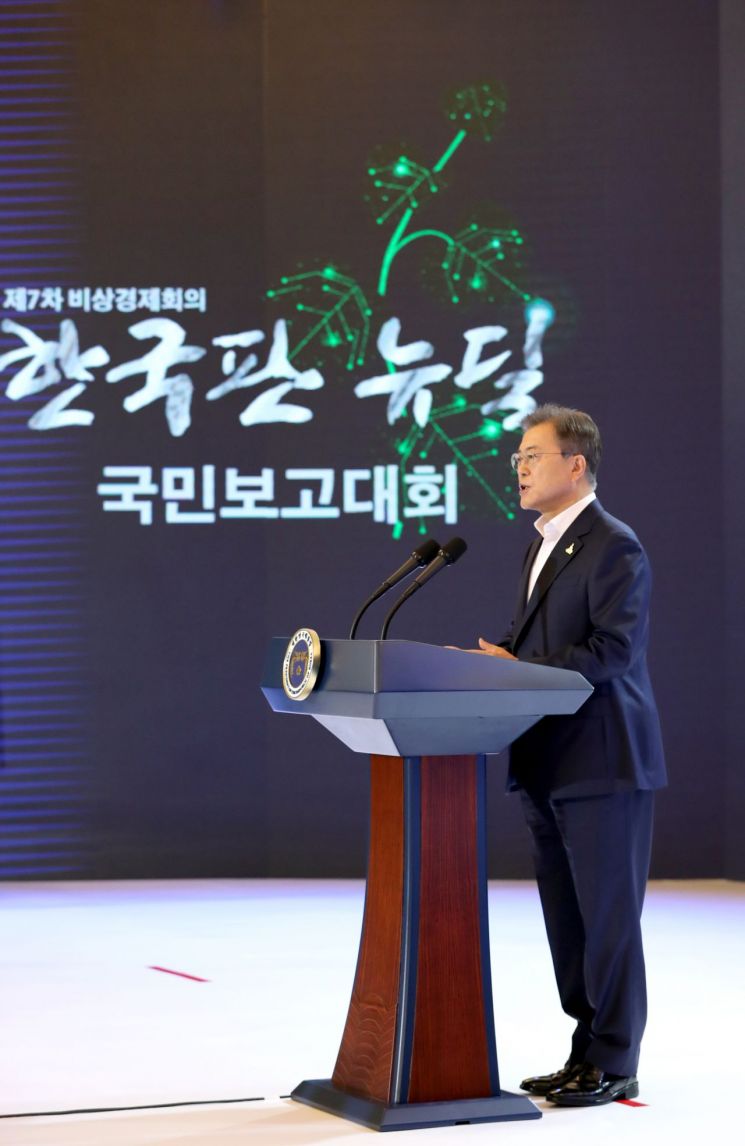
On the 14th, the government held the "7th Emergency Economic Meeting" chaired by President Moon Jae-in and announced the comprehensive plan for the Korean New Deal containing these details.
The Korean New Deal is a project for the government, companies, and citizens to jointly overcome the economic crisis early, create large-scale jobs, and leap forward as a leading nation. The three goals of the Korean New Deal are transforming from a "catch-up economy to a leading economy," from a "carbon-dependent economy to a low-carbon economy," and from an "unequal society to an inclusive society." The transition to low-carbon and distributed energy is one of the tasks for transitioning to a "low-carbon economy."
The core of the government's energy transition policy is to implement the "2030 greenhouse gas reduction target" and the "Renewable Energy 3020 Implementation Plan" to realize a "carbon-neutral (Net-zero)" society. The goal is to reduce total greenhouse gas emissions by 37% compared to the business-as-usual (BAU) emission forecast for that year by 2030 and to increase the share of new and renewable energy to 20% of the national energy supply. The specific practical plan to achieve this is included in the Green New Deal plan within the Korean New Deal.
◆Green New Deal 'Momentum,' Low-carbon and Distributed Energy= The government's Green New Deal is broadly divided into "expansion of low-carbon and distributed energy," "green transformation of urban, spatial, and living infrastructure," and "establishment of a green industry innovation ecosystem." If infrastructure transformation is the roots and ecosystem establishment is the body, then energy transition plays the role of the heart. The detailed tasks are ▲building an intelligent smart grid for energy management efficiency (3.1 trillion won, 20,000 jobs) ▲establishing a foundation for the spread of new and renewable energy and supporting a fair transition (12.8 trillion won, 38,000 jobs) ▲expanding the supply of green mobility such as electric and hydrogen vehicles (18.7 trillion won, 151,000 jobs).
First, smart meters (AMI: Advanced Metering Infrastructure) will be distributed to 5 million apartments. These meters enable two-way communication, and through AMI, power demand dispersion and energy savings are induced. Eco-friendly power generation systems will be established in 42 island regions nationwide to reduce pollutant emissions from diesel engine generators. Thirty-four small island renewable energy conversion facilities, three environmental facilities, and five high-efficiency hybrid power generation installations will be built respectively. By 2025, 2 trillion won will be invested to promote the joint undergrounding of power and communication lines around school commuting routes and other areas.
◆Accelerating Wind and Solar Power Transition... Inducing Resident Participation= The government is taking steps to actively distribute new and renewable energy, such as wind and solar power, which have been criticized for low energy supply stability. Until now, new and renewable energy have been criticized for low economic feasibility and high intermittency (the characteristic of unstable power supply when the sun sets or the wind does not blow), raising doubts about whether they can provide as stable energy supply as nuclear and coal power plants.
For wind power, support will be provided for wind condition measurement and feasibility studies in up to 13 regions, and phased establishment of hinterland and demonstration complexes will be promoted. This is to discover sites for large-scale offshore wind farms (fixed and floating types). An offshore wind turbine test bed will be built in Changwon, Gyeongsangnam-do, and a demonstration complex in Yeonggwang, Jeollanam-do.
To revitalize solar power projects, a resident participation profit-sharing project will be introduced. Financing support for rural and industrial complexes will be expanded. Installation costs for self-use new renewable facilities in 200,000 households, including houses and commercial buildings, will be supported. This may be welcome news for small and medium-sized businesses whose economic feasibility has declined due to the plummeting price of Renewable Energy Certificates (REC) for solar and other new and renewable energy projects.
Earlier, on the 3rd, the Ministry of Trade, Industry and Energy announced that 186.5 billion won would be invested in financial support for new and renewable energy as the third supplementary budget passed the National Assembly review. Through this, resident participation renewable energy projects and solar power loan support projects for industrial complexes were newly established, which aligns with the Green New Deal policy. The government has once again expressed its intention to develop new and renewable energy projects into "profitable businesses."
Support will be provided for coal power operators and others to smoothly transition to green mobility, digital management of new and renewable energy, offshore wind installation platforms, and more.
◆Expansion of Green Mobility such as Electric and Hydrogen Vehicles= The government will actively promote the distribution of electric and hydrogen vehicles in citizens' daily lives. A total of 1.13 million electric vehicles (including passenger cars, taxis, buses, and trucks) will be distributed. Rapid chargers numbering 15,000 and slow chargers numbering 30,000 will be secured.
For hydrogen vehicles, 200,000 vehicles including passenger cars, buses, and trucks will be distributed. Four hundred fifty charging infrastructures will be established. Hydrogen production bases and hydrogen distribution infrastructure will be built. Infrastructure will be equipped to produce hydrogen near demand sites and supply it stably to charging stations. Support will be provided for the conversion of old diesel vehicles to liquefied petroleum gas (LPG) or electric vehicles and for early scrapping.
This policy aligns with the "Hydrogen Economy Committee" launched by the government on the 1st. The Hydrogen Economy Committee promotes plans for hydrogen infrastructure construction, expands international cooperation, and builds a hydrogen industry ecosystem. Recently, it launched the Green Hydrogen Overseas Business Group, focusing on importing clean hydrogen from abroad and developing the hydrogen industry into an export industry.
© The Asia Business Daily(www.asiae.co.kr). All rights reserved.

















