Concerns Over Intensified Confrontation Between Both Sides Ahead of Tripartite Commission Discussions and Collective Bargaining Season
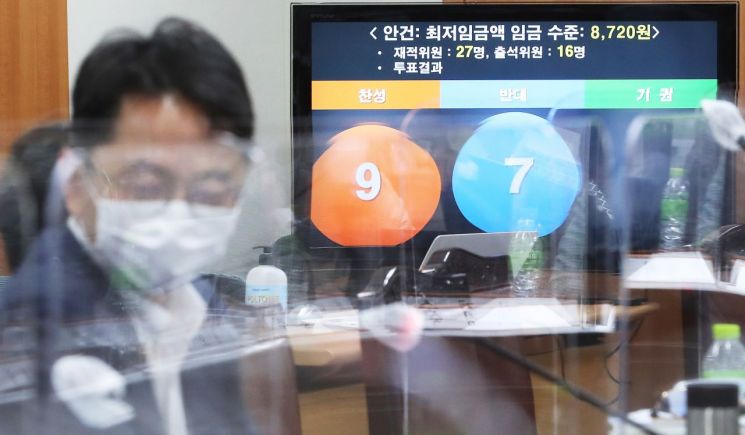
[Asia Economy reporters Kiho Sung, Jonghwa Kim, Byungdon Yoo] Regarding next year's minimum wage increase, the business sector and labor sector are showing conflicting positions. While small and medium-sized enterprises (SMEs) and large corporations expressed regret over the failure to achieve at least a freeze and indicated acceptance, the labor sector strongly opposed, stating, "The public interest commissioners themselves have pronounced the death sentence of South Korea's minimum wage." Due to this, concerns are rising that conflicts will intensify further during the remaining discussions at the Economic, Social and Labor Council and the upcoming wage and collective bargaining (wage and collective agreement) negotiation season.
The Korea Employers Federation (KEF) expressed acceptance in a statement on the 14th, saying, "Considering that this year our economy is showing visible recession due to external shocks from the novel coronavirus disease (COVID-19), and that SMEs and small business owners are struggling to survive by enduring debt, the minimum wage should have been at least frozen, but we regret that this was not reflected." Ryu Kijeong, Executive Director of KEF, said, "Given the economic conditions, the minimum wage should have been at least frozen, but we respect the minimum wage increase plan decided according to procedures," and added, "Going forward, the operation of the Minimum Wage Commission should be completely reformed so that the government and public interest commissioners take responsibility for deciding reasonable figures that our economy can bear."
The Federation of Korean Industries (FKI) also conveyed a similar stance to KEF, emphasizing, "Efforts should be focused on mitigating the side effects of rapid minimum wage increases through differential application of the minimum wage and expanding the scope of minimum wage inclusion, while inducing cooperation from all economic actors to overcome the current economic difficulties."
Small and medium-sized enterprises and small business owners, who are directly affected by the minimum wage increase, voiced their disappointment. Kim Hyungsun, head of the Seoul Jung-gu branch of the Korea Federation of Small and Medium Business, said, "The minimum wage should have been at least frozen, but it was raised again. It has become difficult for self-employed people to survive," and criticized, "Due to COVID-19, sales are less than half. What use is raising the minimum wage when business is not going well?"
However, the SME sector decided to accept the decision of the Minimum Wage Commission this time and to comply with the Minimum Wage Act while doing their best to maintain employment. The Korea Federation of SMEs stated, "To alleviate the management burden on micro SMEs and small business owners caused by this minimum wage increase and to protect vulnerable jobs, rapid and active government support and roles, including the expansion of employment retention subsidies, are necessary." They added, "Furthermore, in a situation where economic uncertainty is increasing, we hope that the minimum wage will be legally and institutionally supplemented so that companies' payment capacity and economic conditions can be properly reflected in the future." The small business sector also expressed a stance of "regret but acceptance."
On the other hand, the labor sector is strongly opposing, saying the increase rate is too low. This is in line with the fact that nine worker representatives left the meeting room before voting in protest against the reduction or freeze-level increase rate during the Minimum Wage Commission negotiations. A representative of the Korean Confederation of Trade Unions (KCTU) said, "We are only sorry to the minimum wage workers for the employers' repeated economic crisis logic and the reduction or freeze proposals every year," and criticized, "Their own league played on a tilted field must end now." They added, "From today, KCTU will resign all minimum wage worker representatives and put everything down to start a struggle for minimum wage system reform."
The Federation of Korean Trade Unions (FKTU) also opposed, saying, "There has never been such a disastrous minimum wage proposal even during the 1997 foreign exchange crisis or the 2009 financial crisis." In a statement released the day after the decision on next year's minimum wage, FKTU criticized, "The public interest commissioners once again shirked responsibility and sided with employers, showing their bias to the world." FKTU also decided that all minimum wage worker representatives will resign.
Because of this, concerns are also emerging that confrontations between the business and labor sectors will intensify further during the remaining Economic, Social and Labor Council discussions and the wage and collective bargaining season. A representative of a large corporation said, "From the labor sector's perspective, the minimum wage increase was a card they could not back down from," and predicted, "Given the many issues to be negotiated between labor and management amid the COVID-19 aftermath, this is an even more worrisome situation."
© The Asia Business Daily(www.asiae.co.kr). All rights reserved.

















