'Using Chicken Instead of Pheasant' Focus on Domestic Flights and Air Cargo but Profit Improvement Remains 'Insufficient'
Industry Anxiety Increases Amid Restructuring Rumors
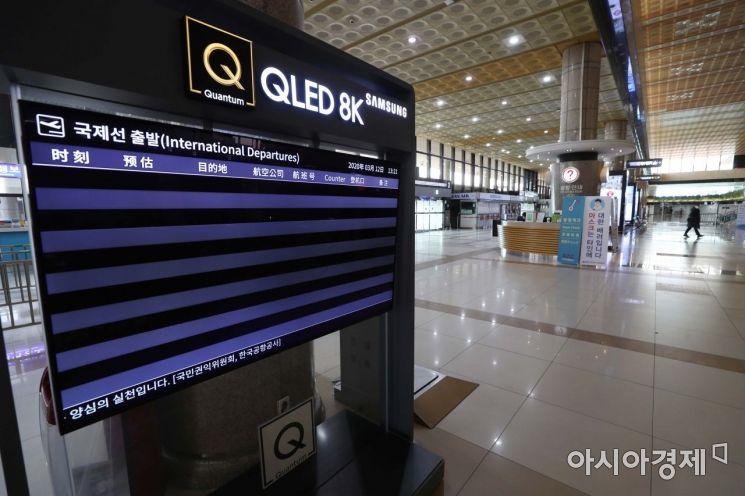 On the 12th, when the World Health Organization (WHO) declared COVID-19 a pandemic, the departure flight information board at the international terminal of Gimpo International Airport in Gangseo-gu, Seoul was empty. Photo by Moon Honam munonam@
[Asia Economy Reporter Yu Je-hoon] As the COVID-19 pandemic prolongs, Korean national airlines are focusing on domestic flights and cargo operations. With air routes blocked due to lockdown measures worldwide, they have chosen the "chicken instead of pheasant" approach. However, relying solely on domestic flights limits profitability, and air cargo rates, which had repeatedly soared, have peaked and are now declining, leading to many evaluations that it is a "bitter-sweet situation."
◆ Although it is 'chicken instead of pheasant'... a 'bitter-sweet situation' = According to the aviation industry on the 14th, even in the third quarter, traditionally considered the "peak season," the business environment for Korean national airlines shows no signs of improvement. Large airlines such as Korean Air and Asiana Airlines earned considerable profits in the second quarter due to soaring cargo rates caused by the global suspension of passenger flights, but recently, air freight rates have also been declining, heightening concerns.
According to the TAC air freight index published in Hong Kong, as of the 13th, the average cargo rate from Hong Kong to North America was $4.74 per kilogram. This is about 30% higher than the same period last year (July 15, 2019, $3.53), but it has fallen to about half compared to the peak after COVID-19 (May 11), which was $8.47 per kilogram.
This is interpreted as a result of global airlines competitively increasing belly cargo operations after the COVID-19 outbreak. An industry insider said, "The rise in air cargo rates was merely due to supply reduction; overall air cargo demand is decreasing," adding, "If cargo rates return to normal and international operations remain at the current level, the crisis could recur at any time."
The situation is not much better for low-cost carriers (LCCs). From the 1st to the 12th of this month, the number of domestic passengers at airports nationwide reached 1,912,147, recovering to 90.04% compared to last year (2,123,443), but this has not translated into improved profitability. In fact, since demand does not lead supply in domestic flights, most airlines' ticket prices are below the published fares. Recently, many have competitively resumed international flights, but this is generally seen as not very helpful.
◆ The crisis is ongoing, and anxiety is growing = Because of this, the atmosphere in the airport area, where the aviation industry is concentrated, is tense. Within the airport area, concerns are widespread that following the prolonged impact of COVID-19, a "second employment crisis" may arise if the government's year-end employment retention subsidies are cut off. Eastar Jet, which is currently not receiving employment retention subsidies, faces inevitable mass layoffs if its merger and acquisition (M&A) with Jeju Air fails. As of the first quarter, Eastar Jet had 1,616 employees.
Recently, rumors have circulated on the anonymous workplace app "Blind" that Korean Air may accept voluntary retirement applications from about 1,500 cabin crew members around the end of the year. A representative from the Korean Air Employee Union said, "There is considerable concern that voluntary retirement will be promoted for the bottom 5-10% of cabin crew based on performance evaluations around the end of the year or early next year when employment retention subsidies end."
Korean Air states that "there has been no discussion," but given that it is currently pushing to sell its in-flight meal and in-flight sales divisions due to the aftershocks of COVID-19, anxiety remains high. It is reported that about 230 to 240 Korean Air employees belong to the in-flight meal and in-flight sales divisions targeted for sale.
Professor Heo Hee-young of Korea Aerospace University said, "This year, companies have overcome the crisis through asset sales and capital increases, but the problem is that there are not many cards left to play," adding, "A second crisis could fully materialize across the aviation industry early next year."
© The Asia Business Daily(www.asiae.co.kr). All rights reserved.

















