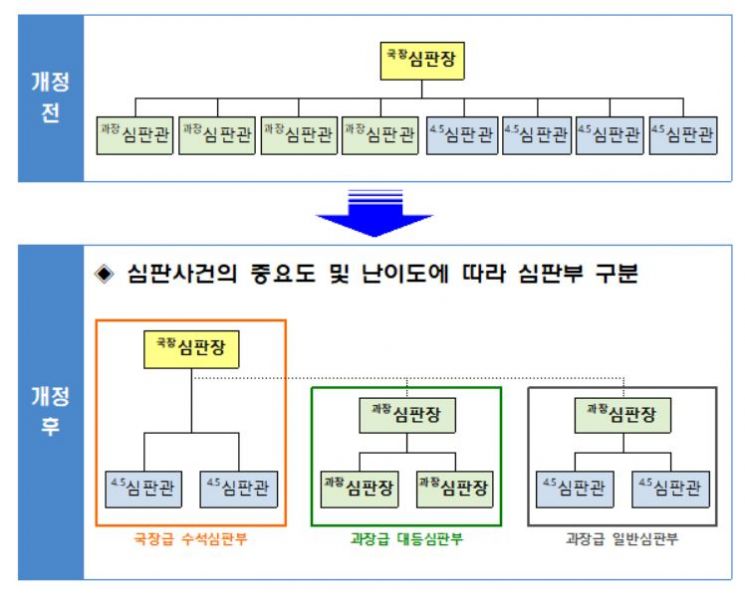
 Conceptual diagram comparing the Patent Trial and Appeal Board organization before and after reorganization. Provided by the Patent Trial and Appeal Board.
[Asia Economy (Daejeon) Reporter Jeong Il-woong] The Patent Trial and Appeal Board (PTAB) will expand from 11 to 36 panels. Each panel will be composed of one presiding judge and two judges, enabling the implementation of a "substantive three-member collegiate body."
On the 14th, the PTAB announced a complete reorganization in this form. The PTAB is a special administrative adjudication body that reviews the validity of rejection decisions made by patent examiners and handles disputes related to intellectual property rights such as patents, trademarks, and designs through quasi-judicial procedures.
Previously, the PTAB operated with 11 panels divided by rights and technical fields, 11 presiding judges at the director level, and 96 judges at the manager level or below. One presiding judge oversaw about nine judges to carry out the board's duties.
However, this supervisory structure has acted as an obstacle to achieving the three-judge consensus intended by the Patent Act and to enhancing the fairness and independence of trials.
Moreover, it was pointed out that among the approximately 10,000 cases handled annually, most are reviewed in writing, making in-depth oral hearings practically difficult.
In response, since last year, the PTAB has gathered opinions from various internal and external sectors and consulted with related ministries to complete amendments to four laws: the Patent Act, the Trademark Act Enforcement Decree, the Patent Office Organization Act, and the Organization Enforcement Rules. These legal revisions were made to enable examinations by a substantive three-member collegiate body.
Based on this, the PTAB expanded the qualification requirements for presiding judges to managers with experience in examination, trial, and litigation, aiming to streamline the trial system without increasing the number of presiding judges or judges. This is expected to lead to an expansion of panels and presiding judges, resulting in faithful three-member consensus hearings, according to the PTAB.
Additionally, the PTAB has laid the groundwork to increase the acceptance of trial results by expanding "oral hearings," allowing panels to directly listen to the parties' opinions in the courtroom, thereby facilitating easier issue organization.
Furthermore, by distributing cases with high social interest, many stakeholders, complex legal and technical issues, or requiring specialized expertise by detailed technology among 36 panels, the efficiency of trial operations is expected to improve.
Park Sung-jun, President of the PTAB, stated, "Considering that major countries such as the United States, Europe, Japan, and China currently have three-member panels composed of one presiding judge and two judges, this reorganization aligns with international standards. The PTAB will further strive to establish a foundation for patent trial innovation, marking the establishment of a three-member collegiate body equivalent to courts this year."
© The Asia Business Daily(www.asiae.co.kr). All rights reserved.

















