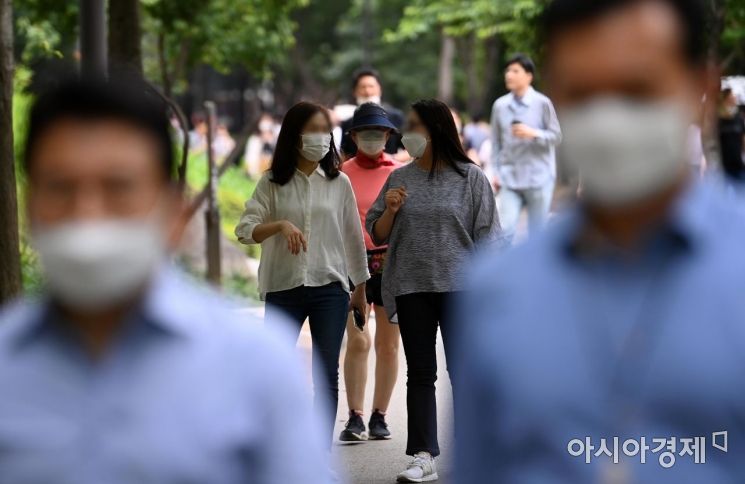
 On the 12th, citizens were seen taking a walk wearing masks at Gyeongui Line Forest Park in Mapo-gu, Seoul, as the government indefinitely extended the strengthened quarantine measures in the metropolitan area. At a briefing that day, Park Neung-hoo, Minister of Health and Welfare and First Deputy Head of the Central Disaster and Safety Countermeasures Headquarters, stated, "We have decided to extend the current strengthened quarantine management system for the metropolitan area," adding, "The end date is not set, and the measures will continue to be maintained until the number of cases in the metropolitan area decreases to single digits." Photo by Kim Hyun-min kimhyun81@
[Asia Economy Reporter Song Seung-yoon] It has been forecasted that the novel coronavirus disease (COVID-19) crisis will inevitably prolong for more than 1 to 2 years.
Park Neung-hoo, 1st Deputy Head of the Central Disaster and Safety Countermeasures Headquarters (CDSCH) and Minister of Health and Welfare, stated at a regular briefing held at the Government Seoul Office on the 12th, "According to the interim results of a recent survey on the formation of neutralizing antibodies against COVID-19, only 1 person out of 3,055 tested, which is 0.033%, was found to have antibodies," adding, "The fact that almost no one has antibodies indicates that it is practically impossible for our society to form herd immunity."
He continued, "The COVID-19 outbreak is inevitably going to be prolonged for more than 1 to 2 years until an effective vaccine is developed," emphasizing, "Ultimately, our society must continue to suppress the spread of COVID-19 as we have done so far, balancing daily life and quarantine management."
Regarding the recent situation where the daily number of new confirmed cases in non-metropolitan areas has surpassed that of the metropolitan area over the past two weeks, Park said, "The metropolitan area is currently at 'Social Distancing' Level 1, while Gwangju and the Honam region are implementing Level 2 on their own," and added, "Since the Gwangju area is enforcing stricter social distancing measures than the metropolitan area, we expect the situation to calm down at this level."
He further explained, "Community infections in the metropolitan area are currently decreasing, and the Gwangju area has shown relative stability this week, so at present, we judge that no additional strengthened distancing measures are necessary."
However, concerning the recent cluster infection at a badminton club in Gwangju, he said, "No measures have been taken yet for lifestyle sports facilities such as table tennis halls or badminton courts, but we will monitor the overall trend and determine the need for additional measures," adding, "(Separately from the central government) Gwangju has issued an administrative order banning all indoor group exercises at badminton courts until the 25th due to multiple confirmed cases."
The government had previously designated indoor exercise facilities conducting intense group workouts such as Zumba, Tae Bo, and spinning as 'high-risk facilities' and strengthened quarantine management.
Meanwhile, Park also revealed that the treatment system is being organized in preparation for a possible surge in patients. He said, "In preparation for large-scale outbreaks in specific regions, the country has been divided into six zones including the metropolitan and Chungcheong areas, and a joint bed response system by zone has been established," adding, "Designated key hospitals have been assigned per zone to allocate beds according to patient severity and characteristics, and beds will be integrated and managed by zone."
He stated, "We will continue to enhance the treatment system by maintaining medical personnel, facilities, and equipment for treating severe patients, operating consultative bodies to adjust infectious disease response systems within regions," and added, "Living treatment centers capable of treating asymptomatic and mild patients will be jointly utilized by each zone, and we will continuously secure living treatment centers in preparation for emergencies."
© The Asia Business Daily(www.asiae.co.kr). All rights reserved.