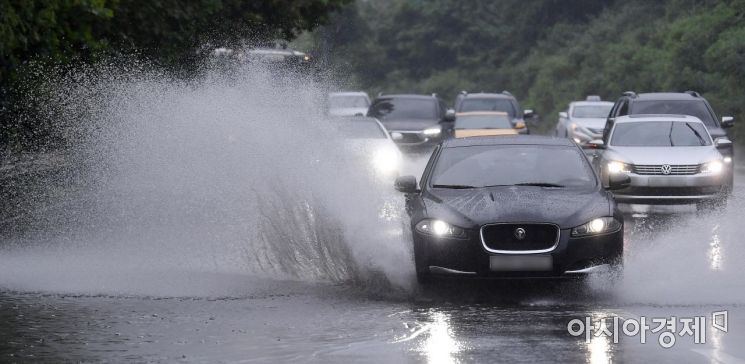
[Asia Economy Reporter Kiho Sung] As the rainy season arrives, a period when traffic accidents on wet roads frequently occur due to heavy rain, car maintenance becomes even more important.
According to the Road Traffic Authority on the 11th, over the past five years (2015?2019), a total of 76,117 traffic accidents occurred on wet roads, resulting in 1,712 deaths and 117,027 injuries, totaling 118,739 casualties.
In particular, in July, when rain frequently falls due to the rainy season, the highest proportion of annual wet road traffic accidents occurred, accounting for 14% (10,728 cases). Among traffic accidents in July, excluding those on clear days, the proportion of accidents during poor weather conditions was highest when it was raining at 69%, compared to cloudy or foggy conditions.
The Ministry of the Interior and Safety emphasized that when it rains, drivers’ visibility is limited and roads become slippery, making it dangerous. Additionally, using mobile phones or watching DMB (Digital Multimedia Broadcasting) can easily lead to serious accidents and should be avoided. Due to the hydroplaning phenomenon between tires and the road, car wheels can slip easily, and stopping distances become longer than usual, so drivers should reduce speed by about 20%. At this time, since stopping distances are extended, the safe distance between vehicles should be maintained at more than twice the usual length.
Especially during the heavy rains of the rainy season, checking the condition of wipers and windows is essential to secure the driver’s visibility. In the case of wipers, if the blades are worn out, they cannot wipe away rainwater properly during operation, which can obstruct visibility, so they should be replaced. Signs that indicate wiper replacement is needed include streaks or water marks on the glass when using the wipers, areas that are not wiped, and shaking or jerking during wiping.
Checking tires to prevent slipping on wet roads is also essential. Since rainwater is discharged through the grooves between tire treads, worn tire treads reduce drainage performance and can cause hydroplaning. Also, if tire air pressure is low, hydroplaning is more likely to occur and braking power decreases, so air pressure should be checked in advance to ensure it is at an optimal level.
The Citizens’ Coalition for Driving Cars for 10 Years presented response measures for flood accidents during the rainy season. Diesel vehicle DPFs (Diesel Particulate Filters) are key components that can reduce fine dust by more than 90% when installed. The DPF is located in the middle part of the undercarriage muffler and is a high-performance platinum catalyst. If the rainy season water flows back into the rear part of the muffler, the platinum catalyst DPF filter, which has a ceramic honeycomb structure, can become clogged with debris. If partial flooding occurs, immediate DPF cleaning is necessary. Neglecting this and driving can lead to reduced filtering performance and costs of several million won.
The flooding criterion is considered when the tires are submerged, not the vehicle roof. When a vehicle is submerged in water, it should be pushed or towed to an area where towing is possible as soon as possible. Leaving the vehicle in a flooded state can cause water to seep into major parts such as the engine or transmission, causing serious damage. At this time, the engine must never be started. Starting the engine will cause water to enter the engine interior in earnest. First, open the hood and disconnect the battery terminals as an emergency measure, then request emergency towing from the insurance company.
© The Asia Business Daily(www.asiae.co.kr). All rights reserved.

















