Prime Minister Lee Kuan Yew's Ruling Party PAP Wins After 55 Years in Power... Seat Share Falls Below 90%, Vote Share Also Declines
Opposition WP Secures 10 Seats, Highest Ever in History
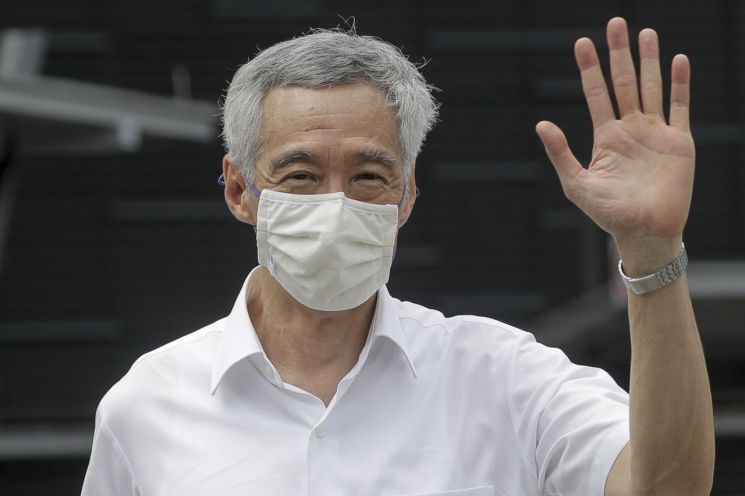
[Asia Economy Reporter Lim Cheol-young] The People's Action Party (PAP) of Singapore won more than two-thirds of the seats in the early general election held on the 10th, but the opposition party secured the highest number of seats in history, indicating a shift in public sentiment.
According to local Singaporean media and foreign news outlets, the results of the Singapore early general election held on the 10th showed that PAP secured 83 out of the total 93 seats. The opposition Workers' Party (WP) won 10 seats, more than the 6 seats they won in last year's general election.
With the opposition party securing the largest number of seats in history, the ruling PAP's seat share fell below 90% to 89.2%. The vote share also dropped by more than 8% compared to the 2015 general election, recording 61.24%. Founded by former Prime Minister Lee Kuan Yew, PAP has won all 17 general elections since Singapore's independence in 1965, with a seat share exceeding 90%.
The opposition's advance was also confirmed through the election results of the Progress Singapore Party (PSP), formed by Lee Hsien Yang, the younger brother of Prime Minister Lee Hsien Loong, who opposed the Prime Minister's political moves. Although PSP, established just one year ago, did not win any seats in this election, it performed well in several constituencies. Lee Hsien Yang and others, the Prime Minister's siblings, claimed that the Prime Minister violated the will to demolish his residence after his death and is using it as a political tool, dreaming of dynastic politics. They also alleged that the Prime Minister intends to hand over his position to Lee Hongyi.
Lee Hsien Yang did not run as a candidate but raised his voice through social media and media interviews, stating that Singapore benefits a small elite while the majority of citizens are frustrated. He highlighted issues such as income inequality hidden behind the glamorous ranking of 8th in per capita national income and immigration problems. When asked why he did not run as a candidate, he replied, "Singapore's political scene does not need another 'Lee'." This was effectively a remark targeting the Prime Minister.
There is growing interest in whether the ruling PAP will change its policies as a result of this election. After losing 6 seats to the opposition and seeing its vote share plummet to the 60% range in the 2011 general election, PAP made policy changes such as tightening regulations on hiring foreign workers. Additionally, changes are expected in the speed of the succession process from Prime Minister Lee to Deputy Prime Minister Heng Swee Keat.
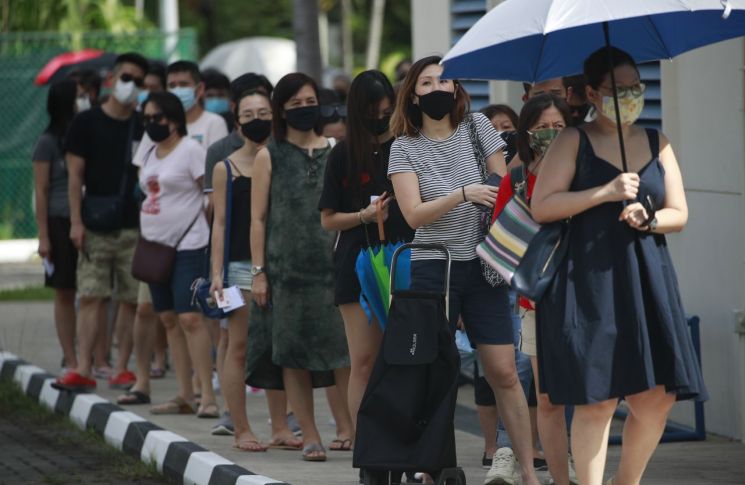
In this election, 11 parties including the ruling PAP competed for 14 Single Member Constituencies (SMCs), each electing one member, and 17 Group Representation Constituencies (GRCs), each electing 4 to 6 members. Meanwhile, due to COVID-19 prevention measures, voting was delayed at some polling stations, extending voting hours from the original 8 p.m. to 10 p.m.
© The Asia Business Daily(www.asiae.co.kr). All rights reserved.
![Clutching a Stolen Dior Bag, Saying "I Hate Being Poor but Real"... The Grotesque Con of a "Human Knockoff" [Slate]](https://cwcontent.asiae.co.kr/asiaresize/183/2026021902243444107_1771435474.jpg)

















