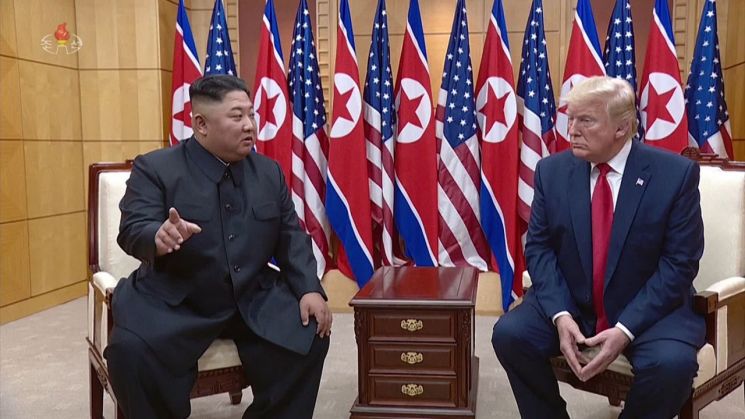
Kim Yo-jong, the First Deputy Director of the Workers' Party, on the 10th, through a statement, superficially dismissed the possibility of a North Korea?U.S. summit within the year. However, reading between the lines, she paradoxically revealed a sense of expectation for the talks, drawing attention.
Kim’s statement came just six hours after U.S. Secretary of State Mike Pompeo expressed on the 9th (local time) that he very much desires denuclearization talks with North Korea and mentioned the possibility of 'high-level leaders' meeting again.
In a phone conference with the media that day, Secretary Pompeo was asked whether a third North Korea?U.S. summit could happen before the U.S. presidential election. He replied, "I do not want to comment on the ongoing dialogue with one of our parties." Although he did not specify what the 'ongoing dialogue' referred to, it suggested the possibility of behind-the-scenes talks with North Korea. However, he was cautious, saying, "I do not want to talk today about who will do it, how, or when." This can be interpreted as leaving open the possibility of a summit depending on circumstances.
In her statement, Kim Yo-jong admitted difficulties caused by sanctions while saying she is not obsessed with lifting them. She revealed North Korea’s hardships through expressions such as "the persistent sanctions blockade led by the United States" and "to break the chains of sanctions for the improvement of the people's living standards."
She also listed specific conditions for talks while stating that North Korea does not want a summit. She reiterated the willingness for denuclearization. Overall, it is assessed that, like the U.S., North Korea is keeping the door open for dialogue but has entered a mid- to long-term situation management phase, considering the period after the U.S. presidential election.
In her statement that day, Kim Yo-jong said, "Although this is just my personal opinion, I believe that a North Korea?U.S. summit will not happen this year." She emphasized that a summit within the year is necessary for the U.S. but not for North Korea. She also referred to former White House National Security Council (NSC) advisor John Bolton’s prediction of an 'October surprise,' making it clear that North Korea will not respond to a summit according to that schedule.
However, Kim Yo-jong highlighted that the special relationship between North Korean State Affairs Commission Chairman Kim Jong-un and U.S. President Donald Trump still continues. She left room for dialogue by saying, "No one knows what sudden events might occur depending on the judgments and decisions of Chairman Kim and President Trump."
She also stated, "We have to deal with President Trump and, after that, with the U.S. administration and the entire United States." This is interpreted as an intention not to engage in premature negotiations in case of a regime change in the upcoming November U.S. presidential election. Notably, Kim Yo-jong’s statement was not published in the Workers' Party’s official newspaper, Rodong Sinmun, which is read by all North Korean citizens. This is also interpreted as a measure leaving room for a reversal in the U.S.-North Korea situation.
Accordingly, Kim Yo-jong emphasized that while North Korea has a willingness for denuclearization, it requires corresponding "irreversible significant measures" from the U.S. She stressed, "We are not saying that we will never denuclearize, but that we cannot do it now," and reminded that "to realize denuclearization of the Korean Peninsula, many changes on the other side, that is, irreversible significant measures, must be taken simultaneously along with our actions."
She also made it clear that even if summits resume after this year, North Korea has no intention to renegotiate the 'Yongbyon nuclear facility dismantlement?partial sanctions relief' card. She said, "I think the basic theme of past North Korea?U.S. negotiations, 'denuclearization measures versus sanctions relief,' should now be changed to the framework of 'withdrawal of hostility versus resumption of North Korea?U.S. negotiations,'" and added, "I hope no one harbors the foolish dream of bargaining again over partial sanctions relief that was on the Hanoi summit table and the permanent dismantlement of large-scale nuclear facilities like the Yongbyon complex, which is the nerve center of our nuclear development."
Professor Im Eul-chul of the Institute of Far Eastern Studies at Gyeongnam National University commented, "By deliberately continuing to emphasize Chairman Kim’s unwavering trust in President Trump, it appears that North Korea is maintaining pressure on the U.S. regarding the existing demand for the withdrawal of hostility," and evaluated that "North Korea has revealed both a short-term management of the U.S. situation and a long-term response plan."
Professor Park Won-gon of Handong Global University analyzed, "While negative about a North Korea?U.S. summit, North Korea seems to actually want the talks," and said, "Since Trump’s reelection is uncertain, considering the 'post-Trump U.S. administration,' the summit would be meaningless, but if there is a 'decisive change in the U.S. stance,' North Korea is sending a message that it would be beneficial."
© The Asia Business Daily(www.asiae.co.kr). All rights reserved.
![User Who Sold Erroneously Deposited Bitcoins to Repay Debt and Fund Entertainment... What Did the Supreme Court Decide in 2021? [Legal Issue Check]](https://cwcontent.asiae.co.kr/asiaresize/183/2026020910431234020_1770601391.png)
















