Spillover Effects on Local Real Estate Market
Smaller than Reconstruction and Redevelopment
Government and Seoul City Housing Supply Alternatives
Seongdong-gu's First Small-Scale Reconstruction Association Established
City Plans Additional Measures Including Floor Area Ratio Relaxation
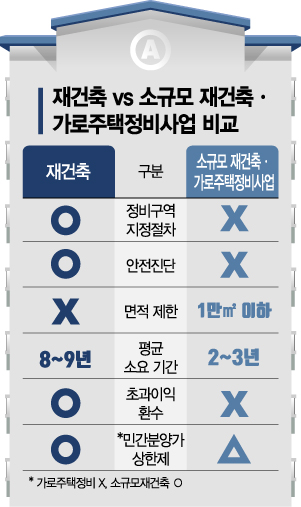
[Asia Economy Reporter Onyu Lim] Following the June 17 real estate measures, concerns over the housing supply shortage in Seoul have intensified, leading to expectations that small-scale housing redevelopment projects will gain momentum. Compared to reconstruction and redevelopment, these projects have a smaller ripple effect on the surrounding real estate market, making them a plan actively promoted by the government and Seoul City as an alternative for urban housing supply. Seoul City plans to prepare and disclose additional measures to revitalize small-scale housing redevelopment projects, such as easing floor area ratio regulations.
According to the real estate industry on the 10th, interest in small-scale reconstruction and street housing redevelopment projects has recently increased. Following the reconstruction excess profit recovery system and the June 17 measures, which strengthened safety inspections and imposed a two-year residency requirement, the intensity of reconstruction regulations has increased, raising concerns about a sharp decline in urban housing supply. According to Real Estate Info, the number of housing units scheduled for occupancy in Seoul's redevelopment projects next year is expected to be 17,655, about half of this year's 36,596 units.
Earlier this month, Jeongan Mansion 3rd in Seongsu-dong 2-ga, Seongdong-gu, received approval for the establishment of a small-scale reconstruction association. This is the first time a small-scale reconstruction association has been established in the Seongdong-gu area. Jung Won-oh, mayor of Seongdong-gu, said, "Since this is a project method recommended by the government, we hope it will become a good model case for Seongdong-gu with benefits such as various regulatory relaxations." Built in 1983, Jeongan Mansion 3rd plans to demolish the existing 66 aging row houses and build 76 new apartment units through the project.
The number of places pursuing street housing redevelopment projects is also increasing. According to Seoul City, the number of street housing redevelopment projects at the stage after association establishment approval increased from 55 in the fourth quarter of last year to 60 in the first quarter of this year. A Seoul City official explained, "Unlike large-scale redevelopment projects, small-scale housing redevelopment projects have a smaller impact on the surrounding real estate market, such as price increases," adding, "Although it may not be a major means of expanding housing supply in urban areas, it can be one of the options."
The atmosphere of revitalizing small-scale housing redevelopment projects is also detected in changes in the non-apartment market. According to KB Real Estate, last month, the sales prices of detached houses and row houses in Seoul rose by 0.73% and 0.47%, respectively. This is unusually higher or similar to the apartment sales price increase rate (0.52%). The industry believes that if small-scale housing redevelopment projects are revitalized, investment demand will flow into detached houses and villas, potentially driving prices even higher.
Small-scale reconstruction involves demolishing aging multi-family housing with fewer than 200 units, and street housing redevelopment involves demolishing 10 or more detached houses or 20 or more multi-family houses to build new apartments. Because these are small-scale developments, their impact on surrounding real estate prices is smaller than that of reconstruction. Accordingly, the government established the "Special Act on Vacant Houses and Small-scale Housing Redevelopment" in 2018 to support small-scale housing redevelopment projects. In the December 16 measures last year, to revitalize street housing redevelopment, it was announced that projects meeting public interest requirements would be exempt from the price ceiling system and that the project implementation area would be expanded (from 10,000㎡ to 20,000㎡). Last month, a policy was also announced that reduces the mandatory number of parking spaces by up to half if nearby parking rights are secured when promoting small-scale housing redevelopment projects.
Seoul City is also preparing plans to increase the number of households by easing floor area ratio and height restrictions to encourage project revitalization. A Seoul City official said, "We are preparing a manual to make it easy for residents to access small-scale housing redevelopment projects and are reviewing ways to increase the number of households through public contributions."
Large construction companies, whose redevelopment projects have decreased, are also targeting the metropolitan area's small-scale housing redevelopment market through subsidiaries. Daewoo Construction is known to be actively entering small-scale housing redevelopment and remodeling projects by merging its subsidiaries Daewoo ST, Prugio Service, and Daewoo Power. The launch of Daelim Construction, formed by the merger of Daelim Industry's subsidiary Samho and Goryeo Development, is also interpreted as related to this trend. An industry insider said, "Small-scale redevelopment projects are fast-paced and have active support from the government and local governments, so they could be a desperate measure for construction companies facing a slump in orders."
© The Asia Business Daily(www.asiae.co.kr). All rights reserved.

















