Health Authorities Ban All Small Gatherings and Events Inside Churches from 6 PM on the 10th
Blue House Petition "Opposing Ban on Church Events Outside Regular Worship" Gains Over 290,000 Supporters
Citizens Debate "Discrimination Against Churches" vs. "Necessary Measures for Prevention"
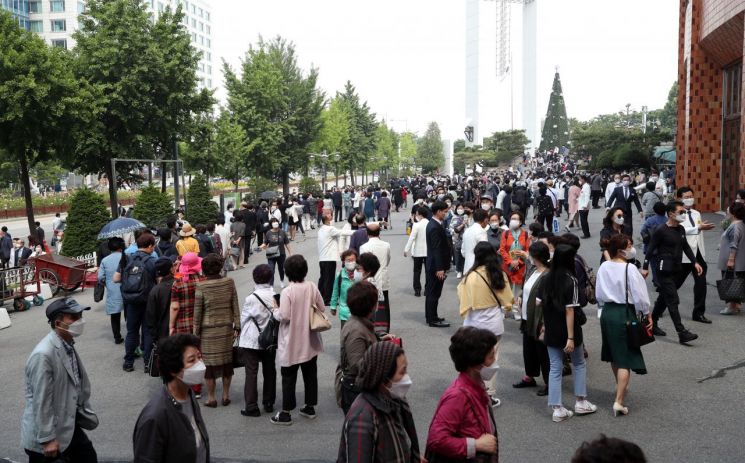 On the morning of May 31, worshippers are entering the main sanctuary at Yoido Full Gospel Church in Yeongdeungpo-gu, Seoul to attend the service. Photo by Yonhap News
[Asia Economy Reporter Kim Ga-yeon] As the government has banned small gatherings, events, and group meals at churches instead of regular worship services due to the spread of the novel coronavirus infection (COVID-19), debates have continued over this measure. Citizens have voiced opinions both claiming it is "discrimination against churches" and asserting it is a "necessary measure to prevent the spread of COVID-19."
In particular, the controversy has intensified as a petition opposing this government measure gained over 290,000 signatures within just one day of being posted.
On the 8th, the Central Disaster and Safety Countermeasures Headquarters (CDSCH) announced that strengthened quarantine rules for churches will be implemented from 6 p.m. on the 10th to prevent the spread of COVID-19. Accordingly, all small gatherings, events, and group meals other than regular worship services at churches will be prohibited. This includes retreats, prayer meetings, revival meetings, district worship services, Bible study groups, and choir practice sessions.
Additionally, churches must introduce QR code electronic entry logs to manage visitor records. Church leaders or staff are required to check visitors for COVID-19 symptoms and restrict entry for those showing symptoms. However, churches themselves have not been designated as 'high-risk facilities.'
These government measures have sparked strong opposition among church members. They argue that such guidelines are not applied to other religious facilities outside of Protestant churches, and that restricting only small gatherings within churches constitutes discrimination.
A petition reflecting these views was also posted. On the 8th, the petitioner posted a message titled "Please cancel the government's ban on events other than regular worship services at churches" on the Blue House National Petition Board, claiming that "this government measure is reverse discrimination against churches."
The petitioner pointed out, "Most of the COVID-19 cluster infections reported in churches in the media occurred because quarantine rules were not followed," and added, "While places where more people gather, such as clubs, karaoke rooms, restaurants, and cafes, have not faced significant restrictions, it is incomprehensible that the government restricts church gatherings."
He stated, "If quarantine rules are not followed, strong penalties are necessary, but imposing sanctions on all churches based on a few cases is an excessive quarantine measure," and added, "This is clear reverse discrimination compared to other religious facilities and is a violation by the government itself of Article 20, Clause 1 of the Constitution, which guarantees freedom of religion to all citizens."
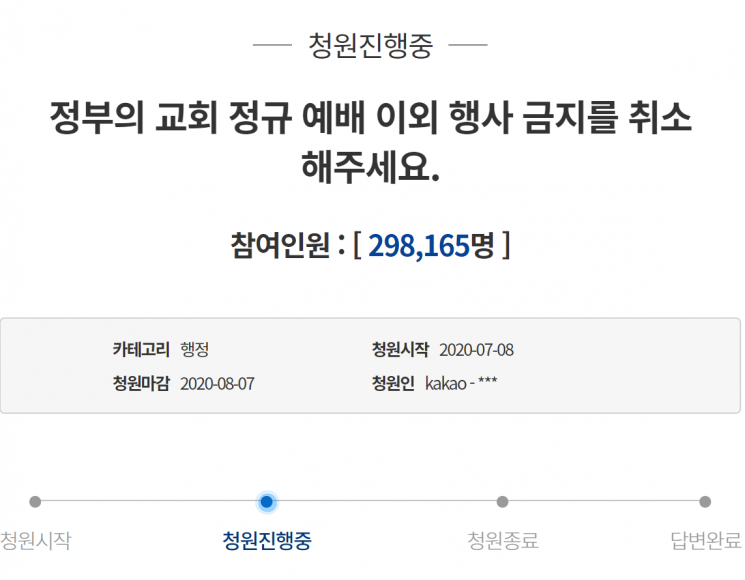 A petition titled "Please cancel the government's ban on church events other than regular worship services" was posted on the Blue House National Petition Board on the 8th. As of 5:50 PM on the 9th, the petition had received 298,165 signatures. Photo by Blue House National Petition Board capture
On the other hand, some argue that "these measures are necessary for COVID-19 prevention." Given that cluster infections have recently been reported in small church gatherings, caution is needed.
B, a 30-year-old office worker, said, "The government did not ban worship itself, so claims of religious persecution seem excessive," and added, "Since the number of COVID-19 cases is not decreasing, it is appropriate to follow the government's preventive measures. If a cluster infection spreads later in churches, people will criticize for not taking early action."
B, a 22-year-old university student, also said, "There have been cases of infections in religious gatherings, and small-scale infections have continued," and raised his voice, "But when people call these measures discriminatory, it sometimes feels 'too selfish.'"
He added, "The religious community should not oppose preventive measures but rather lead by example," and said, "'Don't impose restrictions on us because other places are not restricted' is not the right approach; instead, they should say 'restrictions are needed in other places with high infection risks as well.'"
Meanwhile, Kim Kang-rip, the first chief coordinator of the CDSCH, stated at a regular briefing held at the Government Seoul Office on the 8th, "We are imposing an obligation on all churches nationwide to comply with core quarantine rules."
Kim emphasized, "Although church facilities as a whole are not designated as high-risk facilities and regular worship services, which do not pose significant problems, will proceed normally, basic quarantine rules such as managing entry logs must be followed."
He continued, "Thanks to the active cooperation of the religious community so far, quarantine rules such as social distancing and mask-wearing during worship have been well observed, minimizing cluster infections through worship services," and added, "Currently, cluster infections through small gatherings related to churches are repeatedly occurring in the metropolitan and Honam regions, so we ask for the participation and cooperation of the religious community."
© The Asia Business Daily(www.asiae.co.kr). All rights reserved.
![Clutching a Stolen Dior Bag, Saying "I Hate Being Poor but Real"... The Grotesque Con of a "Human Knockoff" [Slate]](https://cwcontent.asiae.co.kr/asiaresize/183/2026021902243444107_1771435474.jpg)

















