Korean Economic Association 'Economic Discussion' Results
[Asia Economy Reporter Kim Eun-byeol] Most prominent domestic economists appear to oppose the basic income issue that has emerged since the spread of the novel coronavirus infection (COVID-19).
The Korean Economic Association released the results of an economic discussion containing answers to eight basic income survey questions on the 9th. Overall, the prevailing view was that the necessity of introducing basic income is not significant.
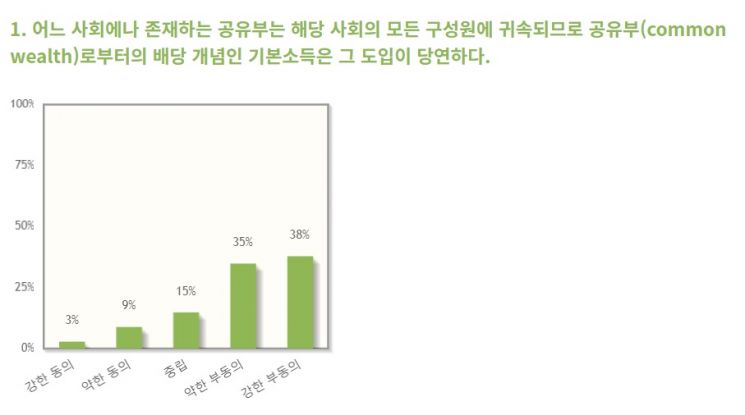
First, regarding the question "It is natural to introduce basic income as a dividend concept of common wealth," 73% answered that they disagreed. Among them, 38% of scholars responded with "strongly disagree." Neutral responses accounted for 15%, weak agreement 9%, and strong agreement only 3%.
Professor Kim Woo-chan of Korea University pointed out, "It seems to be an argument based on the premise that there is enough common wealth. Unfortunately, our government neither owns two-thirds of the North Sea oil fields like the Norwegian government nor owns three-quarters of the national land like the Singaporean government. It is a theoretical discussion that does not consider the reality of our country."
Regarding the question "The introduction of basic income is necessary because future technological changes such as digital transformation reduce opportunities to earn money through jobs," the proportion of agreement increased slightly. Weak agreement was 26%, and strong agreement was 9%. However, 56% still disagreed, accounting for more than half.
Professor Lee Woo-heon of Kyung Hee University said, "In response to technological changes, I believe that creating new markets through regulatory reform is more necessary than providing basic income." There were also responses that new technologies will create more jobs in the long term.
Professor Choi In of Sogang University said, "Rapid technological advancement has been experienced several times over the past 100 years. Since technological advancement ultimately increased human income, it cannot be a reason for the existence of basic income."
Responses indicating that basic income is ineffective in resolving blind spots reached 72%. Although it seems to resolve blind spots because it is given to everyone, the explanation is that the wage level of basic income feasible under fiscal conditions is too low to be effective in resolving blind spots. Professor Sung Tae-yoon of Yonsei University pointed out, "Providing basic income in a universal form and meaningful scale requires enormous resources, making tax increases inevitable, and it is actually difficult to strengthen support for low-income groups."
55% of respondents answered that existing social safety nets such as the Basic Livelihood Security System, which supports the livelihood of the poor, and employment insurance, which compensates for income loss due to unemployment, are more effective means than basic income. Regarding the question "It is more effective to concentrate resources on income security for low-income groups with high consumption propensity, so the introduction of basic income is unnecessary," agreement (50%) and opposition (44%) were similar.
Meanwhile, the Korean Economic Association's "Economic Discussion" is modeled after the IGM Forum of the University of Chicago in the United States and is a platform where economic experts share views on Korean economic issues. Among the 74 scholars participating in the economic discussion, 34 responded to this survey conducted from the 29th of last month to the 8th of this month.
© The Asia Business Daily(www.asiae.co.kr). All rights reserved.
![Clutching a Stolen Dior Bag, Saying "I Hate Being Poor but Real"... The Grotesque Con of a "Human Knockoff" [Slate]](https://cwcontent.asiae.co.kr/asiaresize/183/2026021902243444107_1771435474.jpg)
















