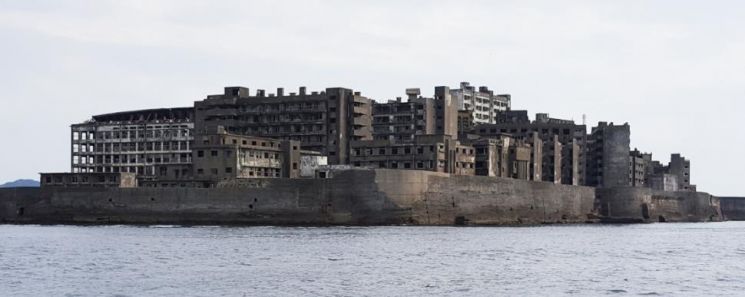
[Asia Economy Reporter Jeong Hyunjin] The Japanese Asahi Shimbun criticized the distorted exhibition at the Industrial Heritage Information Center, which opened on the 15th of last month, and stated in an editorial on the 9th that Japan must confront its negative history.
In the editorial titled "World Heritage Conflicts, We Must Confront Dark History," Asahi pointed out, "Japan, which has demanded the principle of faithfully keeping its external promises as a nation, cannot build trust by bending its own standards."
The Industrial Heritage Information Center is an exhibition facility that opened on the 15th of last month in the annex of the Ministry of Internal Affairs and Communications' 2nd Government Building in Shinjuku, Tokyo. It was established based on Japan's 2015 promise to the international community to register 23 Meiji-era industrial heritage sites, including Hashima Island (commonly known as 'Gunkanjima'), as World Cultural Heritage sites and to provide information on the entire history, including forced labor under Japanese colonial rule.
However, the actual exhibition mainly boasts the achievements of industrialization during the Meiji era, drawing criticism for ignoring or distorting the dark history of forced labor victims. Despite recent criticism, the Japanese government maintains that there is no problem.
Regarding this, Asahi pointed out, "Friction has arisen between Japan and South Korea over the exhibition of the 'Sites of Japan’s Meiji Industrial Revolution,' which was registered as a World Cultural Heritage site five years ago," and stated that the cause is Japan's insufficient explanation of the forced labor victims during the Pacific War.
Asahi mentioned that at the time of registration, the Japanese government representative expressed at the World Heritage Committee that "many Koreans were taken against their will and forced to work in harsh conditions," and stated their intention to take "appropriate measures to remember the victims" through the establishment of exhibition facilities.
Furthermore, the newly opened Industrial Heritage Information Center corresponds to such a facility, but some exhibition content, such as testimonies claiming there was no discrimination against Koreans on Hashima, has sparked backlash from South Korea. The newspaper pointed out, "While testimonies from people who experienced the time are undoubtedly valuable, relying solely on individual experiential testimonies makes it impossible to grasp the bigger picture of history."
Additionally, Asahi criticized, "It has been revealed in official documents from the Japanese government at the time that violence accompanied the mobilization of Korean laborers and that harsh labor was forced, and these facts have been recognized in trials within Japan," emphasizing the need to fully explain these facts and describe the overall picture of Japan’s national policy at the time. It is currently difficult to see that the promised intent is being upheld.
Asahi stated, "Every country has light and shadow in its history, and relationships with neighboring countries are inevitably complex," adding, "Regardless of brightness or darkness, both Japan and South Korea share the responsibility to humbly face historical facts and think about the future." In conclusion, it emphasized, "Since the Meiji era, Japan has achieved remarkable industrialization through much effort and sacrifice," warning that if the darker parts are ignored, the heritage’s brilliance will fade.
© The Asia Business Daily(www.asiae.co.kr). All rights reserved.
![Clutching a Stolen Dior Bag, Saying "I Hate Being Poor but Real"... The Grotesque Con of a "Human Knockoff" [Slate]](https://cwcontent.asiae.co.kr/asiaresize/183/2026021902243444107_1771435474.jpg)
















