SKT-KMA-Kyungpook National University Pilot 'Earthquake Observation Network' Established
Earthquake Sensors Installed at Base Stations and Agencies Linked with KMA System
Network to Expand to 8,000 Sites Including Elementary Schools and Police Stations Within the Year
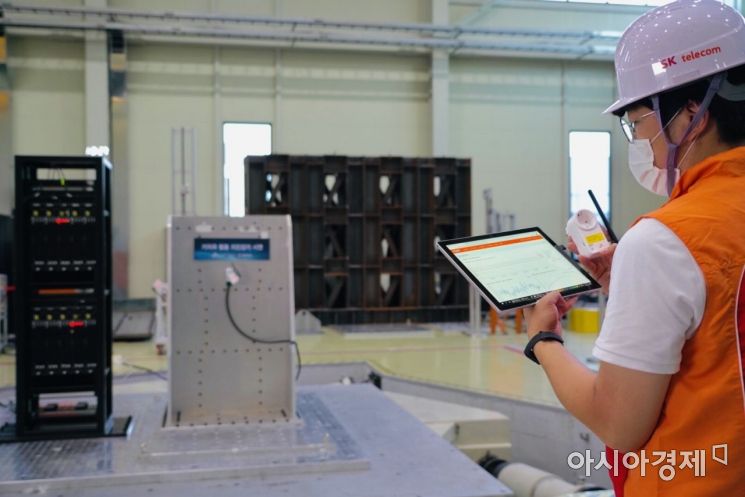 An SK Telecom engineer is inspecting an earthquake detection sensor linked with a base station. (Photo by SK Telecom)
[Asia Economy Reporter Han Jinju] SK Telecom is building a network that detects earthquakes using its agencies and base stations. With densely installed equipment, it will detect earthquakes and link this information with the Korea Meteorological Administration's (KMA) earthquake observation data to collect and deliver earthquake information more accurately and quickly.
On the 9th, SK Telecom announced that it will pilot the construction of an 'Earthquake Observation Network' in collaboration with the KMA and Kyungpook National University, which can be linked to the earthquake detection and warning system on the Korean Peninsula.
SK Telecom will install earthquake detection sensors at about 3,000 locations including base stations and agencies, and create a network linked with the KMA's earthquake observation system. SK Telecom plans to expand the earthquake detection system to about 8,000 locations, including police stations and elementary schools, within this year.
The KMA collects information from 338 earthquake observation stations and issues an earthquake early warning within 7 to 25 seconds after detecting an earthquake. With the cooperation of SK Telecom, the reinforcement of earthquake observation data will enable more accurate information provision and reduction of early warning time. Typically, if it takes 5 seconds for the arrival of the secondary waves (S-waves), nearby evacuation such as under a desk is possible, and if it is more than 10 seconds, evacuation outside the building is also possible.
On the same day, SK Telecom conducted a simulated earthquake test together with the KMA and Kyungpook National University at the Korea SGS Co., Ltd. Dongtan Testing Center, which performs stability verification such as seismic resistance and vibration. For the test, vibrations similar to an earthquake of magnitude 6.0 or higher were generated, and the process of collecting and analyzing vibration data from base stations was demonstrated.
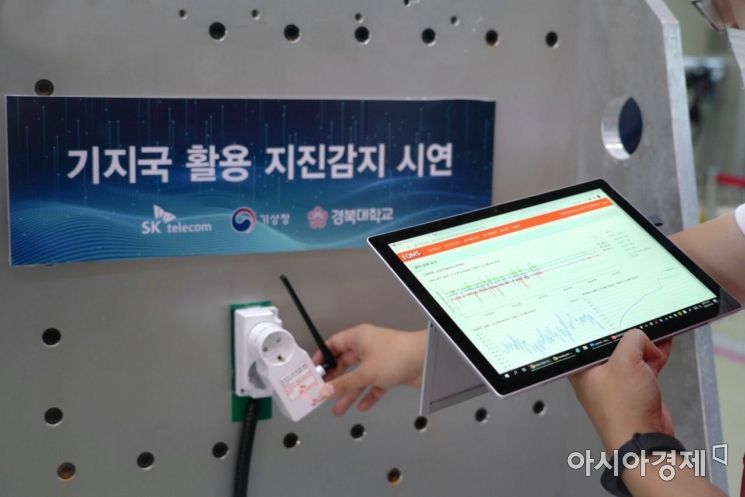 An SK Telecom engineer is inspecting an earthquake detection sensor linked with a base station. (Photo by SK Telecom)
SK Telecom's earthquake detection sensors are small, low-cost devices compared to the high-performance earthquake observation equipment used by the KMA for earthquake analysis. They are plug-type devices powered by 220V and about the size of a hand span, making installation and relocation convenient. They collect vibration data 100 times per second and are designed to distinguish between general vibrations and earthquakes through precise analysis.
SK Telecom classifies the 24-hour real-time vibration data and atmospheric pressure observed by the earthquake detection sensors into the SKT collection server (EQMS; Earthquake Monitoring System) and sends it to the KMA. The KMA is conducting research to utilize the provided vibration data by integrating it with the national earthquake observation network for seismic intensity information production and earthquake early warning analysis.
SK Telecom plans to expand the earthquake detection system to 8,000 locations. It is also promoting plans to extend it to places where public safety is important, such as national and industrial facilities and schools. Once SK Telecom's earthquake warning system using earthquake information is fully operational, it is expected to safely protect facilities and equipment vulnerable to earthquakes, such as power plants, railroads, and semiconductor factories.
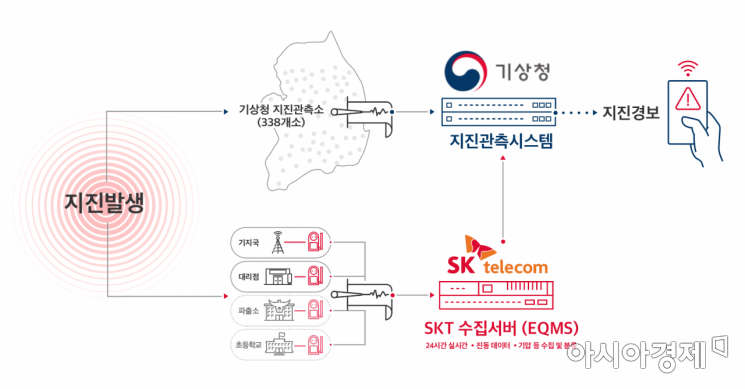
SK Telecom, the KMA, and Kyungpook National University will promote research to advance the national earthquake response system until 2021. They are verifying the earthquake analysis performance by comparing vibration data from earthquake detection sensors installed in SK Telecom's base stations with the KMA's earthquake observation data and are also reviewing the possibility of utilizing it as an earthquake information service.
Lee Deok-gi, head of the Earthquake and Volcano Research Division at the KMA, said, "As public anxiety about earthquakes is high, we will strive to provide rapid and accurate earthquake information services through continuous public-private cooperation and research and development."
Ryu Jeong-hwan, head of SK Telecom's 5GX Infrastructure Group, said, "The importance of establishing a social safety net to prepare for disaster situations, such as the disaster roaming implemented recently through cooperation among the three major mobile carriers, is increasing. We will continue to create social value by utilizing various infrastructures owned by telecommunications companies in the 5G era, including building an earthquake observation network in cooperation with the KMA and Kyungpook National University."
© The Asia Business Daily(www.asiae.co.kr). All rights reserved.



















