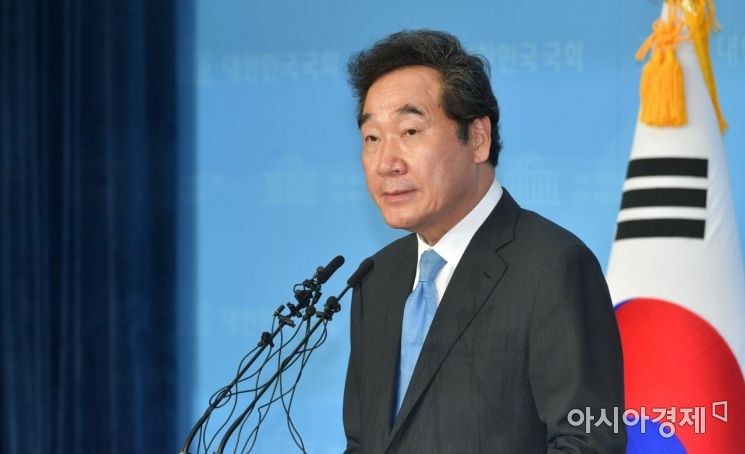
 Lee Nak-yeon, a member of the Democratic Party of Korea, is holding a press conference to announce his candidacy for party leader at the National Assembly on the 7th. Photo by Yoon Dong-joo doso7@
[Asia Economy Reporter Wondara] Lee Nak-yeon, a member of the Democratic Party of Korea, proposed 'measures to expand supply,' such as relaxing the residential-commercial area ratio in Seoul, as a solution to the real estate problem.
On the morning of the 9th, Lee appeared on KBS Radio and said, "First, there will be utilization of idle land, and especially if there is land available near station areas, it is necessary to prioritize focusing on that." He added, "Next, we need to see if regulations that have restricted supply expansion can be relaxed. For example, the residential to commercial area ratio in Seoul is 7 to 3, which is 3 more than in other major cities. We need to consider adjusting this to expand residential areas." He continued, "Another point is whether some parts of neighborhood living areas or quasi-residential areas can be relaxed and converted into residential zones. This should be considered first," adding, "At the same time, a delicate approach is needed to ensure there is no risk of speculation."
Regarding the ongoing investigation by the Democratic Party and the government into multi-home ownership among lawmakers and second-level public officials, he said, "Those in high public office must continuously strive to meet the expectations of the people. While each individual may have their circumstances, I think it is right for those who own more than one house to dispose of them without overthinking." However, on the possibility of real estate blind trusts, he said, "In the case of real estate, if blind trusts were available, even those with many properties could refrain from buying and selling during their tenure as high-ranking public officials. But would that be acceptable to the public?"
When asked about the statement, "As a former Prime Minister, Lee is not free from responsibility for the current government's real estate policy," he replied, "Ultimately, it was not successful." He added, "There were mistakes. That must be acknowledged," citing the 'pinpoint policy' as the cause of failure. Lee said, "We started with the intention to minimize it. The term 'pinpoint' means targeting only specific areas, but its effectiveness was limited. As a result, the policy gradually expanded." Regarding whether Minister of Land, Infrastructure and Transport Kim Hyun-mi should be dismissed, he said, "Personnel decisions are the president's prerogative," but added, "The government must be considering various factors."
On the Ministry of Justice Minister Choo Mi-ae's exercise of investigative command authority, he said, "The prosecution must accept the minister's legitimate investigative directives." Regarding the narrowing gap in approval ratings between Gyeonggi Province Governor Lee Jae-myung and presidential candidates, he said, "There will be more changes ahead," adding, "Especially, my approval rating has risen significantly through the election process. I think it is now being adjusted." On why his approval rating is high, he said, "I believe the public remembers my time as Prime Minister, and their expectations are built upon those memories."
© The Asia Business Daily(www.asiae.co.kr). All rights reserved.

















