Seoul City Online Survey of 1,000 Adults ... Concerns Over 'Living Environment Damage'
"Resident Hearings and Information Provision Needed for Site Selection, Along with Feedback and Compensation Plans"
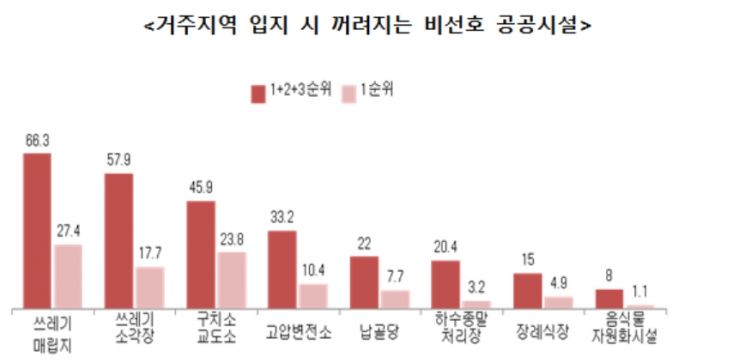
[Asia Economy Reporter Jo In-kyung] Waste transfer stations, incineration plants, and other waste treatment facilities, as well as sewage treatment plants, are recognized as essential in our daily lives, but they are the most undesirable facilities to be located within residential areas. Funeral homes and columbaria also showed low necessity and preference.
According to a survey conducted by the Seoul Metropolitan Government from the 9th to the 15th of last month targeting 1,000 adult men and women aged 18 and over residing in Seoul, the facilities most avoided when located within residential areas were 'landfills (66.3%)', 'waste incineration plants (57.9%)', and 'detention centers/prisons (45.9%)', in that order.
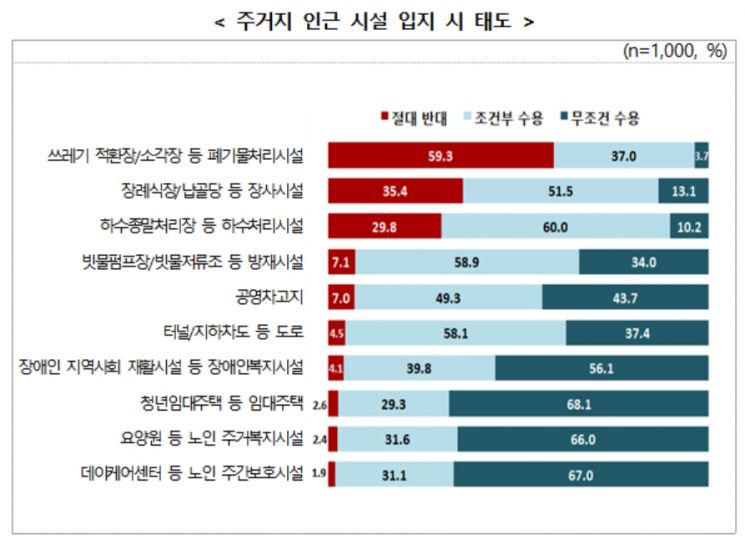
In particular, waste transfer stations and incineration plants were the only facility category among ten surveyed where the majority (59.3%) stated they would "absolutely oppose under any conditions." Conversely, facilities where more than half of respondents said they would "unconditionally accept" included public rental housing, elderly day care centers, elderly residential welfare facilities, and welfare facilities for the disabled.
The most important consideration when deciding the location of undesirable facilities was "collecting residents' opinions (45.8%)," with the preferred methods for gathering these opinions being "resident public hearings (36.2%)" and "providing information and deliberation/discussion (34.3%)."
The biggest cause of conflict when selecting locations for undesirable facilities was "increased demands from residents regarding environment, safety, and health (21.1%)." Other causes included "lack of discussion on emotional harm such as facility aversion (18.0%)," "unilateral government (local government) promotion (17.1%)," "difficulty in finding compromise points with opposition groups (14.9%)," and "insufficient systems and procedures for conflict resolution (14.8%)," showing a relatively diverse range of factors.
The relatively small variation in response rates among conflict causes suggests that multiple conflict factors significantly influence the site selection process.
Regarding providing incentives as compensation to residents in areas where undesirable facilities are located, 82.1% supported this, overwhelmingly higher than the 5.8% who opposed it. The most favored type of incentive for residents was "economic benefits to individual residents such as utility bill deductions" at 49.2%.
The most effective measure to increase local residents' acceptance of undesirable facilities was "establishing compensation plans according to the type of damage (33%)." As for the preferred methods to ensure local residents' participation in the facility location selection, the top responses were "providing opinions related to compensation (22.9%)," "participation in public hearings and explanatory meetings (21.9%)," "monitoring the management status after facility establishment (18.4%)," and "forming decision-making consultative bodies (18.3%)," with most options receiving similar response rates around 20%.
This survey also included perceptions regarding public deliberation on undesirable facility locations. When calculating the average score out of 7 points for the necessity of reflecting opinions from different participants during public deliberation, "residents of the relevant area" scored highest at 6.42 points, followed by "experts in related fields (5.97 points)" and "officials from related departments (5.07 points)." "Seoul citizens outside the relevant area" scored lowest at 3.96 points.
Regarding the importance of conflict issues to be addressed during the public deliberation process, "verification of facility safety and harmfulness" scored highest at 6.45 points, followed by "level of damage to living and natural environments (6.30 points)," "verification of appropriateness of the site selection process (6.27 points)," and "level of compensation for economic losses (6.12 points)," indicating a high perception of importance across all items.
Meanwhile, when asked if they would be willing to participate in collecting residents' opinions regarding the location of undesirable facilities within their residential area, 9 out of 10 Seoul citizens responded affirmatively.
This survey was conducted by a professional research institution to understand the overall perception of citizens regarding undesirable facilities, to review directions for conflict management, and to provide basic data for establishing response measures. The sampling error is ±3.1%p with a 95% confidence interval.
Hong Soo-jung, Conflict Coordination Officer at Seoul City, explained, "Public facilities such as waste treatment plants, which are highly necessary but have low preference, showed a very high likelihood of intensified conflicts during the site selection process. The reasons for disfavor varied by facility type. These survey results can be used as basic data to predict conflict levels and patterns and to prepare response measures from the planning stage of undesirable facilities."
© The Asia Business Daily(www.asiae.co.kr). All rights reserved.


















