[Asia Economy Reporter Yang Nak-gyu] The Ministry of National Defense is facing a dilemma over the replacement plan for the UH-60 Black Hawk utility helicopter. The Ministry of Trade, Industry and Energy insists that it should be replaced with the Korean utility helicopter Surion, but some argue that performance upgrades are also possible.
On the afternoon of the 8th, Defense Minister Jeong Kyeong-doo and Minister of Trade, Industry and Energy Sung Yun-mo co-chaired the '6th Defense Industry Development Council' at the Ministry of National Defense's main conference room in Yongsan-gu, Seoul. The council is an intergovernmental consultative body established to discover and promote related policies such as government-wide defense export support measures, localization of core materials, parts, and equipment for weapon systems, transfer of defense technology to the civilian sector, and transfer of civilian technology to defense. This was the second meeting since the Moon Jae-in administration launched the Defense Industry Promotion Meeting in September 2018, and it was convened to discuss export support measures ahead of the enforcement of the 'Defense Industry Development and Support Act' scheduled for February next year.
The agenda included four items: ▲ Development plans for the Defense Industry Development Council ▲ Activation plans for the Defense Material Trade Support Center ▲ Development plans for localization of defense parts ▲ Industrial ripple effects of the military helicopter performance upgrade project.
The Ministry of Trade, Industry and Energy presented the expected industrial ripple effects if the UH-60 helicopter performance upgrade project is replaced with a domestic model, and the Ministry of National Defense decided to establish a mid- to long-term development plan for medium utility helicopter forces by referring to the final research results from the Korea Institute for Industrial Economics and Trade.
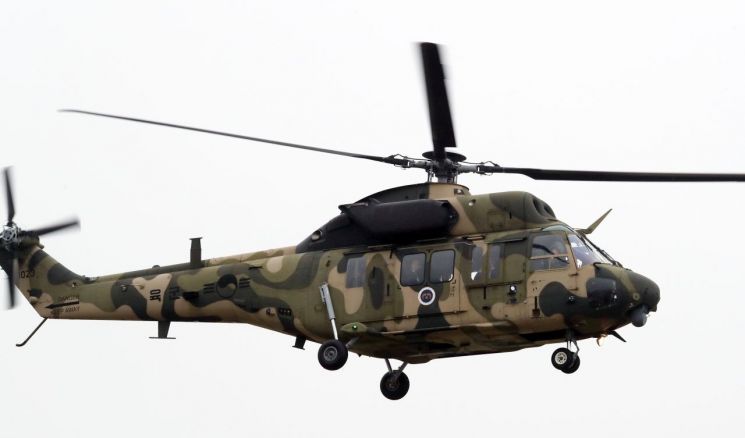
The military must decide whether to replace the currently used UH-60 Black Hawk utility helicopter with the Korean utility helicopter Surion or extend its lifespan through performance upgrades. The UH-60 is a model produced under license domestically by Korean Air in the 1990s and is used for various purposes such as small personnel transport and command. The military currently operates about 140 UH-60s.
Korea Aerospace Industries (KAI), which produces the Surion, explains that if the UH-60 is replaced with the Surion, existing Surion-related facilities can be utilized, and maintenance costs can be reduced by operating a single model. Internally, the military counters claims that the Surion has limited passenger capacity and hoisting capability compared to the UH-60 by stating that squad personnel have been reduced from 11 to 9 according to defense reform, so it can sufficiently carry out operations. They also foresee that increasing the cargo hoisting capacity from the current 6,000 pounds to 7,000 pounds will adequately replace the UH-60's missions.
In particular, compared to the UH-60, the Surion is equipped with ballistic protection, navigation capabilities, various survival equipment, and an autopilot flight device, making its operational capability and survivability much superior. KAI claims that producing the Surion would generate an industrial ripple effect of 5.6 trillion won domestically and create 18,000 jobs.
Korean Air, which is promoting the performance upgrade of the UH-60, argues that a budget of 2 trillion won is sufficient based on U.S. military specifications. Korean Air explains that the UH-60 is an excellent helicopter sold in about 4,000 units across 32 countries including the U.S., and the U.S. Army is also upgrading about 700 units to operate them for more than 30 years in the future. Korean Air, having experience in licensed production of the UH-60, expresses confidence in the performance upgrade. Korean Air explains that the UH-60 can carry 11 fully equipped soldiers, which is more than one infantry squad, and can simultaneously transport one 105mm howitzer and 30 rounds of ammunition, making it an optimized helicopter for operations on the Korean Peninsula.
© The Asia Business Daily(www.asiae.co.kr). All rights reserved.