June Court Auction Market Shows Reversal in Seoul and Non-Seoul Areas within the Capital Region
Bid-to-Price Ratio Falls in Gyeonggi and Incheon but Rises in Seoul
Apartment in Osong-eup, Cheongju with Highest Number of Bidders...78 Participants
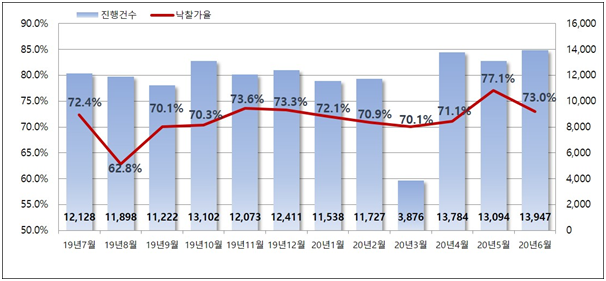
[Asia Economy Reporter Onyu Lim] The Seoul court auction market is heating up as the winning bid rate continues to rise. Analysts say that the strengthened regulations in the metropolitan area through the June 17 real estate measures have created a "straw effect," concentrating buying demand in Seoul.
According to the auction trend report released by Gigi Auction on the 8th, the number of nationwide auctions conducted in June was 13,947, of which 5,087 were successful, recording a winning bid rate of 36.5%. The winning bid ratio (the ratio of the winning bid to the appraised value) was recorded at 73.0%. The average number of bidders was 4.3.
The winning bid rate, which indicates the market absorption capacity, rose by 0.8 percentage points nationwide compared to the previous month, continuing its upward trend for two consecutive months, while the winning bid ratio, which reflects the market's evaluation of real estate value, fell by 4.1 percentage points compared to the previous month.
In the case of residential facility auctions, the atmosphere reversed depending on whether it was Seoul or non-Seoul areas within the metropolitan area. Incheon, which had been driving the upward trend in the metropolitan area until recently, saw its winning bid rate (44.8%) and winning bid ratio (89.3%) decrease by 0.4 and 2.7 percentage points respectively compared to the previous month, and Gyeonggi's winning bid rate (45.8%) also fell by 4.8 percentage points compared to the previous month, showing signs of stagnation. In contrast, Seoul's winning bid rate rose by 2.2 percentage points to 41.2%, and the winning bid ratio increased by 2.2 percentage points to 97.3%. Last month, Seoul's winning bid ratio ranked first nationwide for the first time in seven months since November last year (98.3%).
In office and commercial facility auctions, Seoul's winning bid rate was 30.0%, up 11.0 percentage points from the previous month, surpassing the 30% mark for the first time in eight months since October last year (30.9%), showing active performance. On the other hand, Incheon and Gyeonggi showed sluggishness as both winning bid rates and winning bid ratios fell by around 5 percentage points compared to the previous month.
Researcher Myungwon Oh of Gigi Auction analyzed, "It seems that the government’s expansion of regulated areas to prevent the balloon effect spreading to the metropolitan area caused a 'straw effect' that attracted investment into Seoul," adding, "Due to the same regulations, investors tend to place Seoul at a comparative advantage."
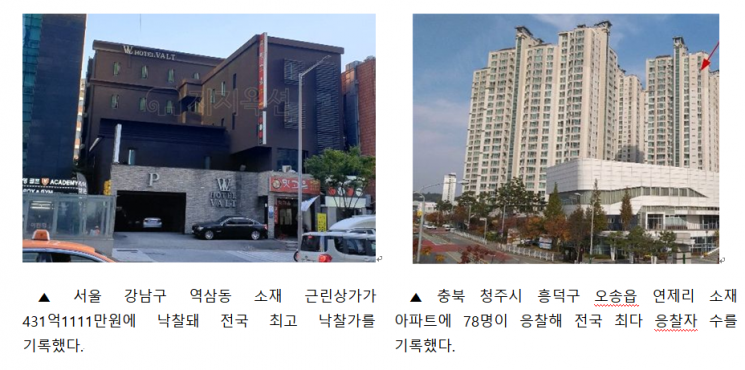
Meanwhile, the highest winning bid item last month was a neighborhood facility with an area of 2,613㎡ located in Yeoksam-dong, Gangnam-gu, Seoul. It was sold at 43.11111 billion KRW, which is 114% of the appraised value (37.8903 billion KRW). Currently, a hotel, restaurants, and a billiard hall operate there.
The item with the highest number of bidders was an 85㎡ apartment located in Yeonje-ri, Osong-eup, Heungdeok-gu, Cheongju-si, Chungbuk. A total of 78 people participated in the bidding, and it was sold at 301.59 million KRW, which is 120% of the appraised value (251 million KRW). It is a complex of 400 households in four buildings completed in November 2010, surrounded by apartment complexes and a national industrial complex. Additionally, near Osong Station, the station area urban development project and the Osong 2nd Life Science General Industrial Complex construction project are underway.
Researcher Oh analyzed, "The announcement of various investment projects including the synchrotron radiation accelerator project, abundant jobs, and a pleasant living environment seem to be the reasons for its popularity."
© The Asia Business Daily(www.asiae.co.kr). All rights reserved.
![Clutching a Stolen Dior Bag, Saying "I Hate Being Poor but Real"... The Grotesque Con of a "Human Knockoff" [Slate]](https://cwcontent.asiae.co.kr/asiaresize/183/2026021902243444107_1771435474.jpg)

















