Democratic Party "Readjustment of the Role of the Korea-US Working Group"
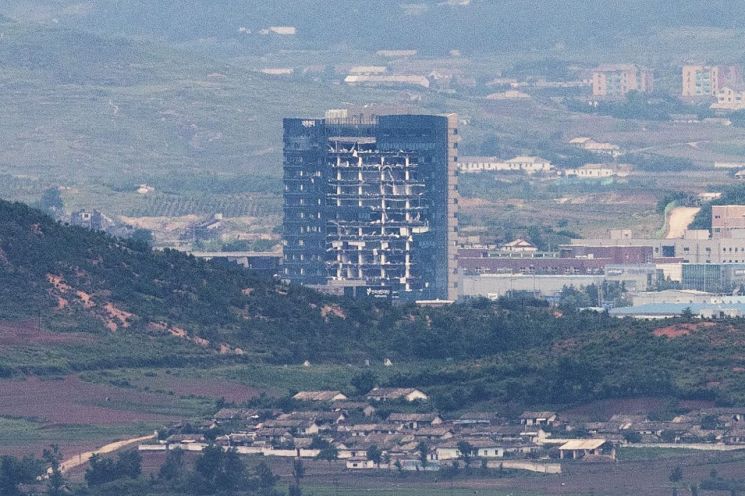 On the 1st, the Industrial Complex Support Center at the Kaesong Industrial Complex, viewed from the border area in Paju, Gyeonggi Province, remains damaged and abandoned following the demolition of North Korea's liaison office.
 Steven Biegun, U.S. Deputy Secretary of State and Special Representative for North Korea, began his official activities after arriving in South Korea on the 8th. The ruling party argued that the role of the Korea-U.S. Working Group should be readjusted and that individual tours to Kaesong should be initiated to improve inter-Korean relations.
Kim Tae-nyeon, floor leader of the Democratic Party of Korea, said at the Supreme Council meeting that day, "It is time to review the readjustment of the roles and functions of the Korea-U.S. Working Group," adding, "It should act as a catalyst, not as a suppressor of inter-Korean exchanges." He also requested Deputy Secretary Biegun to "actively engage in bold discussions to unlock the shackles of inter-Korean relations trapped within the framework of sanctions and open the path for dialogue and cooperation."
Supreme Council member Seol Hoon advocated for the resumption of 'individual tours to North Korea.' He stated, "The most urgent and creative solution for improving inter-Korean relations is individual tours to North Korea," and added, "If both Koreas have the will, it can be implemented immediately, so I propose starting with tours to Kaesong." Seol emphasized, "Individual tours are not subject to UN sanctions, and Kaesong has already been implemented in 2007, so related facilities are in place," and stressed, "Starting with this, we should gradually expand to tours to Mount Kumgang and the resumption of the Kaesong Industrial Complex."
This ruling party stance, coinciding with Deputy Secretary Biegun's visit, is interpreted as a request to the U.S. side to open an independent space for inter-Korean relations. With the Korea-U.S. denuclearization talks at a deadlock and the Korean Peninsula peace process stalled, the government has declared its intention to establish independent inter-Korean relations this year to revive momentum. The Ministry of Unification included measures such as individual tours to North Korea in its '2020 Major Work Plan.'
Lee In-young, the nominee for Minister of Unification, has also expressed the view that inter-Korean relations should not be hindered by the 'Korea-U.S. Working Group.' On the 6th, he said, "My usual view is that we need to distinguish between what we can do through the Korea-U.S. Working Group and what we can decide and do on our own," emphasizing the need for a 'creative solution' regarding North Korea sanctions. This means that issues subject to North Korea sanctions should be resolved through the Korea-U.S. Working Group, but inter-Korean matters not violating sanctions, such as individual tours, should be pursued autonomously and independently.
Meanwhile, North Korea unilaterally blew up the inter-Korean joint liaison office in Kaesong on the 16th of last month. The next day, a spokesperson for the General Staff of the Korean People's Army announced and warned of military measures including ▲ deployment of military units to the Mount Kumgang tourist zone and Kaesong Industrial Complex ▲ redeployment of guard posts (GP) in the Demilitarized Zone from which troops had withdrawn ▲ resumption of military exercises in the West Sea ▲ and military support for leaflet (pamphlet) distribution to South Korea. However, these measures have been 'put on hold' following instructions from North Korean State Affairs Commission Chairman Kim Jong-un on the 26th.
© The Asia Business Daily(www.asiae.co.kr). All rights reserved.

















