Seoul City and Corporation Establish Emergency Transport Countermeasures Headquarters... Implementing Step-by-Step Measures
Minimizing Citizen Inconvenience by Deploying Essential Maintenance Personnel and Non-Union Members
[Asia Economy Reporter Jo In-kyung] The Seoul Metropolitan Government announced that due to the labor union of the Seoul Metro 9 Line Operation Division (Seoul Metro 9 Line Branch), which operates the Seoul Subway Line 9 Phase 2 and 3 section (Eonju~Jungang Veterans Hospital), announcing a strike starting from the 10th, an emergency transportation plan will be implemented from the 8th.
Currently, the Seoul Metro 9 Line Operation Division operates 85 trains, which is 19% of the 445 weekday train runs.
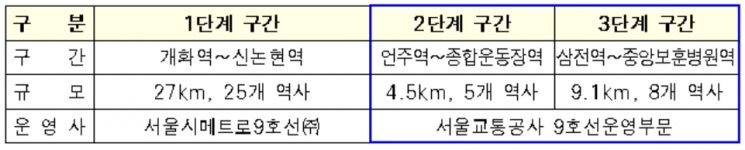
The union's planned strike period is three days starting from the 10th, and the Seoul Metro 9 Line Operation Division plans to operate trains with essential personnel such as drivers (72%) plus non-union members and non-striking employees to minimize inconvenience to citizens.
Accordingly, Line 9 will operate as usual from 5:30 AM to midnight, maintaining the same train intervals.
From the 10th, when the strike begins, the Seoul Metropolitan Government and Seoul Metro plan to assign two staff members each at 13 major congested stations to monitor the normal operation on-site.
Seoul Metro also plans to implement the first-stage transportation measures if the operation rate is between 90% and 99% due to a prolonged strike. They will deploy 26 reserve buses on 24 city bus routes passing through Line 9 and operate 36 shortened buses at normal frequency. Additionally, three Daramswi Bus routes (8331, 8551, 8761) will extend their operating hours by one hour compared to usual.
The city bus routes receiving reserve buses include those passing through major Line 9 stations such as Gayang, Deungchon, Yeomchang, Dangsan, National Assembly, Yeouido, Noryangjin, Express Bus Terminal, and Sinnonhyeon.
If the operation rate falls below 90%, second-stage transportation measures will be implemented. This includes deploying 57 reserve buses on 46 city bus routes, operating 63 shortened buses at normal frequency, extending Daramswi Bus operating hours as in the first stage, and increasing taxi supply by lifting taxi restrictions.
In the second stage, four charter bus routes will additionally operate during the morning rush hours (7 AM to 9 AM). With a 5-minute interval, Gayang→Dangsan and Yeomchang→Yeouido will run 24 one-way trips, Gaehwa→Yeouido 18 one-way trips, and National Assembly↔Jungang Veterans Hospital will operate 18 round trips at 10-minute intervals.
Hwang Bo-yeon, Director of Urban Transportation at the Seoul Metropolitan Government, said, "While we are trying to reduce subway congestion in response to the spread of COVID-19, there is concern that congestion may increase again due to the strike," but added, "Even if the strike proceeds, we will do our utmost to implement emergency transportation measures to minimize inconvenience to citizens."
© The Asia Business Daily(www.asiae.co.kr). All rights reserved.
![Clutching a Stolen Dior Bag, Saying "I Hate Being Poor but Real"... The Grotesque Con of a "Human Knockoff" [Slate]](https://cwcontent.asiae.co.kr/asiaresize/183/2026021902243444107_1771435474.jpg)











