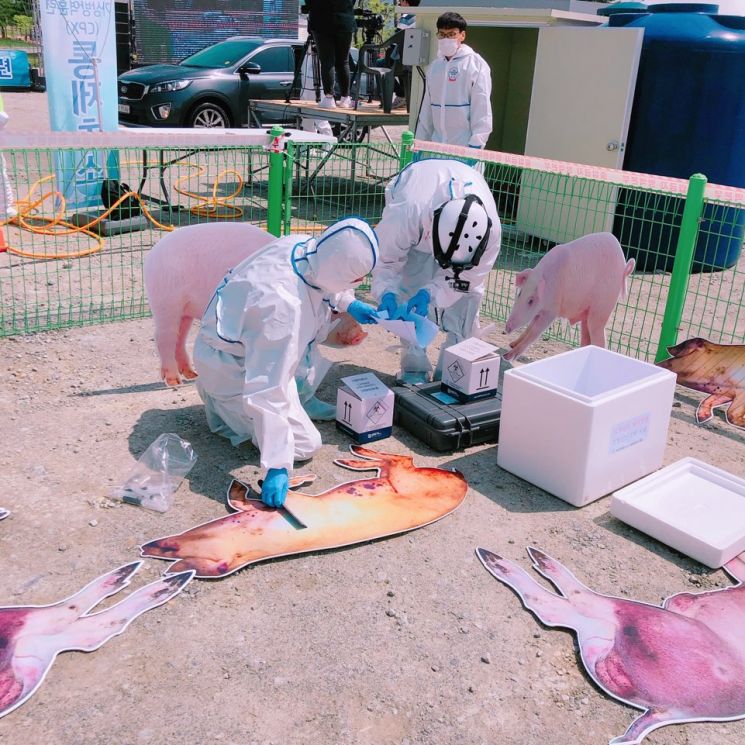
 The Ministry of Agriculture, Food and Rural Affairs is conducting a virtual quarantine drill to respond to African Swine Fever (ASF). To take proactive measures, the total number of pigs culled (including those purchased) so far has reached 446,520.
[Sejong=Asia Economy Reporter Kim Hyun-jung] To respond to the globally spreading African Swine Fever (ASF), the government is implementing farm-level quarantine measures during the summer season, tightening vigilance. The plan is to carry out preventive culling and emergency purchase, and to mobilize special equipment such as helicopters to fully prevent early-stage spread of the outbreak.
According to the Ministry of Agriculture, Food and Rural Affairs on the 7th, the number of ASF-positive wild boars increased from 83 cases in January to 143 in February and 189 in March, then decreased to 115 in April, 46 in May, and 24 in June. ASF, which has a mortality rate of about 100%, was first detected domestically on September 16 last year, and is currently considered to be in the early containment stage due to the proactive response of the responsible ministry. To date, the scale of culling (including purchase) conducted as a preemptive measure has reached 446,520 heads. Notably, within 23 days of the domestic outbreak, the spread to regions outside the northern Gyeonggi area was successfully blocked.
◆Deploying helicopters and drones... mobilizing all available resources= However, the ASF Central Accident Response Headquarters (CARH) is concerned that although the number of positive cases is decreasing, the active period of wild boars born during the spring birthing season is approaching, and the virus may spread through border area rivers due to heavy rains during the monsoon season. In particular, from mid-June, transmission among wild boars due to group living and environmental contamination has led to confirmed infections in young wild boars (Yeoncheon, 1-month-old, 7 heads).
CARH is mobilizing 1,000 disinfection vehicles daily to conduct focused disinfection from the areas where ASF-positive wild boars were found, including vehicle and human movement routes and farm entrances, targeting virus detection sites and movement paths. Among 655 locations where ASF-positive wild boars were found and where virus residue is highly likely, 97 sites are being disinfected using vehicles, and 558 sites where vehicle access is difficult are being disinfected by personnel.
Additionally, in areas where approximately 13,000 people owning farmland live near 20 towns and townships where ASF-positive wild boars were found, about 400 disinfection vehicles are deployed daily to focus on village roads and other areas. In civilian control zones (DMS) where personnel access is difficult, helicopters and drones are deployed, mobilizing all available resources for disinfection operations.
◆Focusing on minimizing farm damage= CARH is also focusing on supporting affected farms. First, compensation for culling has been promptly secured, with 72.1 billion KRW disbursed from 2019 through April this year. To stabilize the management of culled farms, livelihood stabilization funds have been converted into a fund, with 1.3 billion KRW disbursed. In November last year, using prior consulting from the Board of Audit and Inspection, reasonable compensation payment standards for ASF-affected farms were established. For farms culled before the revision of the notification, the revised payment standards have been applied retroactively to allow compensation under the new criteria.
During this process, CARH has held frequent meetings chaired by the Prime Minister and Minister Kim Hyun-soo of the Ministry of Agriculture, Food and Rural Affairs, and improved quarantine measures through daily situation meetings. So far, 11 meetings of the Livestock Quarantine Deliberation Committee, 6 field briefings, 17 expert meetings, and 10 visits by vice ministers and the Prime Minister have been conducted. They have also selected areas that can be practically implemented on-site, such as distributing biosecurity guidelines to pig farms and promoting awareness among foreign workers engaged in pig farming, for focused management.
To enable farm owners and managers to self-check compliance with quarantine rules, a 'mobile self-inspection web' will be piloted this month targeting pig farms in northern Gyeonggi and Gangwon provinces.
Furthermore, in collaboration with related ministries such as the Ministry of Environment, Ministry of National Defense, Korea Forest Service, and the National Agricultural Cooperative Federation, various quarantine measures are being implemented, including installing fences in border areas and searching and capturing wild boars.
Park Byung-hong, Director of the Food Industry Policy Office at the Ministry of Agriculture, Food and Rural Affairs, urged, "Since voluntary biosecurity efforts by pig farms are essential to prevent the recurrence of ASF in farmed pigs, we ask farms to take responsibility with the mindset that 'the last stronghold against the virus is each individual farm,' and to pay special attention to improving quarantine facilities and complying with biosecurity rules."
© The Asia Business Daily(www.asiae.co.kr). All rights reserved.

















