Financial Authorities "Under Multifaceted Review"
Significant Concerns Over Potential Side Effects
"Simultaneous Safety Measures Needed"
Many Listings but M&A Stalled
[Asia Economy Reporters Kim Hyo-jin and Kim Min-young] As calls from the savings bank industry for deregulation of mergers and acquisitions (M&A) grow louder, financial authorities are showing signs of deepening deliberation over the scope, content, and timing of such deregulation. This is due to the need for 'traffic control' within the market caused by the polarization of savings banks and the subsequent restructuring of small and low-income financial functions, as well as the necessity to consider the potential side effects similar to past savings bank bankruptcy incidents.
According to financial authorities on the 7th, the Financial Services Commission is currently reviewing various partial deregulation measures regarding savings bank M&A. A Financial Services Commission official stated, "We are carefully examining the matter while listening to the opinions of relevant experts," adding, "We are contemplating ways to revitalize the market while minimizing risk factors."
Currently, a single major shareholder cannot own three or more savings banks, and only up to two savings banks operating in different business areas can be managed. Merging acquired savings banks is also prohibited. These stringent regulations have been maintained since the large-scale bankruptcy crisis in 2011.
It was initially expected that the deregulation plan for savings bank M&A would be prepared within the first half of this year. A Financial Services Commission official explained, "It seems that more time is needed to review the detailed matters," adding, "We are actively considering it within the broad framework of deregulation."
The Financial Services Commission is reportedly considering not only preparing a separate deregulation plan for M&A but also announcing a comprehensive reform plan for the overall supervision regulations of savings banks, including M&A deregulation. This could result in a much longer time frame than initially expected.
The savings bank industry has consistently demanded the need to normalize and revitalize functions through active M&A due to the deteriorating business conditions of some small savings banks and the resulting contraction of savings bank functions. Especially amid the advancing trend of digital financial innovation, there is growing concern both inside and outside the industry that if some savings banks fail to survive, the damage will directly affect low-income people.
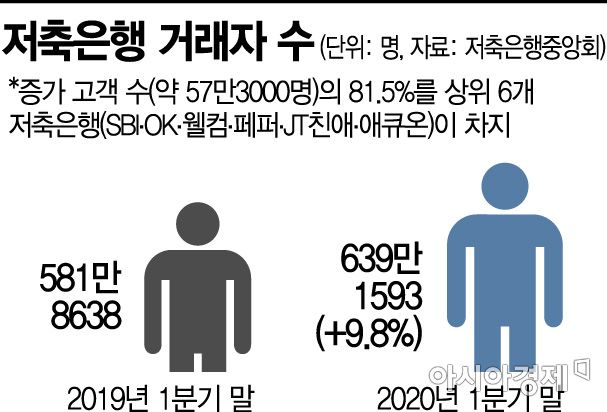
These concerns are surfacing as polarization within the industry. According to the Korea Federation of Savings Banks, the number of savings bank customers in the first quarter of this year was about 6.4 million, nearly 10% higher than the same period last year. Of these, more than 80% of customers concentrated in six major large savings banks: SBI, JT Chinhae, OK, Welcome, Pepper, and Accuon.
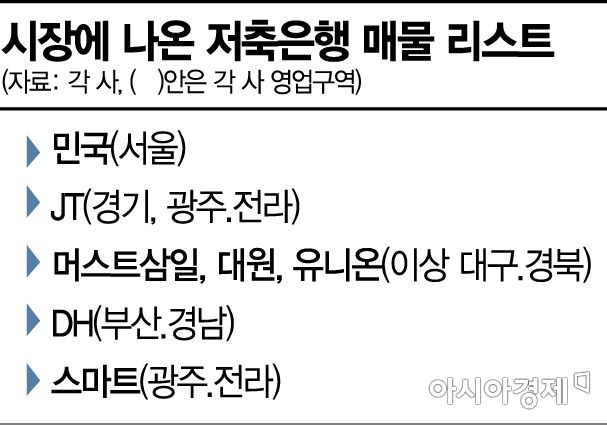
The demand for M&A is already at a considerably high level. Minguk, JT, Must Samil, Daewon, Union, DH, and Smart Savings Bank are currently on the market. In the case of Minguk Savings Bank, Mugunghwa Trust completed due diligence last year and was in the final stages of sale, but the process is now halted. It is reported that Mugunghwa Trust is reluctant to purchase due to stringent major shareholder eligibility criteria and other difficulties.
Japanese financial holding company J Trust Group has recently been putting effort into selling JT Savings Bank, which is considered a 'prime asset,' by selecting the law firm Kim & Chang as an advisor, but no interested buyers have yet emerged.
In this way, after savings banks express their intention to sell, some private equity funds or trust companies approach but ultimately fail, or the banks remain unsold without finding a buyer, a phenomenon repeatedly occurring in the industry. An industry insider explained, "This is a result of the prohibition on M&A between savings banks, making it difficult to find suitable major shareholders."
A financial sector official said, "Financial authorities are facing significant challenges," adding, "It is easy to ease regulations, but if problems arise afterward, it is very difficult to correct them." The official also noted, "Even if regulations are relaxed, corresponding safety measures must accompany them," and added, "This is probably why regulatory reform requires a long time."
© The Asia Business Daily(www.asiae.co.kr). All rights reserved.


















