Bank of Korea 'May 2020 Balance of Payments (Preliminary)'
[Asia Economy Reporter Kim Eun-byeol] The current account, which had recorded a deficit due to the shock of the novel coronavirus infection (COVID-19), turned to a surplus again after one month. However, the surplus amount decreased by more than half compared to the same month last year.
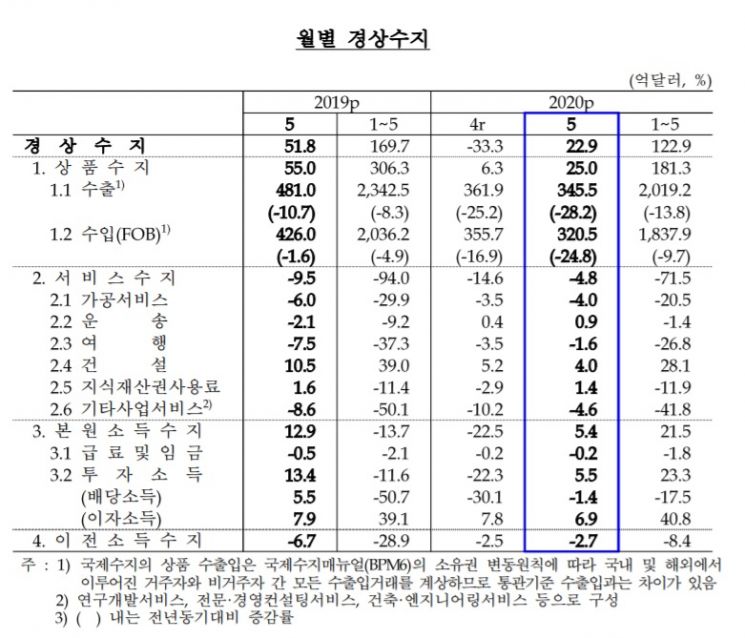
According to the "Preliminary Balance of Payments for May 2020" announced by the Bank of Korea on the 7th, the current account recorded a surplus of $2.29 billion in May, turning positive compared to April (-$3.33 billion). However, the surplus size was less than half of May last year ($5.18 billion). In April, the current account recorded a deficit due to exports taking a direct hit and the overlapping dividend payments to foreign investors.
Although the surplus turned positive as seasonal factors disappeared, the impact of COVID-19 on exports remains. Globally, as lockdowns are gradually lifted, the goods balance has improved, but it is still at a sharply reduced level compared to last year. The goods balance surplus, which is the difference between goods exports and imports, was $2.5 billion, up from April ($630 million) but about half compared to May last year.
Exports were $34.55 billion, down 28.2% year-on-year, and imports ($32.05 billion surplus) decreased by 24.8%. Both have been declining year-on-year for three consecutive months. Moon So-sang, head of the Bank of Korea’s Financial Statistics Department, explained, "The contraction in global trade volume and the decline in quantity and unit prices of major export items such as automobiles are the causes."
However, the cumulative current account surplus as of May was $12.29 billion, and it is expected to comfortably achieve the first half forecast ($17 billion). Moon said, "It is difficult to predict the trend as risks such as low oil prices and US-China trade conflicts coexist while COVID-19 has not subsided," but added, "Looking at the customs clearance figures for June, exports to China have turned to an increase and the surplus margin has expanded, suggesting that it is following the initially expected path."
 Munsosang, Head of the Financial Statistics Department at the Economic Statistics Bureau of the Bank of Korea, is presenting at the briefing on the preliminary balance of international payments for May 2020, held on the morning of the 7th at the Bank of Korea in Jung-gu, Seoul.
Meanwhile, the service account deficit decreased from $950 million in May last year to $480 million this May. Although air passenger transport decreased, freight rates rose, turning the transport balance ($90 million) into a surplus with an increase of $300 million over the year. Due to the sharp decline in overseas travelers, the travel balance recorded a deficit of $160 million, marking the largest deficit in 66 months since November 2014. The net financial account, which indicates capital inflows and outflows, increased by $3.24 billion. As major countries’ stock markets rose, domestic investors’ overseas stock investments increased for 51 consecutive months, and the decrease in foreign investors’ domestic stock investments narrowed.
Among other investments, assets decreased by $11.25 billion, marking the largest decline ever. As global volatility eased, margin call funds related to overseas derivatives were withdrawn.
© The Asia Business Daily(www.asiae.co.kr). All rights reserved.


















