27 Confirmed COVID-19 Cases Related to Uijeongbu Apartments
Jung Eun-kyung: "Likely High Replication and Transmission Power"
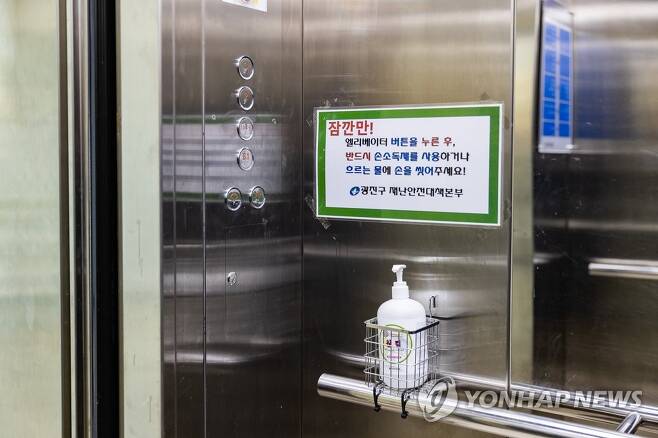 Seoul Gwangjin-gu announced that it conducted a full survey of elevators installed in local multi-family housing (APTs, multi-unit houses, etc.), multi-household buildings, mixed-use residential and commercial buildings, and office buildings last March, and placed hand sanitizers in about 4,000 elevators. Photo by Yonhap News
[Asia Economy Reporter Kim Suwan] Recently, a case of mass infection among residents occurred in an apartment in Uijeongbu, Gyeonggi Province, raising concerns that the novel coronavirus (COVID-19) in South Korea might be spreading in daily life settings such as apartments, gyms, and golf courses. Amid this, an analysis suggests that a variant virus known to be six times more transmissible than before could become a link in mass infections.
According to the Central Disease Control Headquarters (CDCH) on the 7th, in Uijeongbu, Gyeonggi Province, a cluster infection occurred centered around Jangam Jugong Apartment and a gym visited by residents of this apartment, resulting in 27 confirmed cases (9 from the apartment and 18 from the gym).
Previously, since the residents' movements outside the apartment rarely overlapped and they had no contact with each other, the elevator, a shared space, was pointed out as a likely infection route.
However, the investigation by health authorities did not detect the virus, so the elevator was not confirmed as a definite infection route.
Experts warned that droplets from infected individuals on elevator buttons and other surfaces could pose a risk of spreading COVID-19, as the virus can survive on surfaces for several days.
Therefore, it is explained that even without direct contact with an infected person, one can be exposed to infection risk in daily life.
Outdoor activities also cannot be considered safe. At a golf course in Gwangju, Gyeonggi Province, two acquaintances who played golf with confirmed patients related to the Uijeongbu apartment last month were also confirmed positive.
Although health authorities did not conclude that transmission occurred during the golf round, it is presumed that close contact happened during shared meals and transportation.
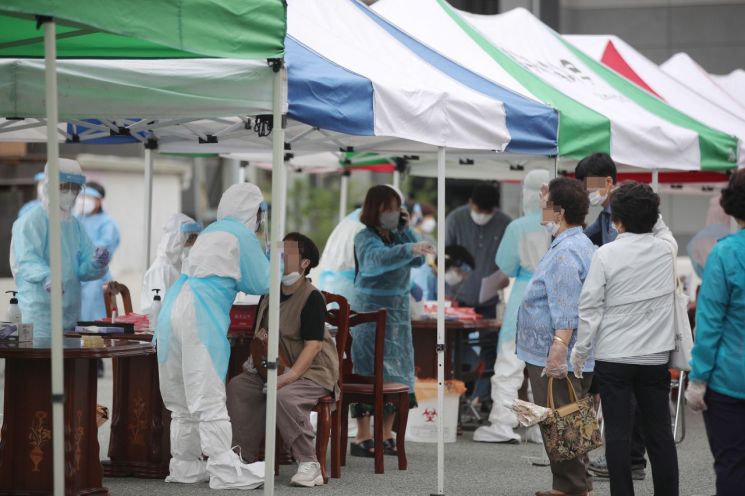 On the morning of the 4th, church members are receiving tests for the novel coronavirus (COVID-19) at a screening clinic set up in the parking lot of Ilgok Central Church in Buk-gu, Gwangju. Among approximately 800 attendees at the church service on the 27th and 28th of last month, five were confirmed positive for COVID-19.
 /Photo by Yonhap News
This golf course infection case confirmed that any space where contact with infected persons occurs cannot be considered safe, even if it is not an enclosed space.
As small-scale cluster infections continue in various daily life settings, infectious disease experts cited the change in the virus type currently prevalent in South Korea as a reason.
The World Health Organization (WHO) classifies the COVID-19 virus into seven types?S, V, L, G, GH, GR, and others?based on amino acid changes caused by differences in genetic sequences.
Recent research by American scientists showed that the variant GH group virus spreads up to six times faster.
According to the CDCH, genetic analysis of 526 virus samples detected in South Korea showed that the GH group accounted for the largest portion with 333 cases (63.3%), followed by the V group with 127 cases, S group with 33 cases, GR group with 19 cases, G group with 10 cases, and others with 4 cases.
In particular, the GH group virus was detected in recent cluster infection cases in the metropolitan area and Gwangju and Daejeon, including the Itaewon clubs, the Seoul door-to-door sales company 'Richway,' Gwangju Gwangneuksa Temple, and a door-to-door sales company in Daejeon.
This type is known to have higher transmissibility than the S group virus detected in confirmed cases among Chinese evacuees from Wuhan, Hubei Province, from January to March, and the V group virus that led the Shincheonji Church cluster infection in Daegu.
Jung Eun-kyung, head of the Central Disease Control Headquarters, said at a briefing the day before, "Recently, including South Korea, the GH group virus is mainly spreading worldwide," adding, "The GH group virus is presumed to have higher transmissibility because the mutation in the S gene allows it to proliferate better in cells and bind well to human cell infection sites."
© The Asia Business Daily(www.asiae.co.kr). All rights reserved.
![Clutching a Stolen Dior Bag, Saying "I Hate Being Poor but Real"... The Grotesque Con of a "Human Knockoff" [Slate]](https://cwcontent.asiae.co.kr/asiaresize/183/2026021902243444107_1771435474.jpg)












