Briefing on the Results of the 7th Regulatory and Institutional Innovation Hackathon by the 4th Industrial Revolution Committee
[Asia Economy Reporter Seulgina Cho] A pilot project is set to be launched in earnest to enable citizens to use rehabilitation robots and care robots at affordable costs. A lodging business utilizing vacant houses in rural fishing villages will also be promoted. However, discussions surrounding telemedicine are encountering difficulties from the outset. This is because major stakeholders such as the Korean Medical Association and the Ministry of Health and Welfare did not participate in the discussion forum organized by the Presidential Committee on the Fourth Industrial Revolution.
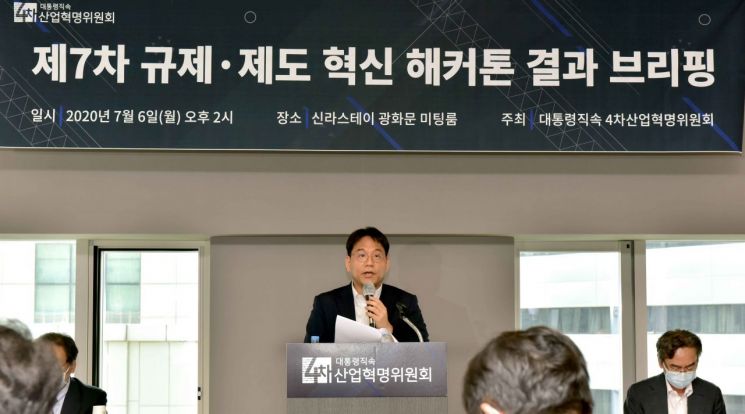
On the afternoon of the 6th, the Fourth Industrial Revolution Committee held a briefing at Shilla Stay Gwanghwamun and announced the results of the '7th Regulation and Institutional Innovation Hackathon,' which included these topics. Previously, about 60 private and government officials attended the hackathon, where key agendas included providing telemedicine services, strengthening medical and welfare services using rehabilitation and care robots, and utilizing vacant houses to revitalize rural fishing villages.
However, the much-anticipated telemedicine service discussion was limited to summarizing future discussion points due to the absence of officials from the Ministry of Health and Welfare and the Korean Medical Association. Yoon Sung-ro, chairman of the Fourth Industrial Revolution Committee, said, "Since this is a very sensitive issue, we have no choice but to approach it step-by-step rather than as a one-time event. Please understand that we have opened the door regarding telemedicine," adding, "We will actively involve stakeholders such as the Korean Medical Association and the Ministry of Health and Welfare in the next hackathon to discuss the topics summarized this time once again."
The Fourth Industrial Revolution Committee categorized four areas where telemedicine is feasible during this hackathon: ▲all fields during pandemic situations such as COVID-19 ▲simple explanations after the initial face-to-face consultation ▲post-management of health checkup results ▲management of chronic disease patients limited to primary medical institutions after the initial face-to-face consultation. Participants shared opinions that it is necessary to share and analyze the results of the existing chronic disease management pilot project and conduct appropriate performance evaluations.
Professor Song Si-young of Yonsei University College of Medicine emphasized, "Before the second wave of COVID-19 or another disease pandemic occurs, a national foundation must be established to apply telemedicine."
The Fourth Industrial Revolution Committee plans to discuss potential problems and countermeasures when introducing telemedicine in these four areas. They will form a study group of experts to supplement detailed plans and hold another hackathon around October with participation from the Korean Medical Association, the Ministry of Health and Welfare, and others. However, considering the Korean Medical Association’s strong opposition to telemedicine, there is a view that they may also abstain from the second hackathon.
Additionally, the Fourth Industrial Revolution Committee will promote a pilot project to popularize treatment using robots amid the surge in demand for non-face-to-face services such as rehabilitation and care robots due to COVID-19. The Ministry of Trade, Industry and Energy and the Ministry of Health and Welfare will also accelerate the establishment of concrete systems such as appropriate insurance fee calculation for rehabilitation robots, classification of robot items, and safety evaluations beyond the pilot project. Chairman Yoon emphasized, "It is meaningful that opportunities have been created for other advanced products that can improve patients’ clinical outcomes to be incorporated into the domestic medical and welfare systems."
Furthermore, the Fourth Industrial Revolution Committee discussed plans to utilize 62,000 vacant houses in rural fishing villages. In the 6th hackathon, the Korean Rural and Fishing Village Lodging Association opposed lodging business models using vacant houses in rural fishing villages, but this time the Ministry of Agriculture, Food and Rural Affairs agreed on the need to revitalize rural fishing villages, and innovative business models utilizing vacant houses are expected to be promoted. The Ministry of Economy and Finance will also participate for in-depth discussions.
© The Asia Business Daily(www.asiae.co.kr). All rights reserved.
![Clutching a Stolen Dior Bag, Saying "I Hate Being Poor but Real"... The Grotesque Con of a "Human Knockoff" [Slate]](https://cwcontent.asiae.co.kr/asiaresize/183/2026021902243444107_1771435474.jpg)
















