Store Facility with Entrance Added Considering Additional Chapter
Surface Narrow and Long Excavated, Stones Cut into Squares Stacked on All Sides
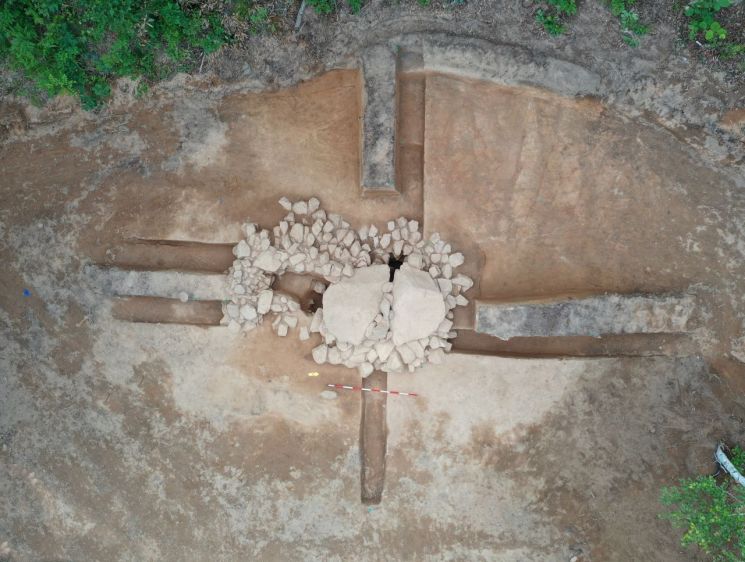 Yangyang Hupomaeri Tumuli Group Silla Apteugi-style Stone Chamber Tomb
[Photo by Cultural Heritage Administration]
A Silla-style front-opening stone chamber tomb (horizontal stone chamber tomb) has been discovered in Hupomaeri, Yangyang, Gangwon Province. It is a burial facility with an entrance prepared considering additional burials. There is a burial passage (mado, a tunnel leading to the tomb), but no coffin passage (a path from the tomb entrance to the chamber where the body is placed).
The Gangwon Archaeological and Cultural Research Institute announced on the 6th that they confirmed this tomb through an excavation at San 32, Hupomaeri, Hyeonnam-myeon, Yangyang-gun, Gangwon Province. The burial mound group is distributed along the ridge near the Hupomaeri Fortress at an altitude of 300 meters and extending southeast from there. Tomb No. 1 was found on a gentle slope at 203 meters above sea level, southeast of Hupomaeri Fortress. It is a medium to small-sized mound with a diameter of about 10 meters. It was severely damaged at the time of discovery. Kim Miran, an official from the Excavation System Division of the Cultural Heritage Administration, said, “The upper part and the east side of the mound appear to have been cut away or affected by the construction of a later civilian grave (minmyo).”
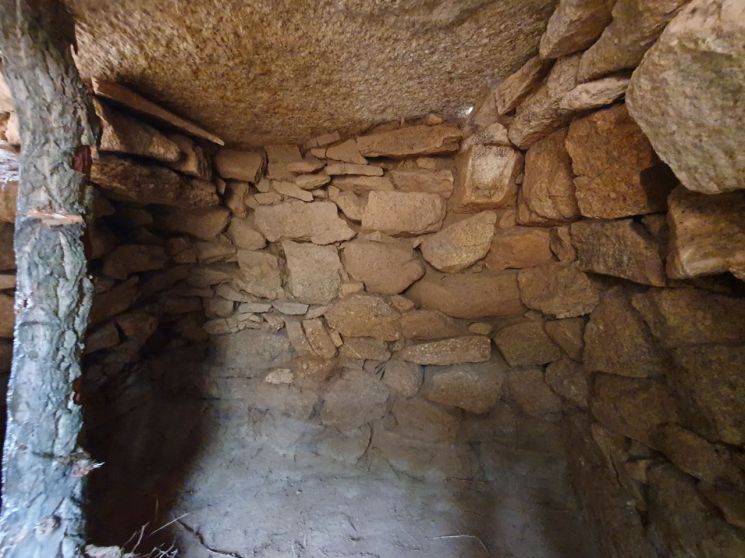 Yangyang Hupomaeri Tumuli Group Silla Apteugi-style Stone Chamber Tomb
 [Photo by Cultural Heritage Administration]
The burial chamber was constructed by digging the hill in an ‘L’ shape. Its dimensions are 3.3 meters in length, 1.86 meters in width, and a remaining height of about 1.52 meters. It is a semi-subterranean type, with a floor plan close to a long rectangle. After digging a narrow and long pit on the surface, squared stones were stacked 9 to 10 layers high on all sides. On top of that, a roof stone measuring 1.8×1.2×0.3 meters was placed. The tomb entrance was blocked by stacking small, uncut stones about 92 cm wide.
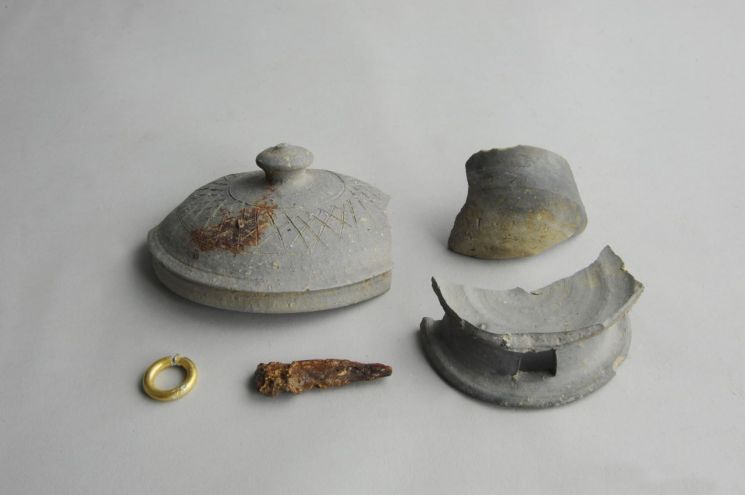 Artifacts discovered in the Silla Apteugi-style stone chamber tombs of the Hupo-maeri Tumuli in Yangyang
 [Photo by Cultural Heritage Administration]
Due to damage such as tomb robbery, only a small number of artifacts were confirmed. These include a 6th-century lid and small cup, gilt-bronze earrings, and an iron knife (cheoldoja, a small knife used for cutting or trimming objects). The Cultural Heritage Administration stated, “Along with Hupomaeri Fortress, this tomb clarifies that Yangyang was a strategic key point in Silla’s northward advance along the East Coast. It is expected to be valuable material for research on Silla’s political situation and burial mound styles.”
© The Asia Business Daily(www.asiae.co.kr). All rights reserved.
![Clutching a Stolen Dior Bag, Saying "I Hate Being Poor but Real"... The Grotesque Con of a "Human Knockoff" [Slate]](https://cwcontent.asiae.co.kr/asiaresize/183/2026021902243444107_1771435474.jpg)


















