'Boiling' 4050 Over 2030 Temporary Fix Prescription
Controversy Over Expansion of Special Supply Quotas for Newlyweds and First-Time Homebuyers
If the Sale Market Shifts to Points-Based System,
Subscription Savings and No-Home Ownership Period May Become Useless
[Asia Economy Reporter Lee Chun-hee] "I trusted the point system and endured, but does this make any sense?"
As the government announced plans to expand the special supply quota for newlyweds and first-time homebuyers, controversy over reverse discrimination is intensifying in the market. The intention is to lower the high apartment subscription threshold to appease young homebuyers, but this effectively deprives those aged 40 and above of subscription opportunities. In particular, since the government introduced a 100% point system in speculative overheated districts, which had made the subscription market centered on the 40s and 50s age group, there is considerable criticism that the policy is undermining the stability of the subscription system by reversing itself, while the effectiveness of the measures is also being questioned.
The expansion of special supply for newlyweds and first-time homebuyers is a measure following President Moon Jae-in’s order on the 2nd to Minister of Land, Infrastructure and Transport Kim Hyun-mi to "devise ways to make it easier for first-time buyers to obtain housing."
Currently, it is nearly impossible for people in their 20s and 30s to win subscriptions in speculative overheated districts such as Seoul. Apartments under 85㎡ (exclusive area) supplied in these districts are allocated 100% by the point system, but the minimum winning point (cutoff) has surged sharply due to the overheated subscription market.
The cutoff for the point system in Seoul is currently formed between the high 50s and low 60s. The maximum points a family of three can get is 64 points if they fulfill the maximum 15 years of no home ownership and 15 years of subscription account membership, barely securing a winning position. Due to the structure of the point system, only those in their 40s can realistically aim for subscriptions.
Although the government has continuously increased the special supply for newlyweds, which people in their 20s and 30s can target, it still accounts for only 20% of private housing. There is an analysis that frustrated people in their 30s are becoming so-called 'Cheongpojok' (subscription quitters). These individuals are actively purchasing homes, driving up housing prices. According to the Korea Real Estate Agency on the 6th, among the total 37,192 apartment sales transactions in Seoul up to May this year, those purchased by people in their 30s accounted for 11,414 (30.7%), the highest proportion.
'Making it easier for first-time buyers... but reverse discrimination against 40s and 50s, and doubts about effectiveness for 20s and 30s'
Since President Moon personally instructed to prepare measures for first-time buyers, there is speculation that the proportion of special supply for first-time buyers and newlyweds targeting people in their 20s and 30s could increase significantly.
However, the special supply for first-time buyers is only allocated to houses under 85㎡ (exclusive area) that are directly built or funded by the state, local governments, Korea Land & Housing Corporation (LH), or local public corporations. In other words, supply is made within 20% of 'publicly supplied small- and medium-sized housing,' so the practical effect under the current system is limited. The public supply complexes in Seoul that have been or are scheduled to be supplied this year are limited to about five complexes: Magok 9 Complex in Gangseo-gu (962 households), Godeok Gangil 8 Complex (526 households) and 14 Complex (411 households) in Gangdong-gu, and Wirye New Town A1-5 Block (1,282 households) and A1-12 Block (394 households) in Songpa-gu, indicating a small actual supply volume.
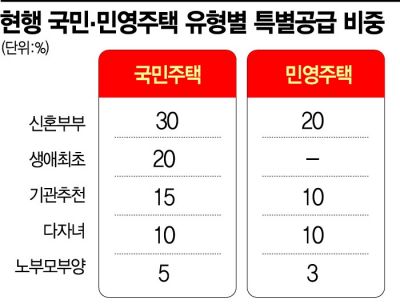
Accordingly, the government is reportedly considering increasing the special supply proportions, currently at about 20% for first-time buyers and 30% for newlyweds based on national housing standards. Considering that the total special supply proportion for national housing, including institutional recommendations, multi-child families, and elderly parent support, is currently 80%, there is speculation that national housing may be supplied entirely through special supply without general supply in the future.
There is also a plan underway to expand the target of first-time buyer special supply, currently limited to national housing, to include private housing. In this case, the special supply proportion for private housing, currently at about 43%, is expected to exceed the majority.
However, there are reactions that these measures will ultimately fail to satisfy everyone. The middle-aged and older generation is already simmering with discontent. On real estate communities, criticisms continue such as "I trusted the point system and endured, but does this make any sense?" and "Isn't it common sense that people in their 40s are more desperate than those in their 30s? The government is stirring up generational conflicts."
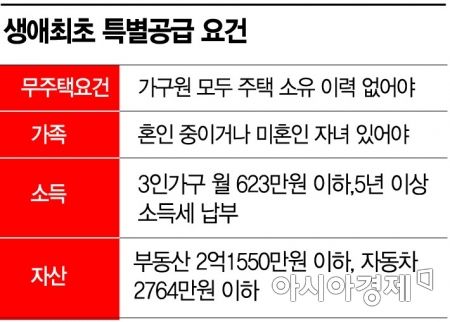
From the perspective of people in their 30s, who were even driven to 'give up subscriptions,' there are voices welcoming the government's shift away from the point system-only approach, but also skeptical voices regarding supply through special supply. There are concerns that it could lead to another 'inheritance of wealth.' For first-time buyer special supply, only those with an income below 5.62 million won for a three-person household can apply this year. Given the rising prices, even if special supply with income and asset criteria is increased, unless loan regulations are eased, only 'gold spoon' individuals receiving parental support will realistically be able to purchase.
© The Asia Business Daily(www.asiae.co.kr). All rights reserved.
![From Bar Hostess to Organ Seller to High Society... The Grotesque Con of a "Human Counterfeit" [Slate]](https://cwcontent.asiae.co.kr/asiaresize/183/2026021902243444107_1771435474.jpg)

















