Deepening US-India Honeymoon Relationship
Aligned Interests Amid Hong Kong Security Law Enforcement and China-India Border Clashes
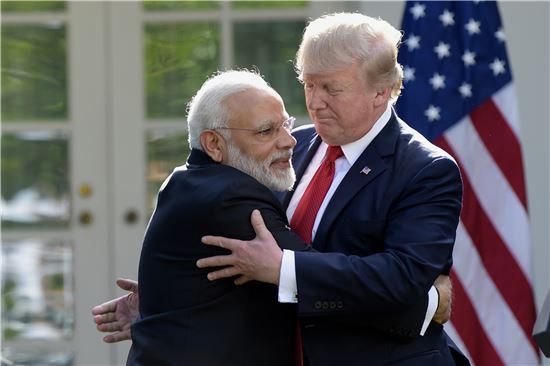
[Asia Economy Beijing=Special Correspondent Cho Young-shin, Reporter Park Sun-mi] "Happy Independence Day" (Narendra Modi, Prime Minister of India)
"Thank you. My friend" (Donald Trump, President of the United States)
The honeymoon between the United States and India is deepening. This is the result of aligned interests between the two countries following the enforcement of the Hong Kong National Security Law (Hong Kong Security Law) and the China-India border clashes.
According to the South China Morning Post (SCMP) on the 6th, Prime Minister Modi sent a tweet message to President Trump on the 4th (local time), the U.S. Independence Day, saying, "Congratulations on the 244th Independence Day of the United States." In response, President Trump replied, "Thank you. My friend. America loves India!"
The link in the friendly tweet exchange between the two leaders is China. Since the brawl between Chinese and Indian troops in the Himalayan Ladakh border dispute area on the 15th of last month, which resulted in the death of 20 Indian soldiers, anti-China sentiment has been growing in India. The Indian Ministry of Defense approved a weapons purchase and missile development budget worth 389 billion rupees (about 6.2 trillion won) this month, and Prime Minister Modi personally visited the brawl site this weekend, warning China, "If someone insists on expansionism, it will pose a threat to world peace."
The United States is also openly expressing its opposition to China, which pushed forward the Hong Kong Security Law. A bill sanctioning Chinese officials involved in the enforcement of the Hong Kong Security Law and banks dealing with them has already passed both the U.S. House and Senate and is awaiting President Trump's signature.
Recent signs of closer ties between the U.S. and India are also being detected elsewhere.
Indian local media Indian Express reported the day before that "U.S. Secretary of State Mike Pompeo spoke with Indian External Affairs Minister Subrahmanyam Jaishankar ten days ago and conveyed the message that the U.S. is actively supporting India in crisis." At that time, Secretary Pompeo reportedly promised to provide information on Chinese military activities in the China-India border area to India.
China cannot help but feel uncomfortable about the close ties between the U.S. and India. Wang Dehua, a South Asia expert at the Shanghai Institute of International Studies, said, "China would not want to see India moving closer to the U.S." Yoon Sun, a senior researcher at the U.S. think tank Stimson Center, explained, "The U.S. factor has become the most important consideration in China's policy toward India," adding, "From China's perspective, the military cooperation between the U.S. and India increases the likelihood and risk of facing U.S. and Indian forces in the Indian Ocean."
However, it is unlikely that China will back down from pressure by the two countries. On the contrary, it is tightening its grip on Hong Kong and making it clear that U.S. influence does not matter.
The Ministry of Public Security under the State Council of China, responsible for economic crime investigations, public security management, anti-terrorism suppression, and cybersecurity, has expressed its intention to intervene in protests related to the Hong Kong National Security Law. According to the Chinese state-run Global Times, the Ministry of Public Security held a meeting on the 4th and decided to support the stable establishment of the Hong Kong Security Law. Zhao Kezhi, Minister of Public Security, said at the meeting, "We will support the Hong Kong police in suppressing riots and restoring order," and vowed to deal firmly with illegal acts. The possibility of dispatching riot control forces from mainland China to Hong Kong has also increased.
China is also seeking ways to deepen relations with Iran, which is in confrontation with the U.S. Mohammad Javad Zarif, Iranian Foreign Minister, appeared before the Iranian parliament the day before and said that they are discussing a 25-year strategic agreement with China and that results could be announced soon.
© The Asia Business Daily(www.asiae.co.kr). All rights reserved.
![Clutching a Stolen Dior Bag, Saying "I Hate Being Poor but Real"... The Grotesque Con of a "Human Knockoff" [Slate]](https://cwcontent.asiae.co.kr/asiaresize/183/2026021902243444107_1771435474.jpg)















