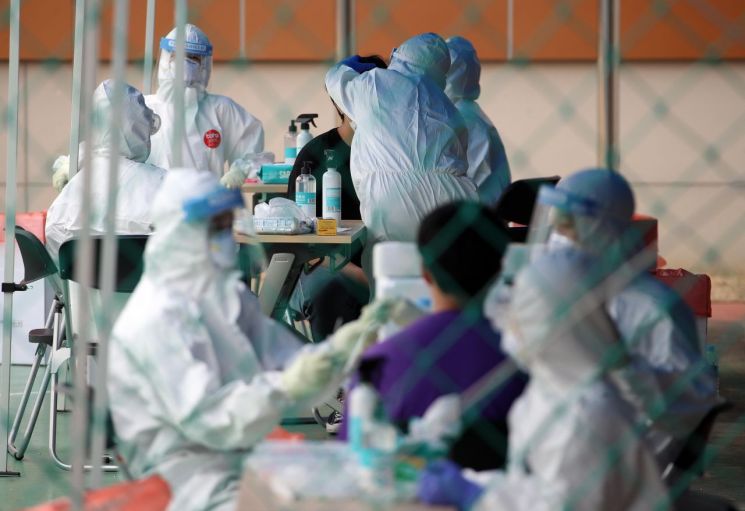
 Screening clinic where tests for the novel coronavirus infection (COVID-19) are being conducted. [Image source=Yonhap News]
[Asia Economy Reporter Lee Chun-hee] In response to the housing instability faced by vulnerable households due to the spread of the novel coronavirus infection (COVID-19), the government is joining forces with local governments and the Korea Land and Housing Corporation (LH) to provide support.
On the 6th, the Ministry of Land, Infrastructure and Transport announced that it will implement housing support measures such as emergency housing supply and early payment of housing benefits for vulnerable households experiencing difficulties like monthly rent arrears due to sudden income reduction caused by COVID-19.
Currently, the government is implementing housing support measures including rent reductions and deferrals for public rental housing tenants, interest rate cuts on Didimdol (housing purchase funds) and Buteemok (jeonse funds) loans, and discounts on jeonse deposit return guarantee fees.
Going forward, in addition to these measures, emergency support housing (temporary shelter) will be provided to households at risk of eviction. Local governments will be supported to offer vacant public rental housing as temporary shelter to households facing eviction risks due to issues such as monthly rent arrears.
The support method involves LH providing vacant public rental housing units to local governments free of charge, and local governments supporting eviction-risk households to reside in public rental housing for up to six months. As this is emergency support, eligibility and rent conditions will be operated autonomously according to local government circumstances. Supply is planned to begin next month.
Additionally, the Ministry of Land, Infrastructure and Transport will, in consultation with LH and local governments, provide information to link relevant welfare programs to these households and support relocation to public rental housing if necessary.
For households selected as emergency support recipients under the 'Emergency Welfare Support Act' due to sudden income loss from business suspension, closure, or unemployment, 2,000 jeonse rental housing units will be supplied. As of last month, 939 households have been supplied, and if additional demand arises in the second half of the year, the supply volume will be increased accordingly.
Under the current emergency welfare support system, low-income crisis households selected due to sudden crisis situations that make livelihood maintenance difficult can receive support for living, medical, housing, and social welfare facility costs. Selection criteria include 75% of the median income (1-person household 1.32 million KRW), property between 101 million and 188 million KRW, and financial assets of 7 million KRW.
To reduce the burden of rental deposits, for jeonse rental housing contracts for emergency support recipients conducted after the 8th, the self-pay deposit portion will be lowered from the existing 5% to 2%. Furthermore, after residing for two years and meeting re-contract conditions, residence can be extended up to 20 years.
The operation method of the housing benefit system will also be improved. Currently, local governments determine housing benefit eligibility based on the 'previous year's average income' as a principle. However, considering the rapid income changes due to the COVID-19 crisis, the plan is to actively utilize the exceptional application of the 'recent 3-month average income' standard.
Also, the current method of 'field investigation first → benefit confirmation later' will be changed to 'benefit confirmation first → post-verification later,' reducing the usual 2-3 months from application to benefit receipt to one month.
The Ministry of Land, Infrastructure and Transport expects that about 7,000 public rental housing units will be provided to households in housing crisis through these measures, and the number of housing benefit recipient households will increase from 1.04 million last year to approximately 1.17 million by the end of this year.
Kim Jeong-hee, Director of Housing Welfare Policy at the Ministry of Land, Infrastructure and Transport, said, "We will continue to closely monitor whether there are households facing difficulties due to COVID-19, strengthen local government publicity to ensure government policies are actively utilized on the ground, and continuously inspect the field."
© The Asia Business Daily(www.asiae.co.kr). All rights reserved.
![Clutching a Stolen Dior Bag, Saying "I Hate Being Poor but Real"... The Grotesque Con of a "Human Knockoff" [Slate]](https://cwcontent.asiae.co.kr/asiaresize/183/2026021902243444107_1771435474.jpg)
















