[Asia Economy Reporter Yoonju Hwang] LG Chem has declared '2050 Carbon Neutral Growth' to respond to climate change. This is the first time in the domestic chemical industry that carbon-neutral growth has been announced. 'Carbon neutral growth' means carrying out reduction activities equivalent to the increase in carbon emissions due to business growth, making the net increase in carbon emissions zero.
On the 6th, LG Chem announced a sustainability strategy for customers and society centered on '2050 Carbon Neutral Growth.'
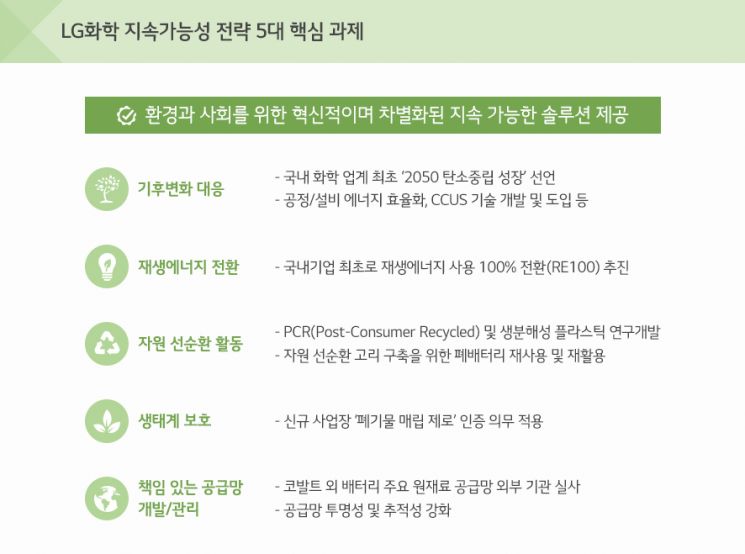
LG Chem has selected and decided to actively pursue five core tasks with the goal of 'providing innovative and differentiated sustainable solutions for the environment and society': ▲ responding to climate change ▲ transitioning to renewable energy ▲ resource circulation activities ▲ ecosystem protection ▲ responsible supply chain development/management.
◆ First in the domestic chemical industry to declare '2050 Carbon Neutral Growth' = Specifically, it plans to limit carbon emissions in 2050 to the 2019 emission level of 10 million tons. Considering current business growth, LG Chem's carbon emissions in 2050 are projected to be about 40 million tons, so more than 30 million tons must be reduced to achieve carbon-neutral growth. Thirty million tons is equivalent to the carbon emissions of 12.5 million internal combustion engine vehicles for one year, or the amount offset by planting 220 million pine trees.
To this end, LG Chem will be the first domestic company to promote RE100 (Renewable Energy 100) at all its global business sites. RE100 means producing products using 100% renewable energy, and companies can either produce renewable energy themselves or purchase renewable energy power from power producers.
Through RE100, LG Chem plans to reduce more than 60% of the projected carbon emissions in 2050 and will establish and actively implement a mid- to long-term strategy considering renewable energy supply methods and country-specific systems.
In addition, to reduce carbon emissions, LG Chem will actively promote energy efficiency improvements in processes and facilities, as well as the development and introduction of carbon capture, utilization, and storage (CCUS) technologies.
◆ Leading resource circulation and ecosystem protection = LG Chem plans to create environmental protection as well as social and economic value by establishing a circular economy system that recycles not only production products but also waste discharged from business sites.
First, it will actively develop products for the resource circulation of waste plastics such as polycarbonate (PCR PC) plastics recycled after eco-friendly consumer use and biodegradable plastic materials.
Currently, LG Chem has developed high-quality, high-content eco-friendly plastics with a PCR PC raw material content of 60% and supplies them to global IT companies. In the future, it plans to increase the PCR PC raw material content up to 85% and continuously expand the product lineup to include ABS (Acrylonitrile Butadiene Styrene) and polyolefin materials.
It will also develop biodegradable plastic materials to address environmental pollution and microplastic issues. LG Chem plans to commercialize biodegradable polymers PBAT and corn-based PLA by 2024.
Along with this, LG Chem will actively engage in the reuse and recycling of waste batteries. For reuse, it is researching and developing technology to collect batteries delivered to customers and predict their remaining lifespan, and a pilot facility for energy storage systems (ESS) for electric vehicle charging stations using reused batteries will soon open.
LG Chem is also pursuing zero landfill waste by recycling waste discharged from business sites to protect ecosystems. For this, it has decided to mandate 'Landfill Zero' certification, overseen by the internationally accredited environmental safety organization UL (Underwriters Laboratory), for newly constructed business sites going forward.
◆ Responsible supply chain management = LG Chem is also actively building a sustainable supply chain that addresses human rights and environmental issues.
Recently, global companies have been demanding high levels of supply chain management. For example, Volkswagen and Apple exclude partners that do not meet human rights and environmental requirements from their supply chains. China’s Huayou Cobalt, a supplier of cobalt, a key raw material for battery cathodes, has declared it will stop transactions with mines in the Democratic Republic of Congo where child labor issues exist.
If a sustainable supply chain is not established, no matter how excellent the products and technologies are, companies may not even have the opportunity to participate in business.
Accordingly, LG Chem plans to build a clean metal supply chain free of human rights and environmental issues. It has applied supply chain due diligence obligations to partners and is expanding supply chain due diligence through external organizations to major raw materials beyond cobalt.
So far, LG Chem joined the global consortium RMI (Responsible Minerals Initiative) in 2019, the first in the domestic battery industry, for responsible mineral sourcing and supply chain management, and has strengthened transparency and traceability by establishing a blockchain-based cobalt supply chain tracking system with automotive OEMs such as Ford and Volvo.
Vice Chairman Shin Hak-cheol said, “The year 2050, when the sustainability strategy is fully achieved, will be an important milestone as LG Chem moves beyond its 100th anniversary into the next century,” adding, “We will make sustainability a core competitive advantage, provide innovative and differentiated sustainable solutions, and create a business model that can endure by solving pain points not only for customers but also for the environment and society.”
© The Asia Business Daily(www.asiae.co.kr). All rights reserved.
![Clutching a Stolen Dior Bag, Saying "I Hate Being Poor but Real"... The Grotesque Con of a "Human Knockoff" [Slate]](https://cwcontent.asiae.co.kr/asiaresize/183/2026021902243444107_1771435474.jpg)
















