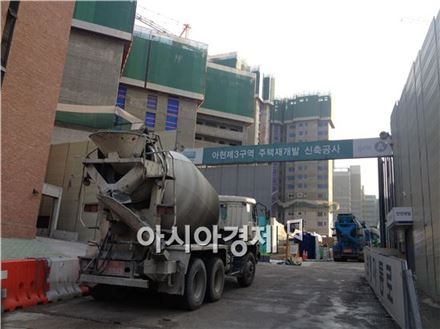
 From today, 70 to 80% of ready-mix concrete trucks have resumed operation. The photo shows a ready-mix concrete truck entering the Ahyeon 3 District construction site.
 [Photo by Asia Economy DB]
[Asia Economy Reporter Kim Jong-hwa] Most of the negotiations to raise transportation fees between ready-mixed concrete (remicon) companies and remicon transport operators in the Seoul metropolitan area have been settled, and on the 6th, about 70-80% of remicon vehicles in Seoul and the metropolitan area resumed transportation.
Remicon transport operators who own leased vehicles (National Remicon Transport Federation) recently demanded a 15% increase in transportation fees from remicon companies in the metropolitan area, causing conflicts, but over the past weekend, they reached a compromise with a 9% increase (4,500 KRW per transport trip).
A representative of the National Remicon Transport Federation (Jeon-un-ryeon) said, "We accepted that everyone is struggling due to COVID-19 and made concessions," adding, "We agreed with the metropolitan branch heads to lower the bottom line to a 9% increase."
Jeon-un-ryeon started a strike on the 1st, demanding a 15% increase in transportation fees per trip for concrete mixer trucks. They have been receiving about 43,000 to 47,000 KRW per trip and have been requesting an increase to around 50,000 KRW since March. On the other hand, remicon manufacturers have been raising transportation fees by about 5-6% annually and expressed reluctance to a 15% increase, citing a decline in sales due to the downturn in the construction market, leading to stalled negotiations.
Remicon manufacturers proposed to Jeon-un-ryeon on the 5th that if the strike extended beyond the weekend, actual construction sites could come to a halt, and with growing critical public opinion against the strike, they suggested compromising on a 9% increase per trip. Jeon-un-ryeon accepted this, averting a crisis.
However, it is expected to be difficult for all construction sites to return to normal immediately. About 20% of remicon transporters (individual business owners) still demand a 15% increase. Also, since they participated in the strike, they must reattach vehicle license plates that were collected and stored by each branch and complete vehicle maintenance before normal operation can resume.
The damage to construction sites from this is expected to be minimal. Jeon-un-ryeon claims that out of about 10,000 remicon vehicles in the metropolitan area, 9,000 (90%) participated in the strike, but according to estimates from remicon companies, only about 5,000, roughly half, took part.
It seems that the number of vehicles participating in the strike was not as high as expected, likely due to awareness of critical public opinion about striking during an emergency situation. Because of this, there is a surplus of remicon vehicles that can be immediately deployed to sites. The industry plans to prioritize supporting mixer trucks to urgent sites to prevent damage.
Although a consensus to "avoid a catastrophe" was formed, and the immediate crisis of a complete stop at construction sites was averted, remicon companies face a burden as they must enter secondary negotiations with construction companies over the increased cost sharing due to the transportation fee hike. While they were in a dominant position when negotiating with individual remicon operators, they now have to negotiate again from a subordinate position.
The price of remicon in the metropolitan area is 66,350 KRW per cubic meter, which is 94% of the standard price (70,580 KRW). Construction companies maintain their stance to freeze remicon delivery prices this year as well, following last year, reflecting the lowered prices of raw materials such as cement and aggregates. Meanwhile, the remicon industry demands an increase to 68,500 KRW, which is 97% of the standard price.
A representative of a remicon company said, "Since transportation costs for companies have increased, construction companies should reflect this in the cost and raise remicon delivery prices," adding, "Remicon delivery prices were frozen last year and the year before when the construction market was relatively good, but now that transportation costs have risen significantly, we ask that this be reflected in the cost structure."
Another representative from a remicon company said, "Remicon manufacturers are caught between remicon transporters and construction companies," adding, "Since we made concessions when the construction market was good, it would be good if construction companies make concessions this time."
© The Asia Business Daily(www.asiae.co.kr). All rights reserved.
















