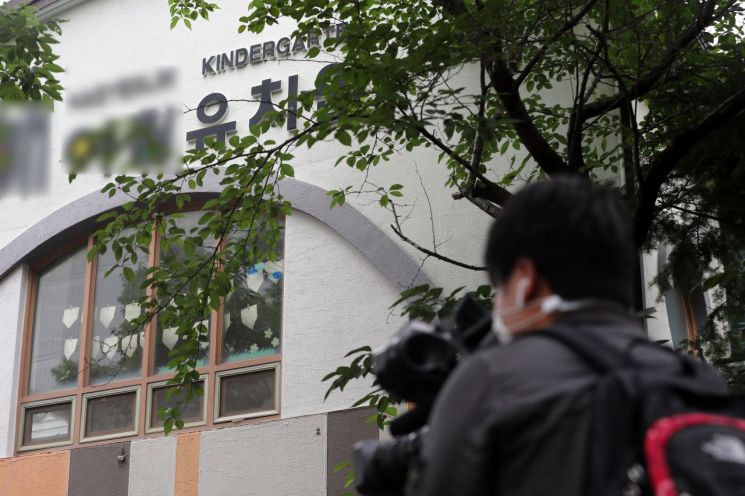
[Asia Economy Reporter Song Seung-yoon] As the police have launched a full-scale investigation into the kindergarten in Ansan, Gyeonggi Province, where a mass food poisoning incident occurred, the related investigation is expected to focus on the suspicion of disposal of preserved food raised by some and on identifying the cause.
The Ansan Sangnok Police Station, which is investigating the case, reportedly obtained a search warrant on the 1st and secured the mobile phones of the director and vice director of Kindergarten A in Sangnok-gu, Ansan, Gyeonggi Province. This was to verify suspicions that the kindergarten deliberately disposed of some menu items instead of preserving them as preserved food.
Earlier, parents of Kindergarten A filed a complaint with the police on the 27th of last month, requesting an investigation into Director B on charges including violation of the Food Sanitation Act. On the 29th of the same month, the police sent five investigators to Kindergarten A and conducted a search and seizure for about two hours, initiating a full-scale investigation. The police secured most of the materials, including one month’s worth of CCTV footage inside the kindergarten and ledgers containing records related to meals. These materials reportedly include meal details around the first symptomatic case’s onset date, the 12th.
The police have so far booked only Director B, the person in overall charge, without detention in connection with this case. B was initially diagnosed with enterohemorrhagic Escherichia coli infection and entered self-quarantine until the 2nd. The police planned to summon B for questioning as soon as the self-quarantine ended, but since a negative test result has not yet been confirmed, they are currently coordinating the attendance date. After comprehensively reviewing the investigation details and the materials secured through the search, the police plan to consider the direction of handling the suspects, including B.
As of now, the cumulative confirmed cases of enterohemorrhagic Escherichia coli infection stand at 60. Among them, 11 (9 children and 2 family members) are hospitalized. There are 16 suspected cases of hemolytic uremic syndrome (HUS), also known as "hamburger disease" (14 children and 2 family members), of which 3 are undergoing dialysis treatment. Kindergarten A remains closed until the 8th.
Since the first child showed symptoms of food poisoning on the 12th of last month, additional confirmed cases have surged at this kindergarten, but the cause of the outbreak has not been identified for nearly a month. Health authorities conducted specimen tests on preserved food stored by the kindergarten, cooking utensils, and supplies within the kindergarten, and also examined the possibility that children were infected during learning activities, but the causative enterohemorrhagic Escherichia coli was not found anywhere.
Some parents suspect that some menu items, such as snacks that were not preserved as preserved food by the kindergarten, might have contained the causative bacteria of the food poisoning. Kindergarten A has stated that some menu items, including snacks other than regular meals, were not preserved as preserved food. According to the Food Sanitation Act, collective meal facilities are required to keep food ingredients served for 144 hours. Since there are suspicions of deliberate concealment, the police also plan to focus on this aspect.
Hemolytic uremic syndrome is a complication of enterohemorrhagic Escherichia coli infection and began to be called "hamburger disease" in 1982 when dozens of children in the United States were collectively infected after consuming hamburgers with undercooked patties. Enterohemorrhagic Escherichia coli infection occurs mainly when consuming undercooked meat or unpasteurized dairy products, as well as hamburgers.
Meanwhile, a similar mass food poisoning incident occurred at a daycare center in Busan. According to Busan city and others, children at this daycare began showing suspected food poisoning symptoms starting on the 26th of last month, and as of the 3rd, the number of symptomatic cases increased to 39. Eleven children who complained of high fever and abdominal pain were hospitalized.
© The Asia Business Daily(www.asiae.co.kr). All rights reserved.


















