Seong Jaemin, Ph.D. at Korea Labor Institute, Presents 'Impact of COVID-19 on Female Employment'
Presented at the 2nd Ministry of Employment and Labor Gender Equality Committee Meeting
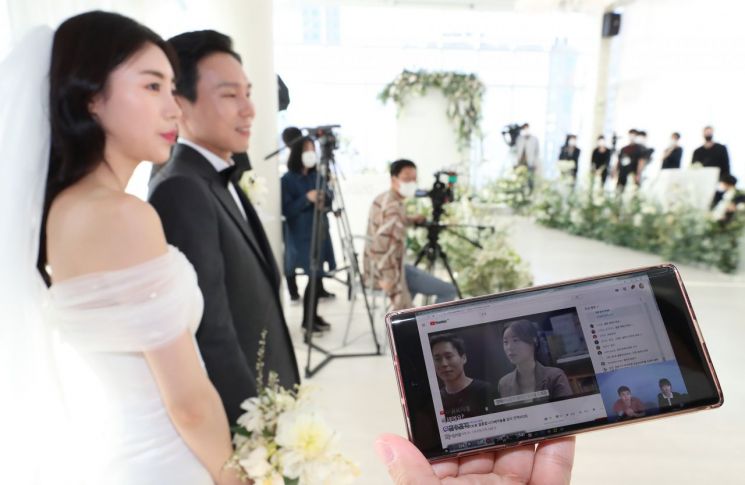
[Sejong=Asia Economy Reporter Kim Hyunjung] As the stability associated with marriage has weakened due to the novel coronavirus infection (COVID-19) crisis, there is a forecast that the unmarried rate among women in their early 30s could increase more sharply.
At the '2nd Ministry of Employment and Labor Gender Equality Committee' held on the 30th of last month at the Royal Hotel in Seoul, chaired by Vice Minister Im Seo-jung, Dr. Sung Jae-min of the Korea Labor Institute stated in his presentation on "The Impact of COVID-19 on Female Employment" that "the symbolic stability provided by marriage may also weaken due to COVID-19."
He explained, "During crises, increased unemployment among traditional breadwinners (men) can act as a factor that sustains and elevates the importance of economic activities by spouses or unmarried children," adding, "In fact, the unmarried rate among women in their early 30s accelerated in its increase as a result of the crisis."
According to Dr. Sung, the unmarried rate of women in their early 30s, which was around 4.8% in 1990, rose by approximately 2.8 percentage points to 7.6% during the 1998 IMF foreign exchange crisis, and then surged by 10.6 percentage points until 2006. Furthermore, this figure, which was about 20.7% in 2008, increased by 5.7 percentage points to 26.4% in 2012, and rose by 12.1 percentage points to 32.8% by 2016.
He also forecasted that the pace of change in corporate culture and employee utilization methods will accelerate further due to this crisis. Dr. Sung said, "In Korea, the proportion of women working part-time tends to spike sharply during crises and maintain the elevated level even after the crisis ends," adding, "Moreover, if experiences such as telecommuting and smart work expand and lead to changes in corporate culture, work practices that support work-family balance could spread."
Dr. Sung emphasized the need to promptly implement the job projects included in the 3rd supplementary budget and to sustain them at least until the first quarter of next year. He stressed, "It is necessary to expand and continue support for employment retention, unemployment, and income reduction, and to promptly carry out the job projects included in the 3rd supplementary budget, sustaining them at least until the first quarter of next year."
© The Asia Business Daily(www.asiae.co.kr). All rights reserved.

















