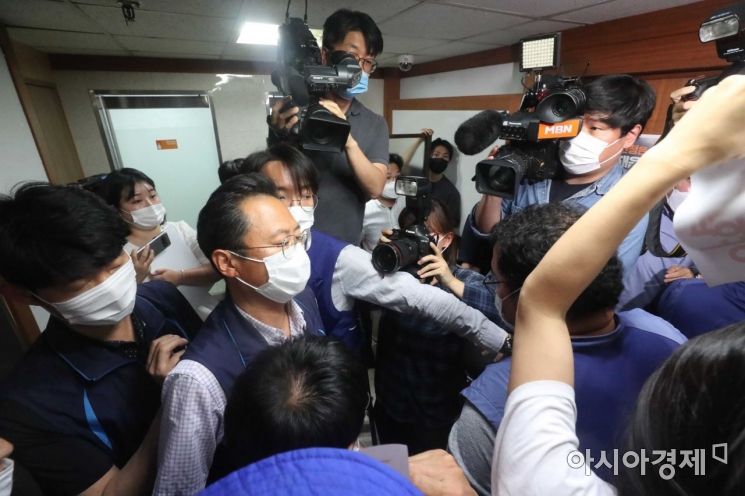
 On the 2nd, the Central Executive Committee meeting was held at the Korean Confederation of Trade Unions in Jung-gu, Seoul, but the meeting was delayed due to protests by KCTU irregular workers opposing the tripartite agreement. Photo by Kang Jin-hyung aymsdream@
[Asia Economy Reporter Jeong Dong-hoon] The Korean Confederation of Trade Unions (KCTU) has decided to hold an extraordinary delegate meeting to make the final decision on whether to ratify the tripartite agreement, which is at risk of collapse for the first time in 22 years. This appears to be the last attempt to ratify the tripartite agreement, which failed to reach a final accord on the 1st.
Since the afternoon of the 3rd, the KCTU held a Central Executive Committee (CEC) meeting and, after an overnight discussion on whether to ratify the tripartite agreement, decided to make the final decision through an extraordinary delegate meeting. Accordingly, the KCTU will convene the delegate meeting online on the 20th and proceed with a process to directly ask the members for their opinions.
This decision was strongly influenced by Chairman Kim Myung-hwan’s determination. After the CEC meeting, Chairman Kim stated, "(The delegate meeting) can be convened under the KCTU regulations by exercising the chairman’s authority," and expressed his intention to "directly ask the members for their consent on the tripartite agreement through the delegate meeting."
The delegate meeting is a large-scale assembly composed of delegates representing one delegate per 500 members. It is a higher decision-making body than the CEC, which consists of about 50 members including KCTU Secretariat executives, representatives of industrial unions, and regional headquarters. The regular delegate meeting of the KCTU in February had about 1,400 registered delegates. Chairman Kim decided to confirm the will of the delegates to save the tripartite agreement. This is interpreted as an attempt to overcome the opposition from factions against the tripartite agreement.
However, industrial unions such as the Metal Workers’ Union and the Public Transport Workers’ Union, which constitute the majority within the KCTU, are blocking ratification of the tripartite agreement, citing insufficient provisions on "prohibition of dismissal" and "guarantee of nationwide employment insurance." They are also demanding Chairman Kim’s resignation. Chairman Kim was even prevented from attending the signing ceremony scheduled on the 1st due to opposition from these union members. The National Council of Democratic Workers (Jeongukhoe), one of the largest factions within the KCTU, has also issued a statement calling for the tripartite agreement to be discarded.
This delegate meeting appears to be the last practical attempt to revive the tripartite agreement. However, it remains uncertain whether a ratification decision will be reached due to continued opposition from hardliners. It is also uncertain whether other entities such as the Federation of Korean Trade Unions (FKTU) will wait for the KCTU’s ratification decision. Chairman Kim is expected to decide his own position depending on the fate of the tripartite agreement.
© The Asia Business Daily(www.asiae.co.kr). All rights reserved.

















