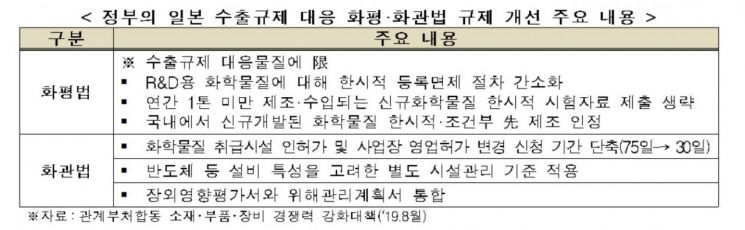
[Asia Economy Reporter Changhwan Lee] One year after Japan's export restrictions, companies evaluate that while the government's chemical substance regulations have improved, there are still many shortcomings.
On the 6th, the Korea Economic Research Institute conducted a survey titled 'Perception of Improvement in Chemical Substance Regulations in Response to Japan's Export Restrictions' targeting major large corporations. The results showed that more than half (58.3%) of the respondent companies were satisfied with the improvement in chemical substance regulations. However, most companies (72.5%) viewed additional relaxation of chemical substance regulations as urgent to overcome the economic difficulties they face.
The survey was conducted by Research & Research, a market research specialist agency, from May 21 to June 18, commissioned by the Korea Economic Research Institute, targeting 120 large corporations subject to chemical substance regulations.
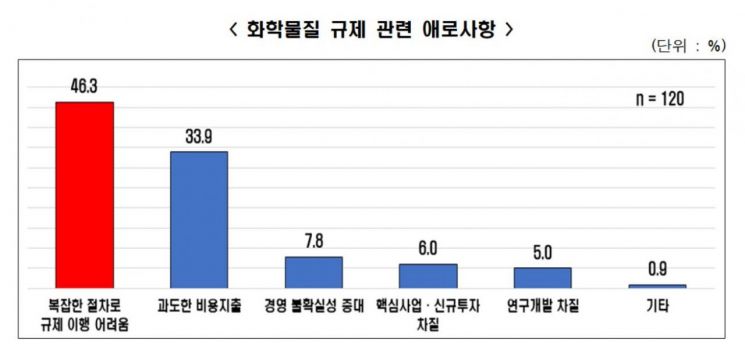
As the biggest difficulties in chemical substance regulations, companies cited difficulties in complying with regulations due to complex procedures (46.3%) and excessive costs incurred in compliance (33.9%). In particular, with the amendment of the Chemical Substances Registration and Evaluation Act (Chemicals Control Act) in mid-2018, the number of substances subject to registration increased from 510 to about 7,000, leading to an increase in registration costs. As a result, companies' production costs are expected to increase by an average of 1.8%.
More than half of the companies (57.5%) reported that chemical substance regulations negatively affect their management. The difficulties in regulation included challenges in compliance due to complex procedures (46.3%), excessive costs incurred in compliance (33.9%), and increased management uncertainty due to new or strengthened regulations (7.8%).
Major difficulties related to the Chemicals Control Act included securing and submitting test data (26.2%), chemical substance registration and reporting (25.7%), and reporting products containing hazardous chemicals (15.4%).
Regarding the Toxic Chemicals Control Act, burdensome items included management of placement and installation of hazardous chemical handling facilities (33.2%), inspection and examination of hazardous chemical handling facilities (32.3%), and ensuring regulatory compliance of small enterprises in contractual relationships such as partner companies (11.8%).
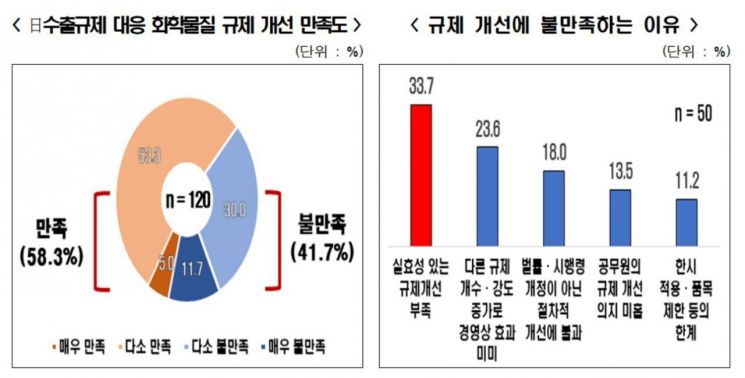
Regarding satisfaction with regulatory relaxation, more than half of the companies (58.3%) were satisfied with the government's improvements in chemical substance regulations following Japan's export restrictions.
However, 41.7% of companies responded that they were not satisfied with the regulatory improvements. The reasons cited included lack of effective regulatory improvements (33.7%), minimal management effects due to increases in the number and intensity of other regulations (23.6%), and procedural improvements rather than amendments to laws and enforcement decrees (18.0%).
A significant number of companies (72.5%) pointed out that continuous efforts to improve chemical substance regulations are necessary to overcome economic difficulties.
The directions for chemical substance regulation improvements that companies hope for from the 21st National Assembly and the government included reflecting practical industry opinions in regulatory improvements (42.1%), setting regulatory standards from a long-term perspective rather than short-term issue responses (19.0%), and bold and substantial regulatory improvements (17.2%).
Choo Kwang-ho, Director of Economic Policy at the Korea Economic Research Institute, stated, "It is desirable that excessive chemical substance regulations have been partially improved since Japan's export restrictions, but companies still face difficulties due to regulations that do not fit reality. The government and the National Assembly should create a rational chemical substance regulatory environment to help companies overcome the economic difficulties they face."
© The Asia Business Daily(www.asiae.co.kr). All rights reserved.



















