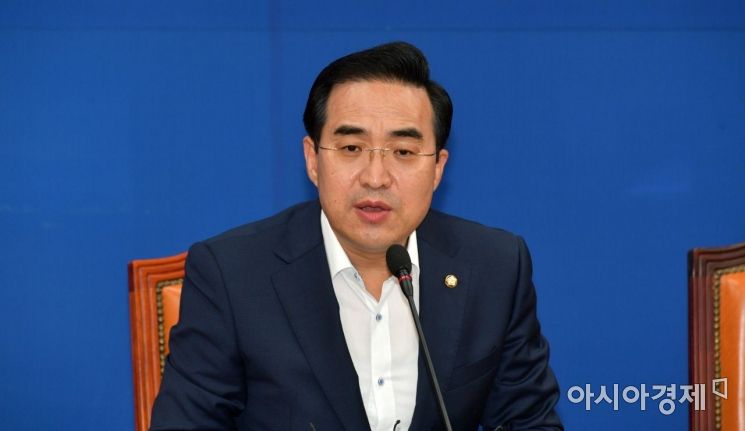
 Park Hong-geun, the secretary of the Democratic Party's Budget and Accounts Committee, is holding a press conference on the third supplementary budget bill at the National Assembly on the 3rd. Photo by Yoon Dong-joo doso7@
[Asia Economy reporters Kang Nahum and Jeon Jinyoung] The Democratic Party of Korea plans to hold a plenary session of the National Assembly on the 3rd to attempt the passage of the third supplementary budget bill worth 35 trillion won. Since the review began only five days ago, it is expected to face criticism for being a 'hasty review.'
Park Hong-geun, the Democratic Party's floor leader on the National Assembly's Budget and Accounts Special Committee, said at a press briefing held at the National Assembly on the morning of the same day, "We have been reviewing the supplementary budget comprehensively considering urgency, the possibility of execution within the year, and the impact on people's livelihoods, in line with the purpose of overcoming the economic crisis caused by the COVID-19 pandemic." He added, "Although there are still practical tasks and consultations remaining, our goal is to hold a plenary session at 7 p.m. today (the 3rd) to approve the third supplementary budget."
Earlier, the Democratic Party completed the sole organization of the National Assembly at the plenary session held on the 29th of last month and immediately opened standing committees to begin reviewing the supplementary budget. Since then, the review process proceeded rapidly over four days. During the preliminary review in the standing committee, the supplementary budget size increased by 3.1 trillion won from the government's proposal of 35.3 trillion won, reaching 38.4 trillion won.
This supplementary budget review process sparked numerous criticisms. The rapid pace of the review?from the standing committee's preliminary review, the Budget Committee's comprehensive policy questioning, to the Budget Subcommittee's increase/decrease review?led to ongoing criticism of a 'hasty review.' In fact, on the first day of the budget subcommittee on the 1st, the decrease review was completed in just over four hours.
There were also criticisms that the amount of budget cuts was small compared to the increases in the standing committee. At the meeting of the budget subcommittee on the 1st, budgets under the jurisdiction of 10 ministries including the Ministry of Science and ICT, Ministry of Trade, Industry and Energy, Ministry of Employment and Labor, Ministry of Environment, and Ministry of SMEs and Startups were reviewed, resulting in only 82.353 billion won being cut. Regarding this, Representative Park explained, "We cut only projects without disagreements. Mainly, projects that raised additional issues were further cut the next day (the 2nd). Although I will explain after it is finalized, I think the cut amount will be the largest among supplementary budgets in history."
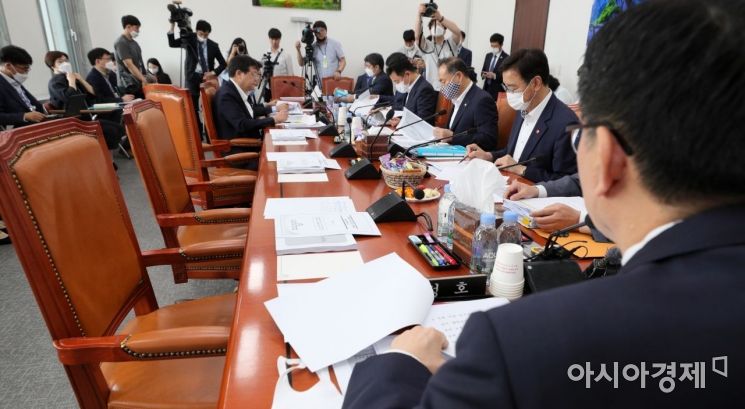 Jeong Seong-ho, the chairman of the Budget and Accounts Committee, is presiding over the 3rd supplementary budget adjustment subcommittee meeting held at the National Assembly on the 2nd. Photo by Yoon Dong-joo doso7@
There was also criticism that the supplementary budget was being used as a tool by the Democratic Party to win public support. In particular, the Democratic Party decided to increase the youth support budget by a total of 360 billion won, including 250 billion won for youth housing financial support, 100 billion won for youth job support, and 10 billion won for youth startup support, leading to speculation that this was intended to recover the declining approval ratings of the government and ruling party, especially among young people.
The budget for projects with petition-like characteristics also became controversial. The United Future Party criticized the Democratic Party by labeling 357.1 billion won worth of 13 regional projects, including a 300 billion won investment in the Korea Ocean Business Corporation and a 10 billion won ICT infrastructure project for major tourist sites in Iksan, Jeonbuk, as 'petition-like' budgets. In response, Representative Park stated, "'Regional petition budgets were inserted,' or 'petition budgets were increased' are not accurate. Petition budgets were rarely increased in the standing committee," adding, "During the Budget Committee review, several lawmakers requested written reviews, but we consistently maintained the standard of excluding petition-like budgets from the review process."
As these controversies piled up, there is also speculation that the final size of the third supplementary budget will be confirmed around the existing government proposal of 35.3 trillion won. Representative Park said, "The overall size of the supplementary budget has a slight net increase or decrease from the government proposal. Rather than increasing, we slightly reduced it. Since we have to consult with the government and go through subcommittee approval, I cannot disclose the exact size," he said.
Meanwhile, only ruling coalition parties such as the Democratic Party, the Justice Party, and the Open Democratic Party are expected to participate in the plenary session for the passage of the third supplementary budget, while the United Future Party and the People's Party are expected to abstain. In particular, the United Future Party plans to hold an emergency party meeting coinciding with the plenary session to condemn the Democratic Party's sole passage of the supplementary budget.
© The Asia Business Daily(www.asiae.co.kr). All rights reserved.


















