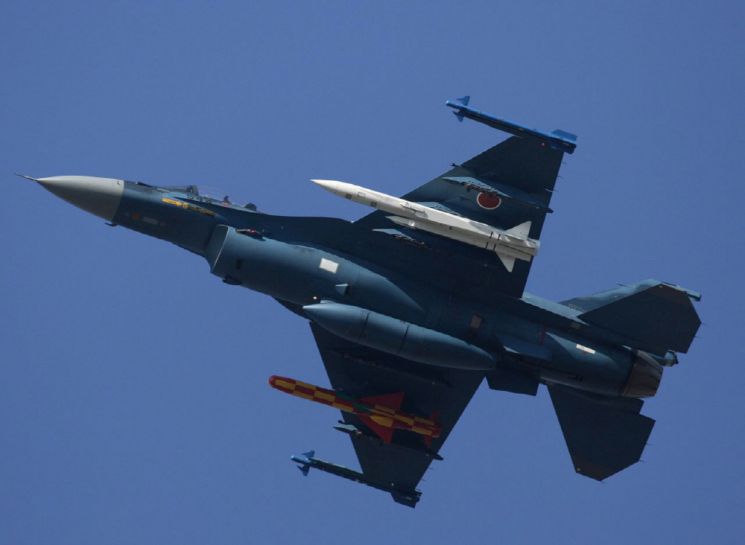
 A Japanese Air Self-Defense Force F-2 fighter jet flying equipped with the supersonic air-to-ship missile 'ASM-3'001' developed by Japan. The white missile is the supersonic air-to-ship missile ASM-3, developed domestically by Japan.
[Military Analyst Kim Daeyoung] A supersonic air-to-ship missile is a missile mounted on fighter jets that flies at speeds faster than Mach, the speed of sound, to attack enemy warships. South Korea does not yet possess supersonic air-to-ship missiles.
However, neighboring China has developed the YJ-12 supersonic air-to-ship missile, which is mounted and operated on fighter jets and bombers. Generally, anti-ship missiles fly at subsonic speeds, around Mach 0.5 to 0.7, whereas supersonic anti-ship missiles fly at Mach 2 to 3, making them difficult to intercept from a defensive standpoint. Especially unlike subsonic air-to-ship missiles, their high speed leaves very limited time for interception.
Japan, which is currently in multifaceted disputes with South Korea, has also developed a supersonic air-to-ship missile. Known as the ASM-3, Japan’s supersonic air-to-ship missile was reportedly completed in 2018. Japan is an island nation surrounded by sea on all sides and composed of an archipelago. For this reason, Japan developed its own domestic air-to-ship missiles and deployed them starting in the 1980s. Japan’s first domestically produced air-to-ship missile was the ’Type 80 air-to-ship missile,’ which flew at subsonic speeds with a range of 50 km and used an active radar homing guidance system, meaning the missile itself was equipped with a small radar transmitter and receiver. The Type 80 air-to-ship missile was called ’ASM-1’ in English.
The Type 80 air-to-ship missile, mainly used by the Japan Air Self-Defense Force’s F-1 support fighter, had over 300 units produced. In 1993, the ’Type 93 air-to-ship missile’ was introduced. Known as ASM-2, this missile differed from the Type 80 by being equipped with a turbojet engine, increasing its flight speed and extending its range to over 100 km. It used an infrared imaging guidance system, which detects infrared emissions from enemy ships, converts them into images, and tracks the target to achieve a hit. This allowed it to strike enemy ships more stealthily compared to the active radar homing method, which emits radio waves and reveals the missile’s presence.
The F-2 fighter, specialized for air-to-ship missile attacks, can carry four Type 93 air-to-ship missiles. This is effectively the highest number of air-to-ship missiles carried by any existing fighter jet. Between 2000 and 2002, an improved version of the Type 93 air-to-ship missile with added GPS guidance and enhanced accuracy was deployed. Unlike the Type 80 and Type 93, the ASM-3, developed as a supersonic air-to-ship missile, flies at up to Mach 3.0 and has a range of 200 km.
A notable feature is that among supersonic air-to-ship missiles deployed worldwide, the ASM-3 is the lightest. Weighing 900 kg, it is significantly lighter compared to China’s YJ-12 supersonic air-to-ship missile, which weighs 2.5 tons (t), demonstrating how lightweight the ASM-3 is. Additionally, it uses a combination of active and passive radar homing guidance methods, and its exterior is designed with stealth features and made from composite materials to enhance concealment.
Despite the completion of its development, the ASM-3 supersonic air-to-ship missile is not yet in mass production. As Chinese naval vessels have become more advanced, the Japan Air Self-Defense Force plans to develop an improved version of the ASM-3 with an extended range of 400 km starting this year and deploy it in the future.
© The Asia Business Daily(www.asiae.co.kr). All rights reserved.
![Clutching a Stolen Dior Bag, Saying "I Hate Being Poor but Real"... The Grotesque Con of a "Human Knockoff" [Slate]](https://cwcontent.asiae.co.kr/asiaresize/183/2026021902243444107_1771435474.jpg)
















