Laying the Foundation for Urban Planning to Enhance Regional Value and Future Development in Gwangjin-gu
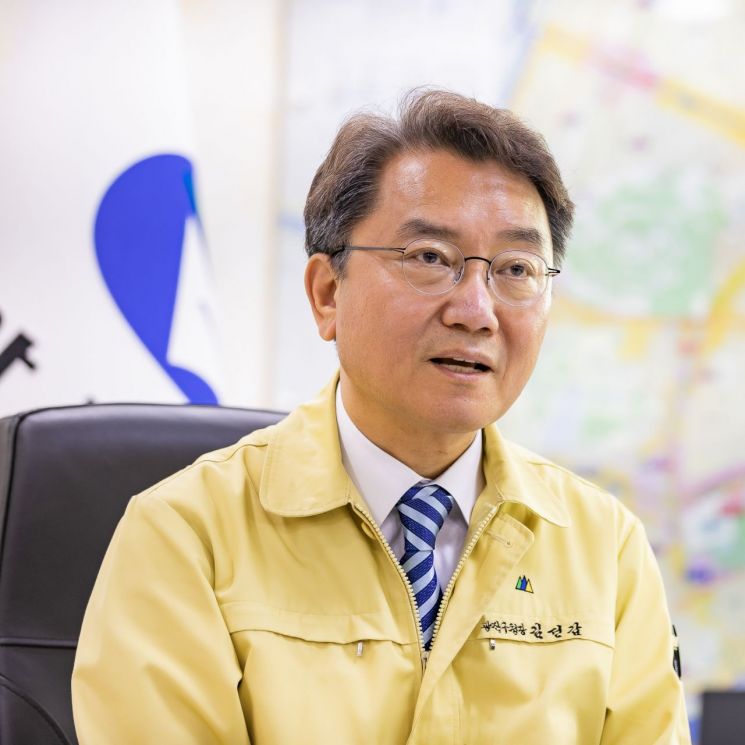
[Asia Economy Reporter Park Jong-il] Kim Seon-gap, Mayor of Gwangjin District, marked the first day of the third year of the 7th local government administration on the 1st.
Mayor Kim has focused on practicality over the past two years, making every effort to establish a proactive quarantine system to overcome COVID-19 and revive the stagnant economy.
Here is a summary of Mayor Kim’s achievements over the past two years.
1. Neighbors, This Kind of Relationship
Two years have passed since the launch of the 7th local government administration. Mayor Kim Seon-gap spent the first year focusing on practicality and building a new system, and the past year was a year of leap forward to produce tangible results that residents could feel based on the foundation laid in the first year.
Mayor Kim’s past two years started with the residents and still prioritize them. Upon taking office, a typhoon was approaching, so the inauguration ceremony was canceled, and the first schedule was to check flood prevention facilities and residents’ safety. In September of that year, he presented a vision plan for 68 pledge projects in 8 major areas in front of the residents and subsequently held over 1,500 meetings to listen to residents’ opinions and communicate.
Through these meetings, Mayor Kim focused on listening to residents’ voices and incorporating projects necessary for their daily lives. As a result, he secured a total of 48 external awards worth 2.5 billion KRW and 38.8 billion KRW in project funds through public contests.
2. Overcoming COVID-19
From the early stages of the COVID-19 outbreak, Gwangjin District established a meticulous quarantine system and made every effort to prevent the spread of local infections through proactive responses. There have been a total of 17 confirmed cases in Gwangjin District: 7 imported cases, 6 from the Itaewon club cluster, and 4 from infections in other regions, with no cases of community transmission.
This was possible thanks to the mature civic consciousness of the residents, voluntary participation of volunteers, dedication of medical staff, and donations from residents?all actively cooperating.
◆ Establishing a Proactive Quarantine System
Before the Shincheonji cluster infection occurred, Gwangjin District proactively visited various religious facilities to request temperature checks, hand sanitization, and mask-wearing at entrances. The district supported mask distribution and quarantine activities in return for active participation.
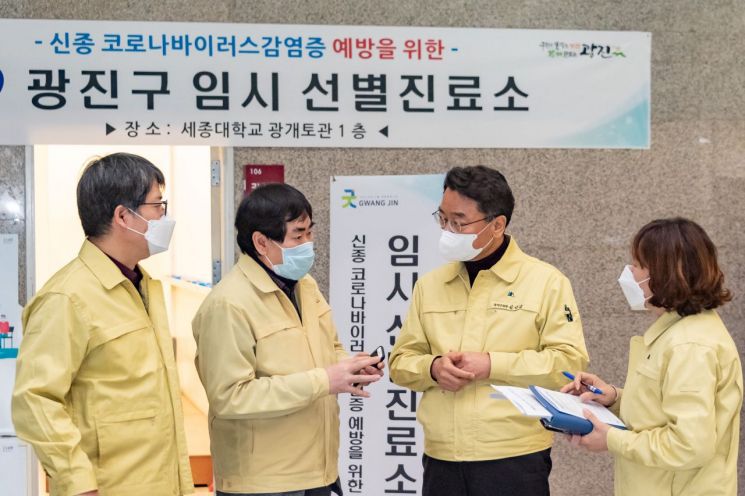
Since the virus originated in China, the district thoroughly managed Chinese international students to block overseas inflow routes. Gwangjin was the first autonomous district in Seoul to set up a temporary screening clinic on university campuses, conducting secondary tests (after initial screening) and one-on-one monitoring of international students. Later, temporary residential facilities were prepared for direct medical visits and examinations.
To prevent local infection spread, from the onset of COVID-19 until now, the district distributed over 2.2 million masks and 40,000 hand sanitizers (hand sprays) to all sectors. When the Itaewon club cluster spread and related confirmed cases appeared in Gwangjin, the district quickly formed a ‘Special Task Force for Entertainment Facilities’ due to serious concerns about local infection spread. Regular testing guidance was provided via disaster text messages and SNS, and considering the high number of foreign visitors, the district was the first nationwide to send disaster messages in English.
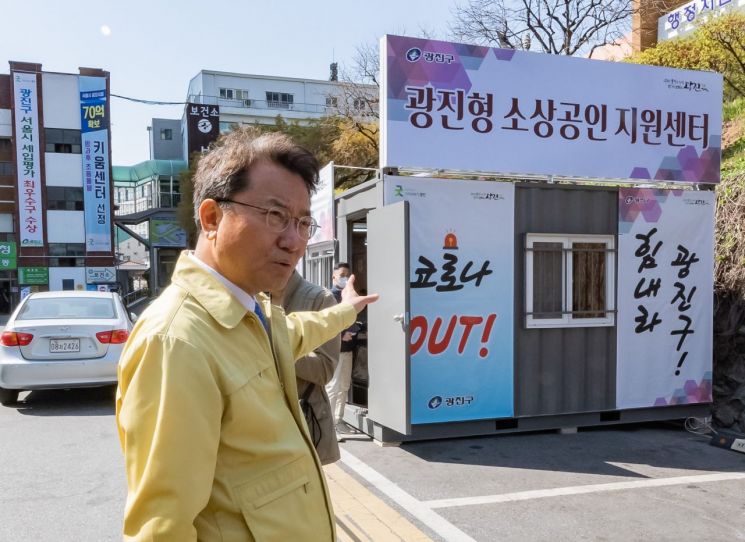
◆ Focus on Reviving the Stagnant Economy
Gwangjin District invested a total of 40.6 billion KRW in emergency operating funds to help small business owners who suffered economic damage to get back on their feet.
Especially, through the earliest supplementary budget among Seoul’s autonomous districts, the district promoted the ‘Gwangjin-type Emergency Operating Fund’?a special loan with zero interest (including existing borrowers) and waived guarantee fees for one year?and set up a one-stop support center in a container at the Gwangjin District Office parking lot, where banks, guarantee foundations, and the district office collaborated to provide quick and easy support.
Additionally, to revive the stagnant local commercial district, proactive measures included ▲early execution of local finances worth 147.1 billion KRW in the first half ▲prioritizing local companies in private contracts ▲full closure of district cafeterias ▲extension of deadlines for local tax payments and postponement of tax audits ▲issuance of Gwangjin Love gift certificates and payback events ▲support funds for businesses affected by closures and COVID-19 visits ▲free collection of food waste from small restaurants ▲public jobs for residents called ‘Gwangjin-type Happy Jobs.’
3. Over Two Years
◆ Urban Planning
In January this year, the district completed the ‘Urban Planning Service for Gwangjin’s Future Development,’ a comprehensive review of Gwangjin’s urban planning. Based on this, in February, Mayor Kim visited Seoul Mayor Park Won-soon to explain the necessity and fairness of upgrading the downward-designed urban plan of Gwangjin and conveyed the district’s urgent position. In November last year, the area around Guui Station, which had difficulties after the relocation of the Eastern District Court, was selected as a target area for Seoul’s urban regeneration revitalization project, securing 20 billion KRW in project funds over five years (2020?2024).
◆ Customized Welfare Sector
To enhance residents’ welfare, the district launched the Gwangjin Welfare Foundation in October last year. The foundation’s main functions are efficient fundraising and redistribution, and it strengthens its role as a control tower for the welfare platform.
Also, to support income preservation and stable independence of elderly waste paper collectors, the district is running the nation’s first ‘Waste Paper Collection Unit Price Difference Support Project.’ The unit price is set at 70 KRW per kg, and the difference from the actual price is supported to the elderly.
◆ Job Creation and Local Economy Sector
In February last year, the district opened the 50+ Counseling Center on the 2nd floor of the Civil Welfare Building to support the new life preparation, successful retirement, and job creation for the 50+ generation.
Moreover, centered on the Mujungrokji Gwangjin Youth Center, educational programs for young entrepreneurs are supported. All universities in the area (Sejong University, Konkuk University, Presbyterian University) were selected for Seoul’s ‘Campus Town Project,’ seeking ways to utilize university human and material resources and promote coexistence and cooperation with the local community.
The district promoted the activation of social economy enterprises by expanding private market channels to create jobs. Support was provided for operating sales booths at art markets and local festivals, and a pop-up store was held for a week at Lotte Department Store Star City branch. In November last year, the Social Economy Integrated Support Center, which was only 4 pyeong in size, was relocated and expanded to Gunja-dong, establishing startup incubating rooms and shared offices, actively fostering the social economy ecosystem.
◆ Living Safety Sector
To ensure residents’ safety in daily life, the district provided anti-slip mats to prevent elderly falls and distributed LED canes and yellow cards to elderly and children to prevent walking accidents. To make fine dust?a social disaster?easily visible in daily life, fine dust traffic lights were installed, and a ‘Smart Air Quality Notification Service’ was implemented using CCTV electronic boards for illegal parking enforcement to provide air quality information and action guidelines.
The district also installed ‘LED floor traffic lights’ and ‘pedestrian signal voice guides’ at crosswalks to protect pedestrians using smartphones while crossing.
◆ Culture and Arts Sector
To expand the insufficient cultural complex facilities, the ‘Jayang Culture and Sports Center’ was built in January. The center utilizes the idle space of Jayang retention basin and houses the Jayang Gymnasium and Jayang Hangang Library. In July last year, the ‘Junggok-dong Jungnangcheon Water Playground’ was created to help residents cool off in the city. This resolved the difficulties of Junggok residents who felt frustrated due to the concentration of water playgrounds in one area and lack of rest facilities.
4. Just the Beginning
The district will prioritize residents’ lives and safety, strengthen a meticulous quarantine system, and lead the pioneering post-COVID-19 era. After COVID-19, the revival of the shrinking local economy, the spread of untact culture, the development of the ICT industry, and the quality of medical services have become important. The existing local government operation direction will be adjusted to the post-COVID-19 era to lead more innovative regional changes.
First, based on the results of the ‘Urban Planning Service for Gwangjin’s Future Development,’ a development plan for five major hub areas (Konkuk University Station, Guui Station, Gunja Station, Gwangnaru Station, Junggok Station) will be established, linking and fostering industries that reflect the characteristics of each area. All efforts will be devoted to meticulous and efficient consultations with Seoul City.
Second, with 20 billion KRW secured through Seoul’s ‘Urban Regeneration Revitalization Area’ contest, the Guui Station area will be developed as a testbed for 5G and advanced industries, attracting startup companies and promoting urban commercial district revitalization through improving local commercial conditions and residential environments.
Third, when the Junggok-dong Comprehensive Medical Complex is completed early next year, it will be developed as a specialized strategic hub focused on medical, educational, and research work to improve the quality of medical services. The 3rd and 4th floors will house a comprehensive childcare support center and a children-only performance hall, expected to enhance residents’ convenience. The complex is expected to have about 1,200 residents and 3,000 daily visitors, leading to local economic revitalization.
5. Mayor Kim Seon-gap After Two Years
He expresses gratitude to residents who donated nearly 300 million KRW and items such as handmade cotton masks and blood donation certificates, medical staff who devoted themselves day and night, and employees who voluntarily contributed about 36 million KRW to overcome COVID-19 by participating in the closure of district cafeterias.
Above all, maintaining trust with residents is the most important thing while leading the district administration. He will do his best to develop practical administration and policies for residents by adhering to basics and principles and working together with wisdom. For the remaining time, he will quietly move forward with the spirit of ‘steady effort moves mountains’ to ensure all pledges are fulfilled.
© The Asia Business Daily(www.asiae.co.kr). All rights reserved.
![Clutching a Stolen Dior Bag, Saying "I Hate Being Poor but Real"... The Grotesque Con of a "Human Knockoff" [Slate]](https://cwcontent.asiae.co.kr/asiaresize/183/2026021902243444107_1771435474.jpg)


















